City guide
Art in Rennes: Rubens, Veronese and the Parlement de Bretagne in Two Days
A Bavarian prince’s hunting picture reached Rennes after a military seizure. Start with its smallest animal, then follow the city’s art from a private cabinet to a palace rescued from fire.
2. november 2026 · 7 min. læsning · ART WIKI’s redaktion
The horse rears, the rider twists, and a tiger has already reached him. Rubens’s The Tiger Hunt gives the eye no safe place to settle. Then, near the horse’s feet, another action comes into focus: a tigress is carrying a cub away from danger. The hunt suddenly has two sides. In the enormous canvas that belongs to Rennes, the tigress’s departure is easy to miss among the hunters’ raised weapons.
Give Rennes a full day, or two if you like time to linger. Build the first around the Musée des Beaux-Arts on quai Émile-Zola and a reserved visit to the Parlement de Bretagne. Add the Musée de Bretagne at Les Champs Libres on a second morning. The walk connects aristocratic collecting, confiscated pictures, a rescued palace and images that helped turn a miscarriage of justice into a national argument.
Rubens: a Bavarian hunt arrives in Brittany
Maximilian of Bavaria acquired four hunting pictures by Rubens for his palace at Schleissheim. Painted around 1616, this canvas was recorded in the dining room in 1637: a fierce accompaniment to a princely meal. French forces removed the group in 1800, and the painting reached Rennes from Paris in 1811. Its presence in Brittany follows military power and the redistribution of collections. No tiger hunt needed to take place anywhere near Rennes for the city to inherit its painted consequences.
Try following one weapon through the tangle, then one animal’s body. Each clear movement runs into another. Rubens borrowed the underlying energy from Leonardo’s lost battle composition, which he knew through copies, turning a struggle between soldiers into a clash of riders and beasts. The costumes refuse a single, ordinary setting. This is an invented theatre of danger, built to occupy a large wall and hold attention across a room.

The cub changes the moral temperature. Once noticed, it becomes harder to see every animal as simply an obstacle to human courage. The painting need not become an argument against hunting for that detail to complicate it. Give the edges as much time as the central horse. Rubens has filled them with reasons to question the first impression of a heroic contest.
A judge’s collection escapes its private house
An eighteenth-century magistrate lies behind much of the museum’s early collection. Christophe-Paul de Robien, president at the Parlement de Bretagne, gathered thousands of objects in a cabinet of curiosities. Art, antiquities and natural specimens belonged to the same appetite for knowledge. His collection passed to his son and was confiscated during the Revolution. In 1794, the inventory-maker Pierre de Quéru admired its abundance while complaining about its disorder. The complaint gives the collector’s achievement a wonderfully domestic scale: someone eventually had to sort it all.
Rennes’s public collections grew from such seizures, then from state deposits, gifts and purchases. In 1855, they acquired a building shared with the university, the palace on quai Émile-Zola that houses the fine arts museum. The modern division between beautiful objects, historical evidence and natural science came after the collecting. Keep Robien in mind when moving between the two museums. Their different subjects partly descend from an earlier ambition to fit the world inside one person’s rooms.
Veronese sends a rescuer through the air
Perseus arrives from above with his sword ready, while Andromeda remains chained to the rock. In Veronese’s Perseus Freeing Andromeda, the monster approaches from the water and the rescue comes from the sky. The body that cannot move becomes the pivot of the action. Behind the emergency, a distant town continues to exist. Its small buildings make the danger feel oddly local, as if an appalling event were happening just beyond a perfectly habitable waterfront.
The myth punishes Andromeda for her mother Cassiopeia’s offence against the gods. Veronese lets the poised sword and open space tell the story; he leaves out both the severed head of Medusa and Pegasus. Winged footwear is enough to get his hero airborne. Compare that economy with Rubens’s crowd. One composition presses bodies against bodies, while the other separates the endangered woman, attacker and rescuer so that the eye can anticipate their meeting.

Before reaching Rennes in 1801, the picture passed through Nicolas Fouquet’s collection and the French royal collections. It had already belonged to an entirely different world of patronage. Robien’s private cabinet explains one route into a public museum; this canvas explains another. A provincial gallery could receive a picture whose previous audience had been a king and his court. The change of setting opened a private spectacle to people who had no place in that earlier social order.
Bernard’s yellow tree changes the scale of the day
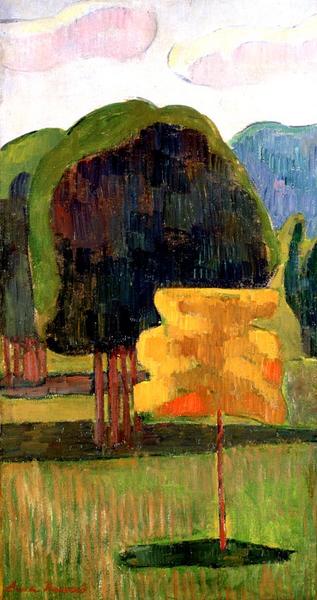
At only about sixty-six centimetres high, Émile Bernard’s The Yellow Tree asks for an abrupt adjustment after the large narrative canvases. Painted around 1888, it belongs to the moment when Bernard and Gauguin were testing simplified forms and broad areas of colour in Brittany. Their exchange at Pont-Aven that summer helped develop the approach called Synthetism. The tree need not supply a story with a victim and a rescuer. Colour itself can decide what deserves attention.
Think of the yellow as a decision that holds the painting together. The title identifies a tree, yet the subject is also the permission to alter how nature appears on a canvas. Rennes purchased the picture in 1964. That late acquisition matters: a museum formed from revolutionary confiscations kept choosing its own direction, adding a small landscape that argues with the pictorial ambitions of its older collection. Size and force are quite separate questions here.
The Parlement: paintings rescued through windows
During the night of 4–5 February 1994, fire destroyed the Parlement’s roof. Conservators and firefighters worked together to protect the interiors; large works were passed through windows and treated in the street before removal. On a guided visit, look at the decorated ceilings with that awkward physical operation in mind. Painted magnificence has weight, dimensions and vulnerable surfaces. Someone had to decide how to move it while the building was still an emergency.
The palace remains a working court of appeal, so arrange access through the tourist office. The Grand’Chambre brings together an interior designed by Charles Errard and ceiling paintings by Noël Coypel. It also returns the walk to Robien’s professional world. A magistrate’s curiosity helped create the museum, while the institution that employed men like him commissioned art to give authority a visible setting.
At Les Champs Libres, the Musée de Bretagne offers a harsher history of images and justice. Its Dreyfus collection began with documents gathered during the 1899 retrial in Rennes; a later gift from his daughter added almost 4,500 items. The renewed presentation opened in 2026. Newspapers, photographs and caricature make looking a question of evidence and persuasion. Reserve the Parlement first, then fit the museums around that appointment. Leave an unclaimed hour for lunch or the river: these collections benefit from a pause between them.
På forsiden: Tigerjagten — Peter Paul Rubens. © musée des beaux-arts de Rennes; Ministère de la Culture (France), base Joconde
Mere at læse
Art city by city →City guide
Art in Lyon: Renoir, Suzanne Valadon and the Musée des Beaux-Arts in Two Days
A convent lived partly on shop rents, a museum helped the silk trade, and an actress left the city her paintings. Lyon’s art is tangled up with the ways people earn, believe and choose to live.
City guide
Art in Troyes: Seurat, Courbet and Stained Glass in One Day
A textile fortune brought modern painting to an old bishop’s palace. Follow it from Seurat’s factory smoke to a sea assembled in the darkroom, then let the cathedral change the light.
City guide
Art in Kazan: Nikolai Fechin, the Fine Arts Museum and a Kremlin Walk
A girl seated on a table, a soaking village crowd and a slaughterhouse reveal three very different sides of Fechin. His home city gives these paintings a history beyond the frame.