City guide
Art in Agen: Goya, Corot and the Museum’s New Home in the Jacobins Church
Goya’s face survived a knife and a journey to Switzerland. Its home collection now leads visitors through another change of address, from old town houses to a medieval church.
2. november 2026 · 7 min. læsning · ART WIKI’s redaktion
A knife once separated Goya’s face from the edges of its canvas. Stolen in 1949, the Self-portrait belonging to Agen was recovered in Switzerland; in 1953 a restorer rejoined the damaged centre to the margins left behind. That physical history gives the steady gaze an unexpected vulnerability. Agen’s connection with Spain survives on a canvas repaired far from the Madrid where it began.
In autumn 2026 the collection has another change of address to negotiate. The main Musée des Beaux-Arts is closed for renovation. A selection from its collections opened at the Jacobins church on 29 October, under the name Musée en mouvement. Start there, then walk through the old centre towards the museum buildings and the Garonne. Goya and Corot provide two good reasons to explore the collection; the church and former town houses explain how Agen made room for art.
Goya’s hand, corrected after the mirror
The eyes in Self-portrait are alert, the body much less clearly defined. A diagonal beside the face gives the composition its cramped working space. Compare the attention lavished on the features with the dark bulk underneath. This imbalance has a history: laboratory research identifies an initial self-study followed by extensive alterations, possibly by another hand. The museum connects the original, probably made around 1783, with Goya’s preparation for inserting himself among listeners in a Madrid altarpiece.
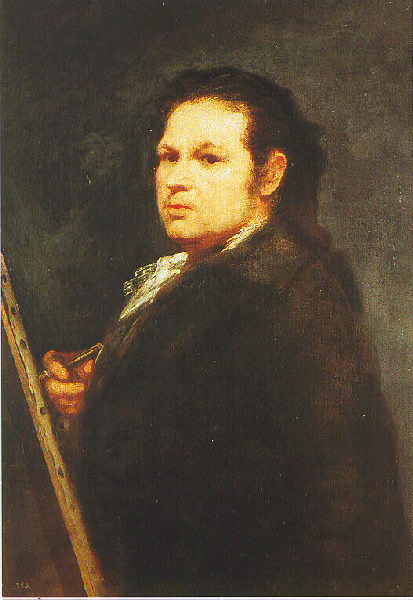
X-rays reveal brushes beneath the drawing implement now held in the hand. Their reversed arrangement supports the use of a mirror, according to Bruno Mottin’s technical study. The later changes remain harder to assign. A visitor can therefore admire the scrutiny of the face without treating every visible stroke as an equally secure statement by Goya. Attribution sometimes asks for this degree of patience: the object contains more than one moment, and the surface is not a transparent record of its beginning.
The journey to Agen passed through a diplomat’s drawing rooms. Count Damaze de Chaudordy collected during his ambassadorship in Madrid in 1874–78, buying from Federico de Madrazo, himself a painter and former Prado director with connections to Goya’s heirs. Chaudordy’s bequest followed in 1899. These names turn an apparently surprising provincial destination into a sequence of human contacts. An ambassador had access, a family had pictures, and a collector chose his native town as their future home.
Four houses, and a staircase someone invented
Before there was a museum, the buildings near Place Esquirol had accommodated civic offices and prisoners. In 1875 the mayor, Joseph Meynot, decided to rescue the disused premises for the collections; work began the following year. This was a practical solution to two problems. Objects were deteriorating in cramped accommodation, while substantial old buildings faced demolition. The council saved the old premises while finding room for the collections.
A look at the exterior needs a little scepticism about appearances. Architect Léopold Payen reshaped the southern facades during an early twentieth-century restoration, altering roofs and adding a stair turret leading to a crenellated platform of his own invention. A pleasingly old-looking silhouette may thus contain a modern decision about what the past ought to look like. The four houses accumulated gradually; the municipality acquired the Hôtel de Monluc only in 1971. Their unity is a museum achievement, not an original building plan.
That knowledge makes the present construction site less of an interruption to the story. Adaptation has been part of this address for centuries. Follow the outlines visible from public streets, noticing where one house meets another, but save the interiors for a future visit. There is plenty to occupy a day elsewhere in Agen; waiting outside a locked door would be a poor tribute to the people who worked to make this collection public.
Corot returns to the same water
Corot’s The Pond at Ville-d’Avray, painted around 1865, takes the journey north to the outskirts of Paris. His parents bought a house there in 1817, and the surrounding woods and ponds remained a recurrent subject. This was a landscape available for return, with all the small adjustments of season and attention that repetition permits. The picture’s broad format, about twice as wide as it is high, gives water and trees space to settle around the small human presence.
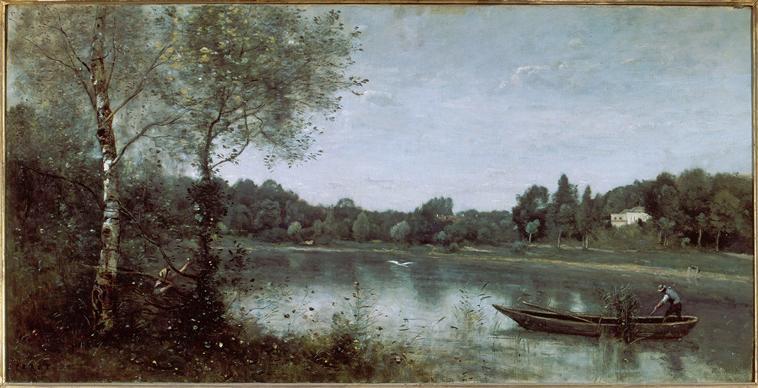
The pond entered the national collections through Alfred Chauchard’s bequest in 1909 and was deposited in Agen in 1977. Its route differs from the diplomat’s Spanish purchases: one picture came through a private preference for a home town, the other through the movement of national collections. Both routes matter to a traveller. They explain why the history of painting can be followed far from the capitals in which its best-known collections were assembled.
Give the fisherman less attention than a portrait ordinarily demands. Find him, then let the surrounding space recover its weight. A figure can establish the scale of a landscape without becoming its main event. After Goya’s concentrated examination of a face, this is a useful change of pace: the eye has no single expression to decipher. Recalling a familiar patch of water from your own life may help more than trying to identify every tree.
A church built to be heard in
Three central pillars divide the Jacobins church into two parallel naves. The Dominican foundation dates to 1249; brick walls and stone supports give it a different character from a densely carved cathedral. History repeatedly filled this space with speech. In 1279 representatives of the French king formally handed the Agenais to those of Edward I of England. In March 1789 the three estates gathered to prepare their grievances. The current museum occupies a building accustomed to public argument.
Look up before letting the exhibition set your pace. The new installation groups objects around themes including portraits, landscapes, animals and daily life; its designers had to accommodate the church’s strong architecture. For a family visit, the labels at children’s height are a welcome practical thought. The building has hosted the museum’s temporary exhibitions since 1990, so this latest move also draws on an established relationship between the two addresses.
End outdoors if daylight allows. At the pont-canal, twenty-three arches carry one waterway across another: navigation opened in 1849. Walking beside a channel suspended above the Garonne changes the familiar business of crossing a river. For the gallery itself, avoid Tuesday under the regular timetable, and remember that winter weekends begin at 2pm. Ask about any particular painting before travelling for it, then leave enough of the afternoon to reach the water without watching the clock.
På forsiden: Autoportrait — Francisco de Goya. Agen, musée des beaux-arts; Ministère de la Culture (France), base Joconde
Mere at læse
Art city by city →City guide
Art in Agde: Ancient Bronzes, the Éphèbe Museum and Château Laurens in One Day
A diver found a bronze body beside the town’s quays; its missing leg emerged months later downstream. Follow that discovery from the Hérault to a museum built to bring it home.
City guide
Art in Nîmes: Delaroche, Boucher and Contemporary Museums Beside Roman Monuments
An empty fixing hole can restore a Roman name; a painter can make a doubtful story look real. Nîmes offers a day of looking closely, from Cromwell’s lifted coffin lid to Foster’s glass museum.
City guide
Art in Sens: A Cathedral, a David Mystery and Marquet’s Quiet Harbour
A saint sails home towards his murder; a fallen emperor passes a butcher’s shop. Around the cathedral of Sens, small details make distant history feel disturbingly close.