City guide
Art in Nîmes: Delaroche, Boucher and Contemporary Museums Beside Roman Monuments
An empty fixing hole can restore a Roman name; a painter can make a doubtful story look real. Nîmes offers a day of looking closely, from Cromwell’s lifted coffin lid to Foster’s glass museum.
2. november 2026 · 7 min. læsning · ART WIKI’s redaktion
The letters had disappeared, but their holes remained. In 1758 Jean-François Séguier used the fixings on the Maison Carrée to recover its dedication to Gaius and Lucius Caesar, Augustus’s grandsons and adopted sons. Stand back from the temple, then look up beneath its pediment. Those absences once allowed a scholar to put names back onto a building. Nîmes rewards this movement between a grand first impression and a small piece of evidence.
A day of art can begin at the Musée des Beaux-Arts, south of the arena, before continuing past the Musée de la Romanité and across the centre to the temple and Carré d’Art. For two days, give the archaeological museum a separate visit. The paintings make a useful interruption to a holiday dominated by Roman stone. They ask how a picture can make an invented encounter feel as convincing as something recorded in an inscription.
Cromwell lifts the lid
A booted man holds a coffin open in Delaroche’s Cromwell Discovering the Coffin of Charles I. The dead king lies in bright light; his opponent keeps his hat on. Painted in 1831, the scene draws on literary accounts, including Chateaubriand and Guizot, rather than a securely documented meeting between Cromwell and the corpse. Its apparent directness is the achievement of a nineteenth-century painter imagining seventeenth-century England.
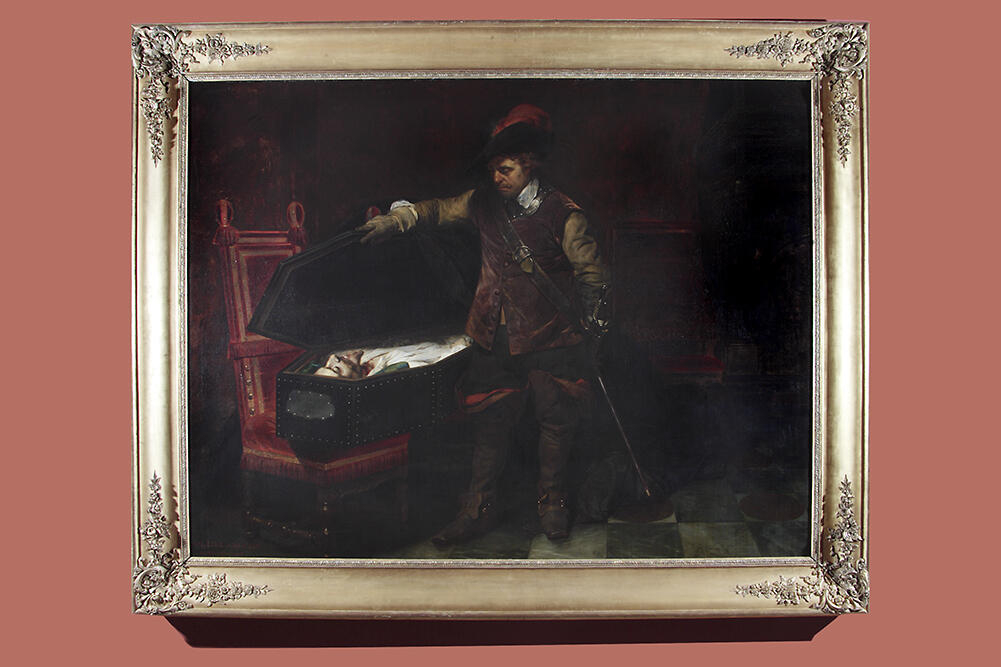
Delaroche worked to make that invention physically persuasive. Paris Opera scene-makers prepared a model with plaster figures, and he researched Cromwell’s clothing. Such preparation helps explain the painting’s peculiar intimacy. You can imagine the weight of the lid and the space required to hold it, although that bodily conviction cannot verify the event. Move your attention from the king to the hand controlling what is visible. The viewer’s access depends on a gesture performed by the dead man’s enemy.
Delacroix and Paul Huet objected to Cromwell’s rough, insufficiently respectful attitude, according to an account preserved by Alfred Robaut. That dispute gives you something precise to test. Does the retained hat read as discourtesy? Does the bent head suggest curiosity, calculation or something harder to name? Delaroche leaves that question open. Its effect changes if you regard Cromwell as a victor inspecting the outcome of his actions or as a living person surprised by the finality of death.
The French state commissioned the picture in 1830 for 5,000 francs, with the Salon and Nîmes in view; it was deposited here in 1834. This destination was part of the plan, not an accidental later landing. A provincial museum would receive a painting around which the Paris public had already argued. The history of the collection includes this movement of contemporary controversy, carried south in a large canvas rather than confined to the exhibition that first made it public.
Boucher rewards a dog and entertains a collector
The raised paw in Boucher’s Obedience Rewarded belongs to a very different performance. A young man offers a treat while a woman leans against a fountain. Painted in 1768, the small canvas was probably intended for a collector’s cabinet; a reproductive engraving links it with the royal official Papillon de la Ferté. Nîmes acquired it in 1827, when the municipal collection was still young. A private amusement had become something strangers could share.
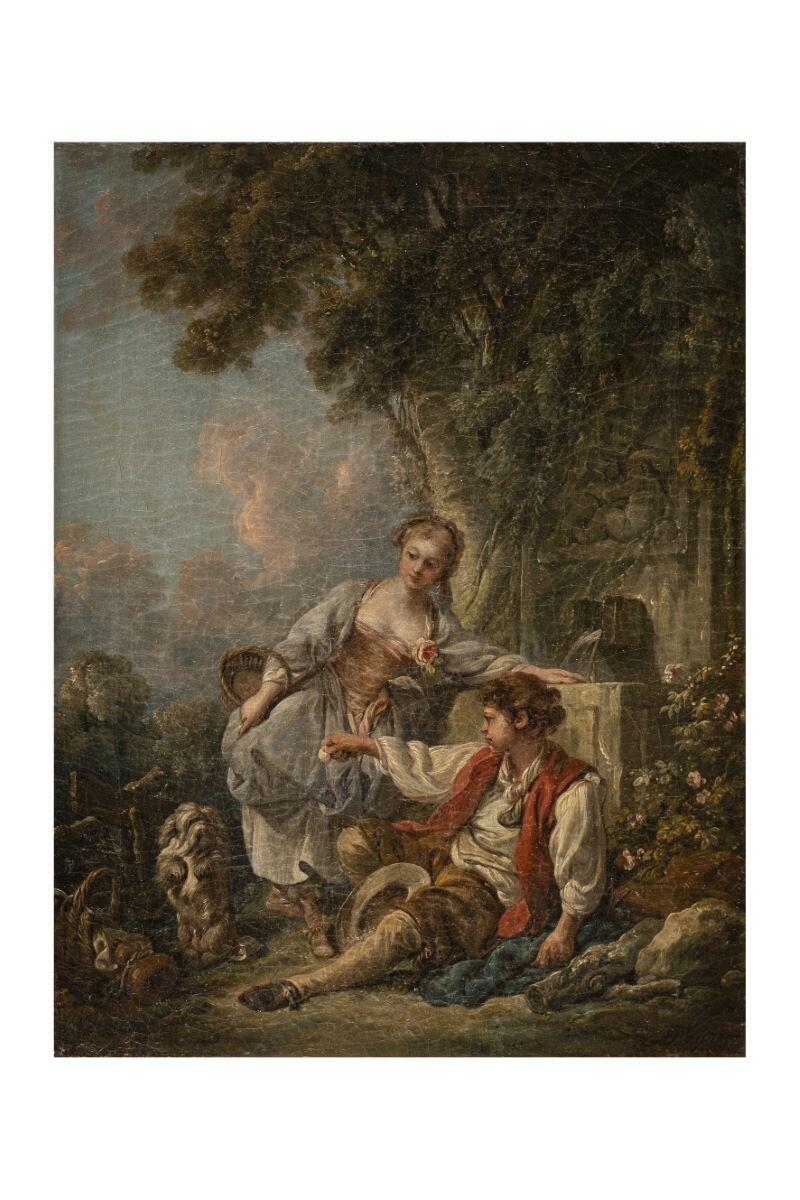
Notice the rose at the woman’s neckline, then the pink carried into her cheeks and the clouds. The scene appears relaxed, but the figures fit a controlled triangular arrangement. Boucher gives the eye several reasons to linger without requiring a dramatic plot. The dog will either receive its reward or wait a little longer. Everything beyond that modest suspense lies in the looking between people, the changes of colour and the painter’s ability to make a carefully arranged encounter seem casual.
Put the two pictures together in memory before leaving. Each offers a spectator access to a partly private moment. One makes us inspect the body of a deposed king; the other lets us watch a tiny act of training. Their unequal scale matters. Delaroche’s encounter occupies a large field in front of the visitor, while Boucher’s can be taken in at closer range. Changing your distance is part of changing the kind of attention you give.
A museum outgrows a Roman temple
These paintings belong to a collection whose first home was the Maison Carrée. Antiquities shared the temple with later painting and sculpture until space became inadequate. The present museum followed an architectural competition won by the Nîmes-born Maximilien Raphel and was built in 1903–07. Its ceremonial exterior conceals a practical concern with modern construction and light. Glass roofs and metal framing help explain how a building can look backward while solving the needs of its own time.
On the way north, pause beside the arena at Elizabeth de Portzamparc’s Musée de la Romanité, opened in 2018. The glass skin folds around a square volume opposite the stone amphitheatre. An interior public passage leads towards the archaeological garden. Even if you reserve the collections for tomorrow, the approach repays attention. Cross the space between the buildings and watch the apparently soft surface of the museum alter against the repeated arches opposite.
Foster answers the temple across the square
Carré d’Art began with a competition in 1984, won by Norman Foster, and opened on 8 May 1993. The brief joined a contemporary art museum to a public library. Facing the Maison Carrée, Foster used slender metal supports and a canopy to answer the ancient portico, while placing much of the accommodation below ground. The confrontation is easiest to understand from the shared square. Move sideways and the two sets of columns alternately separate and overlap.
Inside Carré d’Art, a glazed atrium brings daylight through the building. This is a second architectural visit as well as an art stop, so do not hurry directly to the exhibition entrance. Look through the structure towards the town. The library gives the building a daily purpose beyond museum tourism, and the temple remains part of the experience through changing views. Leave time for the current exhibition after that first slow circuit, rather than treating the glass facade as the whole achievement.
For this route, Tuesday to Sunday is the safer choice: the fine arts museum and Carré d’Art both have regular Monday closures. Ask ahead if your visit depends on a particular painting. With tired feet, stop at the Maison Carrée and postpone the archaeological collections; trying to fit every interior into one afternoon leaves little time for looking. The square is a good place for a long break, with enough architecture in front of you to make putting the guide away worthwhile.
På forsiden: Cromwell devant le cercueil de Charles 1er ; Cromwell découvrant le cercueil de Charles 1er ; Cromwell ouvrant le cercueil de Charles 1er — Paul Delaroche. © Rémi Bénali, Florent Gardin; Ministère de la Culture (France), base Joconde
Mere at læse
Art city by city →City guide
Art in Sens: A Cathedral, a David Mystery and Marquet’s Quiet Harbour
A saint sails home towards his murder; a fallen emperor passes a butcher’s shop. Around the cathedral of Sens, small details make distant history feel disturbingly close.
City guide
Art in Orléans: Le Nain, Bourdon and Joan of Arc in a Day
A lost princess helped rebuild a bombed city, and a forbidden painting found a second audience in a newspaper office. Orléans rewards a day spent following the unlikely lives of its pictures.
City guide
Art in Paris: The Louvre, Musée d’Orsay and Two Days with Leonardo, Delacroix and Manet
A stolen portrait, an emperor’s edited family gathering and a nude Paris refused to forgive. Follow the arguments that carried these pictures into the city’s museums.