City guide
Art in Sens: A Cathedral, a David Mystery and Marquet’s Quiet Harbour
A saint sails home towards his murder; a fallen emperor passes a butcher’s shop. Around the cathedral of Sens, small details make distant history feel disturbingly close.
2. november 2026 · 7 min. læsning · ART WIKI’s redaktion
In 1835, the demolition of ancient walls left Sens with a problem familiar to any town improving its streets. What should happen to the old stones? Some were Roman carved blocks, and they were gathered in the town hall garden. That improvised outdoor collection belongs to the ancestry of today’s Musée de Sens. The city’s museum began, in part, with people refusing to let building material disappear. Its paintings arrived by other routes, including family inheritance, state purchase and a modern collector’s gift.
An art day in Sens can stay close to the cathedral while travelling surprisingly far, from an English archbishop’s exile to a Roman emperor’s public humiliation and a Breton fishing port. Begin with the church in the morning, then give the museum your afternoon. There is one immediate restriction for autumn 2026: the cathedral treasury is temporarily closed. The stained glass, rather than a promised encounter with the treasury’s contents, should anchor the first part of the visit.
A boat in the window, and an exile from England
Thomas Becket came to Sens in 1164 to meet Pope Alexander III; he passed through again in 1170 before returning to Canterbury. His story was personal history here before it became a saint’s legend in coloured glass. Find the cathedral window devoted to him and begin at the bottom. A small boat carries the story across the Channel. Higher up, the welcome at Canterbury gives way to the murder that made his return so terribly brief.
The early thirteenth-century window, probably installed after a fire in 1207, asks for the patient reading of a page. Follow its scenes upwards and from left to right. A kneeling figure or an outstretched arm matters more at first than the whole dazzling surface. The figures occupy little architectural compartments, yet the narrative keeps escaping them. A traveller comes home; men arrive with weapons; the sequence ends in death and sanctification. Sens remembered someone who had once needed shelter.
Look away from the glass long enough to examine the building that received it. Construction began in the 1130s, making Saint-Étienne one of the earliest great Gothic churches. The nave’s six-part vaults belong to that experiment. The broad transept windows came much later, with Martin Chambiges’s work around 1500. Those different scales of light record different ambitions. You need not solve every date to enjoy the change from the tightly told medieval story to the expanses of glass across the transept.
David before the public speeches
There is another sort of vulnerability in Jupiter and Antiope, attributed to the young Jacques-Louis David and usually dated 1771. Jupiter, disguised as a satyr, lifts the covering from a sleeping woman. The French heritage inventory records something less mythological on the reverse: a sketch of a woman selling fish. The two sides bring an elevated subject and an ordinary occupation uncomfortably close together. Even an oil painting can preserve the practical, unfinished business of a working canvas.

The route to Sens ran through a family. Madame Baudry, related to the architect Buron who helped bring David up, received the picture; it eventually reached the museum through Adolphe Guillon’s bequest in 1896. Such a passage helps explain the survival of an unusual early image. A family can keep what a later account of a painter’s career finds awkward. Here the softness of the sleeping body and the intruder’s gesture demand attention before any grand story about David can take over.
The setting has its own domestic past. The former archbishops’ palace contained private apartments as well as offices; much later, it housed a girls’ school and boarding establishment. Museum rooms began opening there in 1985. Think of that succession while crossing the courtyard. The same doorway can belong, at different moments, to clerical ceremony, a school day and someone arriving to spend half an hour with a painting. This is a particularly good museum in which to notice the building between pictures.
A fallen emperor passes the butcher’s shop
Oyster shells and discarded soles caught the critic Henry Houssaye’s eye at the Salon of 1882. He was reviewing The Emperor Vitellius Dragged through the Streets of Rome by the People, Georges Rochegrosse’s vision of imperial collapse. Houssaye also noticed the butcher’s stall, with animal organs hanging from hooks. These scraps matter. They bring ancient Rome down to the level of a street through which a terrified man can be pushed.
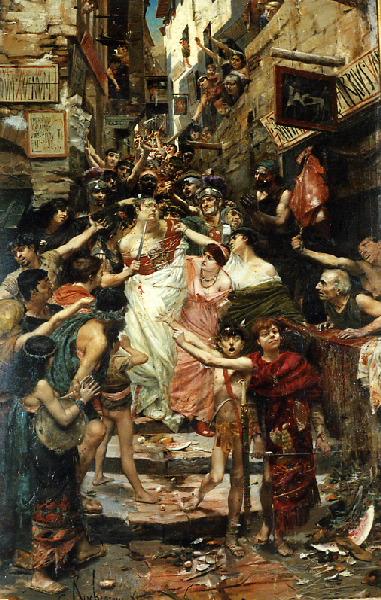
Rochegrosse won a medal for the canvas in 1882, and the state bought it at that year’s Salon. He had grown up in the household of the poet Théodore de Banville, his stepfather, among people for whom the ancient world remained material for new stories. Here learning becomes spectacle. The painting is nearly two and a half metres high but much narrower, so the crowd seems to press down its length. There is little room for the disgraced emperor, or for a spectator seeking a comfortable distance from the violence.
Houssaye compared the handling of the scene to an episode from the Revolution or the Commune. That is a revealing nineteenth-century response, rather than evidence about Roman events. The canvas allows its viewers to recognise a political mob before they have identified every costume. After Becket’s carefully separated scenes, this crush of bodies feels almost breathless. Sens offers both kinds of historical storytelling within a short walk, and the contrast is worth carrying back to the cathedral.
Marquet leaves some water between us and the quay
Two men lean at a railing in Albert Marquet’s Audierne, also known as Port d’Audierne: Morning. Their long shadows establish the hour without a clock. Painted in 1928, the view looks down over the harbour, probably from a window. Roofs and quays cut diagonally across the canvas while masts stand upright. Small notes of red interrupt the restrained colour. After Rochegrosse’s crowd, those two unhurried figures offer a welcome change of company.
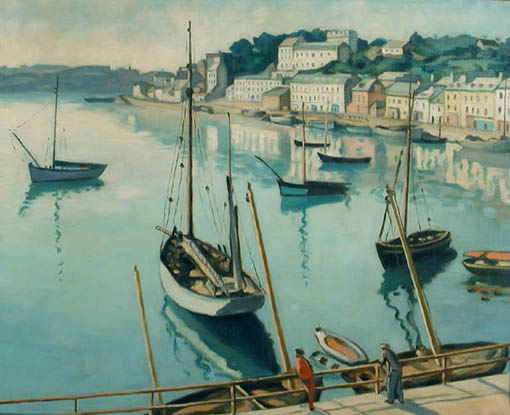
The painting came with Lucien and Fernande Marrey’s donation in 2008. Their collection added the choices of twentieth-century private collectors to a museum already shaped by archaeology and older bequests. Marquet makes a useful pause in that long history. Follow one mast into its broken reflection, then let the eye travel back to the firm edge of the quay. Water and masonry behave differently under the brush, although both must fit into the same small rectangle.
Finish outside at the orangery garden. Built in the 1740s for Archbishop Languet de Gergy, the orangery sheltered citrus trees through winter; it later became the girls’ school gymnasium. Gardening tools carved on its pediment still advertise the earlier purpose. For an autumn visit, plan around the museum’s 13:30–17:30 opening, every day except Tuesday, and remember that it closes in January. Admission is free. If one painting determines your journey, ask the museum about it before buying your ticket to Sens, then leave enough daylight for the garden.
På forsiden: Nymphe endormie et satyre ; Jupiter et Antiope — Jacques-Louis David. Cl. J.-P. Elie, Musées de Sens; Ministère de la Culture (France), base Joconde
Mere at læse
Art city by city →City guide
Art in Orléans: Le Nain, Bourdon and Joan of Arc in a Day
A lost princess helped rebuild a bombed city, and a forbidden painting found a second audience in a newspaper office. Orléans rewards a day spent following the unlikely lives of its pictures.
City guide
Art in Paris: The Louvre, Musée d’Orsay and Two Days with Leonardo, Delacroix and Manet
A stolen portrait, an emperor’s edited family gathering and a nude Paris refused to forgive. Follow the arguments that carried these pictures into the city’s museums.
City guide
Art in London: Van Eyck, Holbein, Turner and Manet in Three Galleries
A homesick ambassador, a warship on its last journey and a barmaid whose mirror refuses to behave. Give London’s pictures time to unsettle your first impressions.