City guide
Art in Agde: Ancient Bronzes, the Éphèbe Museum and Château Laurens in One Day
A diver found a bronze body beside the town’s quays; its missing leg emerged months later downstream. Follow that discovery from the Hérault to a museum built to bring it home.
2. november 2026 · 7 min. læsning · ART WIKI’s redaktion
Jacky Fanjaud found the bronze a few metres from Agde’s quays on 13 September 1964. The Youth of Agde was badly damaged; six months later, its missing left leg turned up three hundred metres downstream. A body had become a search area. Begin your day beside the Hérault, opposite the dark cathedral, where an ordinary stretch of urban river suddenly acquired a face from antiquity.
Then make the separate journey to the Musée de l’Éphèbe at Cap d’Agde, on Avenue des Hallebardes. The discovery site and the museum are different stops. Give the bronzes a morning, return to the old town for the cathedral, and reserve a Château Laurens visit if you want to follow the story of private luxury into the twentieth century. Here art has arrived through water, travel and the expensive wishes of householders.
The face that required a museum
The Youth of Agde became a local cause while spending years away. After restoration it was presented at the Louvre, but the town wanted it back. The state required an appropriate museum and a curator. A new institution grew around an eighteenth-century farmhouse on La Clape hill, opened in 1985, and received the bronze in 1987. Agde had to construct the conditions for possession before it could enjoy the return.

Look first at the lifted hair above the forehead, then follow the angle of the face. These features helped suggest Alexander; the royal band and the short military cloak supported the comparison. The connection is with the portrait language associated with Lysippos, not a securely signed work. Retaining the question makes the face more interesting. A name can organise what we notice, but the lifted locks remain there when certainty about the sitter and maker recedes.
Survival was also an engineering problem. Some sections of the bronze had thinned to only one or two millimetres. The restorer Aimé Thouvenin reinforced the interior with resin and fibreglass before reattaching the recovered leg. Remember that hidden support when looking at the figure’s balance. Its apparent ease depends partly on modern labour inside a shell that water had made fragile. The river preserved enough to recognise a person, while damaging the material that allows him to stand.
Eros has lost his wings but kept his silver eyes
A second discovery began with barely visible shapes in sand. In December 2001 Nicolas Figuerolles found two bronzes off the coast near Marseillan, about six metres down. One was Eros. Subsequent underwater examination found no surviving wreck, and the circumstances of the loss remain uncertain. A cargo for a Roman household is a plausible interpretation; the precise shipwreck narrative is missing. The sea has supplied objects without handing over a passenger list.
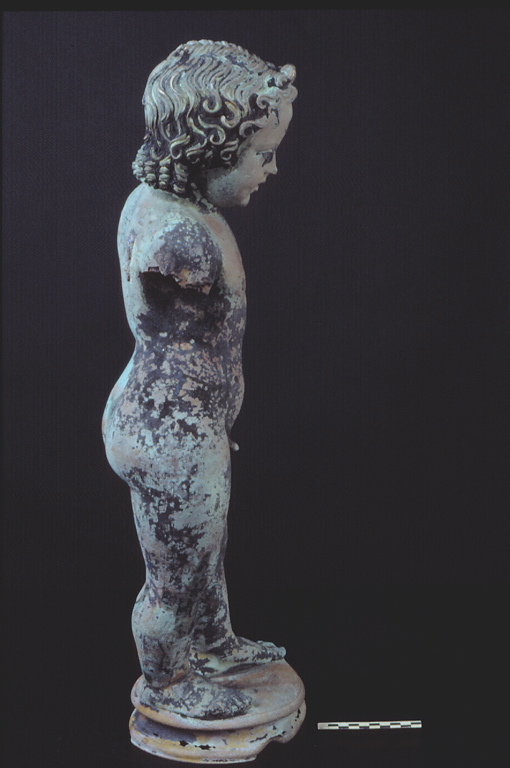
The little god’s broken wing attachments distinguish him from an ordinary child. His arms had been made separately and detached at their joins. Deposits protected the silver covering his eyes, revealed by cleaning; a knot of hair sits above his forehead. Read the face slowly before looking down at the body. Colour was part of this bronze’s original appearance, and the surviving silver interrupts the expectation that ancient metal sculpture should look uniformly dark or green.
Small rectangular patches on the body repaired casting faults in antiquity. They are evidence of manufacture, not simply scars left by the sea. That distinction changes the pleasure of close looking. A smooth child’s body was assembled through a sequence of difficult operations, with corrections along the way. Search for the patches after taking in the whole figure, as you might notice a seam only after appreciating the cut of a coat. The craftsman’s adjustments have outlasted the owner’s name.
A trading town before it became a resort
Agde’s Greek past emerged from much less glamorous finds as well. Excavations at the Peyrou cemetery revealed imported eastern Greek pottery in local graves from the late seventh century BC. Contact preceded the fully developed colony. Large vessels could unload cargo near the river town, with smaller craft taking goods inland. A bronze body belongs within this broader traffic, alongside the pots and raw materials that made journeys economically possible.
Through 29 November 2026, the museum’s Agde Grecque exhibition follows those contacts across the region, from the Rhône to the Pyrenees. Finds from Rue Perben place Phocaean Greeks at Agde by about the middle of the sixth century BC; the exhibition distinguishes that commercial settlement from the later colony. The chronology resists the single founding date a visitor might expect. A town can take shape through repeated arrivals before it acquires a stable political identity.
Back in the old centre, Saint-Étienne looks built to resist visitors. Local basalt gives its walls their dark colour, while battlements and projecting defensive features turn a church into a fortification. The rebuilding associated with royal permission in 1173 belongs to that defensive history. Walk around the exterior before entering. From the riverbank, the distinction between a religious monument and a strong point in the town’s defences becomes difficult to maintain.
A medical student inherits another life
In 1897 Emmanuel Laurens inherited the Belle-Isle property from his father and a fortune from a distant relative. He had studied medicine in Montpellier; travel and the building of an extravagant house now took over. Between 1898 and 1901 he enlarged the existing pavilion with architect Jacques Février. The resulting Château Laurens brought a colonnaded entrance into conversation with Art Nouveau interiors and decoration drawing on imagined eastern worlds. Its owner could assemble his travels into rooms.
Follow the permanent decoration rather than looking for a single signature. Painted surfaces meet woodwork and coloured glass; the house was also equipped with running water and central heating. Modern comfort supported historical fantasy. Laurens eventually had to sell the estate in 1938 while retaining the right to live there. The town bought it in 1994, and a long restoration culminated in its public opening in June 2023. The music room recalls the household he shared with the singer Louise Blot.
The château is reached on foot across a pedestrian bridge, so allow time between parking and your booked visit. At the Éphèbe museum, the regular September-to-June timetable closes on Monday and pauses from 12.30 to 2pm. Contact the museum about the bronzes before planning a journey around them. With only half a day, choose the museum and the riverbank; with a full day, the house adds a different kind of encounter with the desire to bring beautiful things home.
På forsiden: l'Ephèbe d'Agde (titre d'usage) ; l'Alexandre d'Agde — Lysippe. © Pierre Arnaud, 2010; Ministère de la Culture (France), base Joconde
Mere at læse
Art city by city →City guide
Art in Nîmes: Delaroche, Boucher and Contemporary Museums Beside Roman Monuments
An empty fixing hole can restore a Roman name; a painter can make a doubtful story look real. Nîmes offers a day of looking closely, from Cromwell’s lifted coffin lid to Foster’s glass museum.
City guide
Art in Sens: A Cathedral, a David Mystery and Marquet’s Quiet Harbour
A saint sails home towards his murder; a fallen emperor passes a butcher’s shop. Around the cathedral of Sens, small details make distant history feel disturbingly close.
City guide
Art in Orléans: Le Nain, Bourdon and Joan of Arc in a Day
A lost princess helped rebuild a bombed city, and a forbidden painting found a second audience in a newspaper office. Orléans rewards a day spent following the unlikely lives of its pictures.