City guide
Art in Orléans: Le Nain, Bourdon and Joan of Arc in a Day
A lost princess helped rebuild a bombed city, and a forbidden painting found a second audience in a newspaper office. Orléans rewards a day spent following the unlikely lives of its pictures.
2. november 2026 · 7 min. læsning · ART WIKI’s redaktion
A painting was already on the wall when the order came to remove it. On the eve of the Paris Salon in 1885, Louis-Maurice Boutet de Monvel’s The Apotheosis of the Rabble became too politically combustible for the exhibition. Le Figaro promptly showed it in the newspaper’s premises. The attempted silencing supplied another audience. That troublesome canvas now belongs to the Musée des Beaux-Arts in Orléans, the painter’s native city, and gives a visit here an unexpectedly argumentative starting point.
Allow a full day for Orléans, with the fine arts museum as its centre and Sainte-Croix Cathedral and the Hôtel Cabu within the walking route. The three stops offer different ways of rebuilding a past. A painting can be rediscovered under the wrong title, a cathedral can give a medieval heroine a nineteenth-century face, and a bomb-damaged house can become a museum again. There is plenty to see without treating the city as a quick interval between Loire châteaux.
A sleeping princess bought with war compensation
An antiques dealer in Château-Thierry found Bacchus and Ariadne around 1954. For a time it appeared in a Paris gallery as Theseus Abandoning Ariadne, a title that reversed the emotional direction of the scene. Orléans acquired the canvas in 1970 using war-damage funds. A seventeenth-century encounter on a mythical island thus became part of the city’s recovery from a very real destruction. The purchase also enlarged what people thought the Le Nain brothers could paint.
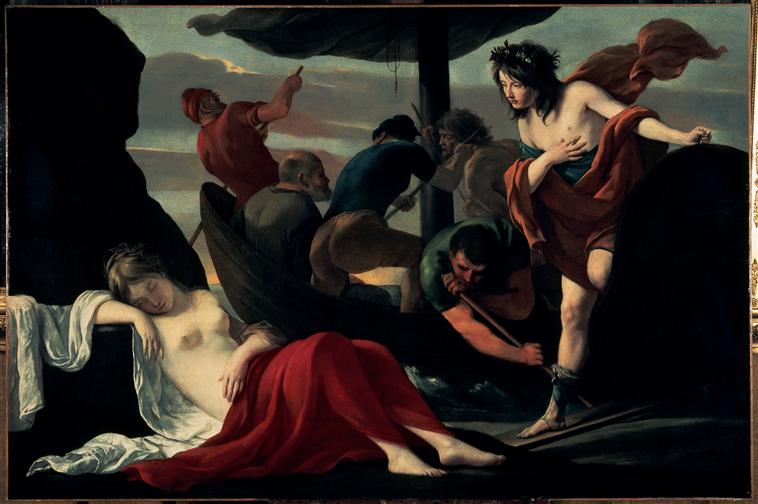
Which brother held the brush remains disputed. Louis and Mathieu have both been proposed, and the museum also discusses the possibility of several hands. The family name is the safest way into the picture. Ariadne lies asleep after Theseus has left her on Naxos. Bacchus has arrived and stopped, his hand against his chest. The scene has none of the noisy procession one might expect around the wine god. His response has to travel through a look and a small, almost courtly gesture.
The mistaken title is worth remembering while you look. Departure and arrival can share the same landscape; a sleeping figure cannot explain which is happening. Once the man becomes Bacchus, abandonment gives way to the beginning of another attachment. Yet the woman remains unaware of either our interpretation or his presence. Try giving the picture a minute before reading its name. It is possible to notice the pause first and only afterwards fit it into the myth.
Iphigenia’s rescue, seen too late by one woman
At the lower right of The Sacrifice of Iphigenia, a woman bends into her grief. She may be Clytemnestra, the victim’s mother; the identification is uncertain. Sébastien Bourdon gives her an especially painful role in a scene that is already changing. Above her, Artemis is carrying Iphigenia away and substituting a deer for the young woman about to be killed. The rescue has begun, but not everyone has understood it. One body can remain inside a tragedy after the plot has moved on.
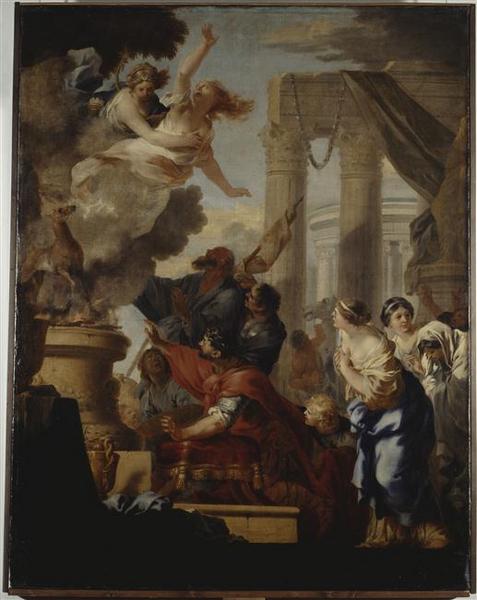
The myth starts with an army unable to sail for Troy. Agamemnon is required to sacrifice his daughter to secure favourable winds; some versions let her die, while others grant the reprieve Bourdon paints. His diagonal composition separates the people below from the figures ascending into the sky. It also separates their knowledge. Follow the movement upwards, then return to the grieving woman. A label can tell the whole story in a sentence, but the painting makes its characters live through different moments at once.
Bourdon knew how many forms a career could take. The son of a Protestant painter and glazier, he worked in Rome, returned to Paris and later became painter to Queen Christina in Sweden. The Orléans museum itself has roots in an institution directed by Jean Bardin in 1799, linked to a free drawing school where copying older masters supported instruction. Remember those students when a complicated historical subject feels remote. A turned head or a bent knee was also a problem someone could learn to draw.
A coronation that the Salon could not tolerate
The throne in The Apotheosis of the Rabble, or The Triumph of Robert Macaire carries a drunken man in rags. At his feet lies a woman personifying France. Robert Macaire, a criminal borrowed from the stage, supervises the mock coronation while his accomplice Bertrand beats a drum. Painted in 1884, the scene looks back to the overthrow of Louis-Philippe in 1848, but its hostility was directed towards the republic of Boutet de Monvel’s own day. This is a partisan attack, and its contempt belongs to its maker.
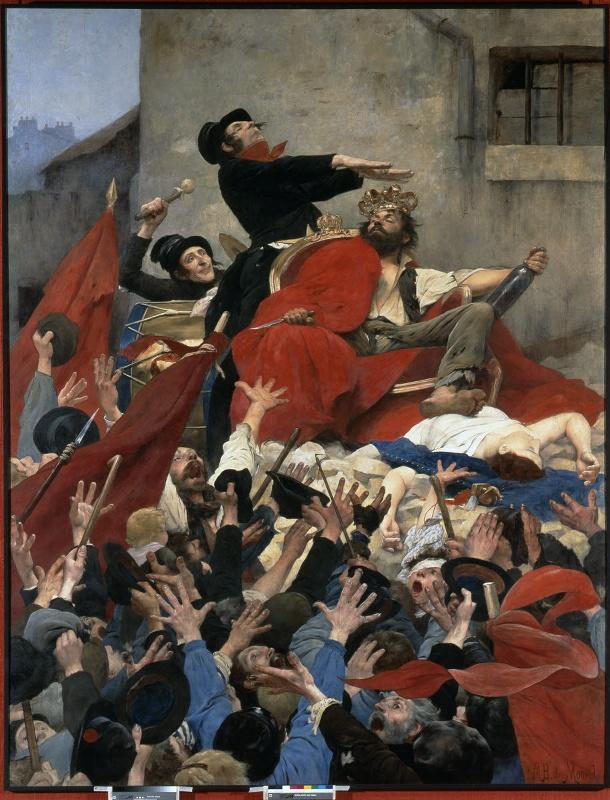
A reproduction can make the picture look like a cartoon; the canvas is 4.3 metres high. That change of scale matters. The spectator must look upwards towards a ceremony designed to be repellent. A royalist argument occupies the kind of space normally given to a public triumph. The government’s intervention then supplied an irony the painter had not arranged: a picture attacking the republic became a dispute about whether that republic could tolerate an enemy’s image. Le Figaro’s alternative exhibition made the disagreement visible.
Boutet de Monvel is also remembered for children’s book illustrations, a surprising second career to hold beside this angry image. Orléans later acquired more than a thousand photographs from the family studio, together with materials including palettes, brushes and a studio staircase used by father and son. Such objects bring the enormous paintings back to the work of making them. Someone needed a high enough step, a clear photograph and paint within reach. Scale begins with equipment before it becomes rhetoric.
Joan in glass, and a house rebuilt after the bombs
Cross to Sainte-Croix and watch how another century tells a national story. The ten Joan of Arc windows by Jacques Galland and Esprit Gibelin were made between 1893 and 1897. Their medieval costumes belong to a carefully researched nineteenth-century reconstruction. During the Second World War the windows were removed, a precaution that saved them from the bombing that damaged the cathedral. Their survival depended on being taken apart and carried away, an easily forgotten fact when coloured glass seems inseparable from a church.
The sequence moves from the voices at Domrémy through the entry into Orléans and the fighting at the Tourelles to captivity and death. Choose two adjacent episodes and follow the changes in Joan’s position among the people around her. She can command attention in one scene and be subjected to other people’s decisions in the next. After the museum’s contested or rescued heroines, that changing balance of power gives the windows more to say than a simple succession of patriotic illustrations.
Continue to the Hôtel Cabu, built around 1550 for a lawyer, Philippe Cabu. The courtyard façade stacks three classical orders above one another. Bombing in June 1940 badly damaged the house, and more than twenty years passed before the museum could reopen. Its architecture gives physical weight to the war-damage funding that helped buy the Le Nain painting. Look upwards through the levels of carved decoration, then leave time to walk down towards the Loire.
Choose a Thursday if you want breathing room: the fine arts museum stays open until 20:00. Both museums close on Mondays and on 11 November; in the autumn the Hôtel Cabu opens at 13:00. A combined ticket covers the municipal museums for one day. Check the museum directly if a particular canvas is your reason for coming. The nineteenth-century mezzanines also have an accessibility restriction, so visitors who need step-free access should arrange their route with staff. Keep the river walk as an interval whenever your eyes need a rest.
På forsiden: Bacchus et Ariane — Le Nain, Famille. RMN-Grand Palais; Ministère de la Culture (France), base Joconde
Mere at læse
Art city by city →City guide
Art in Paris: The Louvre, Musée d’Orsay and Two Days with Leonardo, Delacroix and Manet
A stolen portrait, an emperor’s edited family gathering and a nude Paris refused to forgive. Follow the arguments that carried these pictures into the city’s museums.
City guide
Art in London: Van Eyck, Holbein, Turner and Manet in Three Galleries
A homesick ambassador, a warship on its last journey and a barmaid whose mirror refuses to behave. Give London’s pictures time to unsettle your first impressions.
City guide
Art in Madrid: Velázquez, Goya and Picasso at the Prado, Thyssen and Reina Sofía
A palace mirror, a firing squad and a painting that waited decades to reach Spain. Madrid’s museums turn an art weekend into an encounter with the people history leaves exposed.