 Raphael意大利, 1483–1520
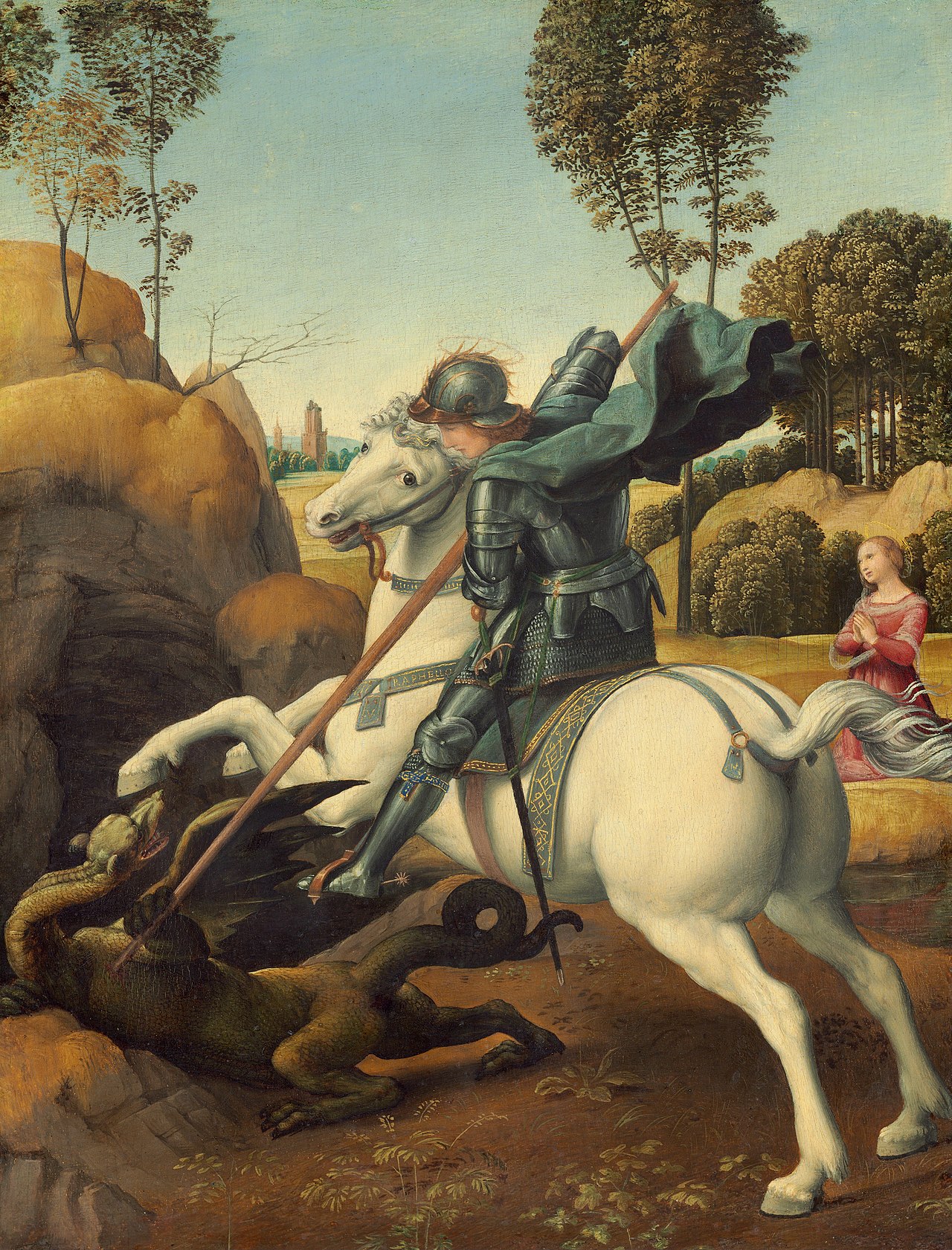
聖喬治大戰惡龍
Saint George and the Dragon
能看到吗?
是,正在展出
《聖喬治大戰惡龍》现在在哪里? 国家美术馆, 展厅 20 · 西馆, 主层, 華盛頓哥倫比亞特區. 是,正在展出. 核实 2026年9月29日.

闭馆· 10:00 开馆
正对公众展出。
- 核实
- 此状态始于
- 出处
- 博物馆
关于这幅画
St. George and the Dragon is a small oil on wood cabinet painting by the Italian High Renaissance artist Raphael, painted c. 1505, and now in the National Gallery of Art in Washington, D.C. The saint wears the blue garter of the English Order of the Garter, reflecting the award of this decoration in 1504 to Raphael's patron Guidobaldo da Montefeltro, Duke of Urbino, by King Henry VII of England. The first word of the order's motto, "HONI" can be made out. The painting was presumably commissioned by the Duke, either to present to the English emissary who brought the regalia to Urbino, Sir Gilbert Talbot, or to Henry himself—recent scholarship suggests the latter. The honour paid to a minor Italian ruler reflected Henry's appreciation of the cultural prestige of Renaissance Italy as much as any diplomatic purpose.
继续阅读
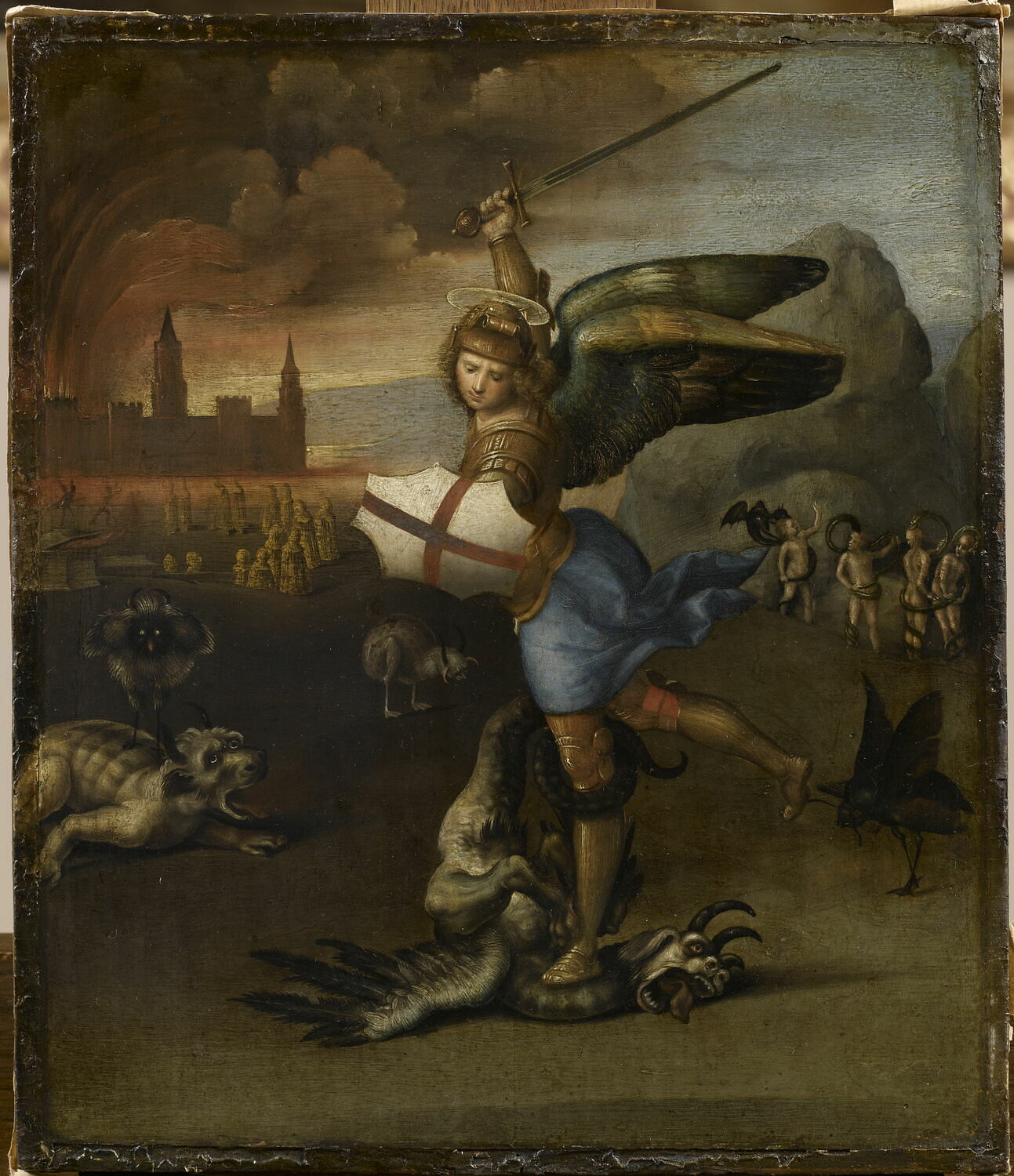
The traditional subject, Saint George and the Dragon, combining chivalry and Christianity, is appropriate for the occasion; like his father, Guidobaldo was a condottiero, or proprietor of a band of mercenary soldiers. In the early stages of his career Raphael painted a number of tiny cabinet paintings, including another St George in the Louvre, and the Vision of a Knight in the National Gallery in London.
作品信息
- 馆藏编号
- 1937.1.26
画面内容
已收入目录
展示史
在展 · 展厅 20 · 西馆, 主层
国家美术馆 · 2026年9月29日 — 现在 · 已核实
当时曾展出 · 展厅 20 · 西馆, 主层
国家美术馆 · 2026年9月29日 — 2026年9月29日 · 已核实
当时曾展出 · 展厅 20 · 西馆, 主层
埃尔米塔日博物馆 · 2026年9月28日 — 2026年9月29日 · 已核实
当时曾展出 · 展厅 20 · 西馆, 主层
国家美术馆 · 2026年8月30日 — 2026年9月28日 · 已核实
出处
- 埃尔米塔日博物馆
- 图片: 国家美术馆 — Museum open access
Raphael当时的生活
完整生平c. 1503 – c. 1504 · 工作地
Siena
late 1504
Meets Leonardo and Michelangelo
Having moved to Florence, Raphael met Leonardo da Vinci, Michelangelo and Bartolomeo della Porta and closely studied Leonardo's sfumato. His first Florentine commission, portraits of Agnolo Doni and his wife, was painted under the clear impression of the “Mona Lisa”.
1504
Friendship with Baldassare Castiglione
In Urbino Raphael met the philosopher, writer and patron Count Baldassare Castiglione; they formed a firm friendship and correspondence, including the famous letters about the fresco “The Triumph of Galatea”.
1504
To Florence, to study
The mother of the next Duke of Urbino gave Raphael a letter of recommendation to the Gonfaloniere of Florence: “The bearer of this will be found to be Raphael, painter of Urbino, who, being greatly gifted in his profession has determined to spend some time in Florence to study.” She called him “a sensible and well-mannered young man”.
1507
Meets Donato Bramante
Raphael met the architect Donato Bramante, by an unproven account his relative. Bramante became his adviser and patron and later recommended him to Pope Julius II as the best candidate for work in the Vatican.
1508
Moves to Rome at the invitation of Julius II
The new pope, Julius II, invited Raphael to Rome, perhaps at the suggestion of his architect Bramante, a distant relative of the artist. Unlike Michelangelo, kept waiting for months after his summons, Raphael was immediately commissioned to fresco what was to become the pope's private library, a far larger commission than any he had had before.




![The Crucifixion with the Virgin, Saint John, Saint Jerome, and Saint Mary Magdalene [right panel], Pietro Perugino, c. 1482/1485](https://api.nga.gov/iiif/49cffd8d-5c06-4628-9369-1b6bdb3e7b90/full/!2400,2400/0/default.jpg)
![The Crucifixion with the Virgin, Saint John, Saint Jerome, and Saint Mary Magdalene [left panel], Pietro Perugino, c. 1482/1485](https://api.nga.gov/iiif/b43e331e-ede9-44ca-a276-0b8806630fbd/full/!2400,2400/0/default.jpg)
![The Crucifixion with the Virgin, Saint John, Saint Jerome, and Saint Mary Magdalene [middle panel], Pietro Perugino, c. 1482/1485](https://api.nga.gov/iiif/63049d6b-06b2-4e4b-9443-532df5b30fa7/full/!2400,2400/0/default.jpg)


