ART WIKI32 963 em exposição
MapaColeçãoArtistasMuseusExposiçõesRevista
Entrar

ART WIKI

Onde está a obra-prima, e a que horas se abre a porta.

Coleções: Art Institute of Chicago, Galeria Nacional de Arte, Galeria Tretiakov, Getty Villa, Harvard Art Museums, Hermitage, Hirshhorn Museum and Sculpture Garden, Instituto de Artes de Minneapolis, Museu de Arte de Cleveland, Museu de Arte Moderna, Museu do Louvre, Museu Estatal de Amesterdão, Museu J. Paul Getty, Museu Metropolitano de Arte, Museu Nacional de Arte da Dinamarca, Museu Pushkin, Museu Russo, Museu Smithsoniano de Arte Americana, Museu Vitória e Alberto, Museu Whitney de Arte Americana, National Museum of Asian Art, National Portrait Gallery, Catálogo Estatal do Fundo Museológico da Rússia (274 museus), Europeana (19 museus), Wikidata (6 museus), Paris Musées (12 museus) e Joconde, a base de museus do Ministério da Cultura de França (495 museus). As imagens pertencem aos titulares dos direitos.

Secções

  • Mapa
  • Pesquisa
  • Coleção
  • Obras-primas
  • Em exposição agora
  • Artistas

Mais

  • Museus e galerias
  • Exposições
  • Revista
  • De onde vêm os dados
  • Privacidade e cookies
InícioMapaCatálogo
  1. Coleção/
  2. Galeria Nacional de Arte/
  3. Venus and Adonis
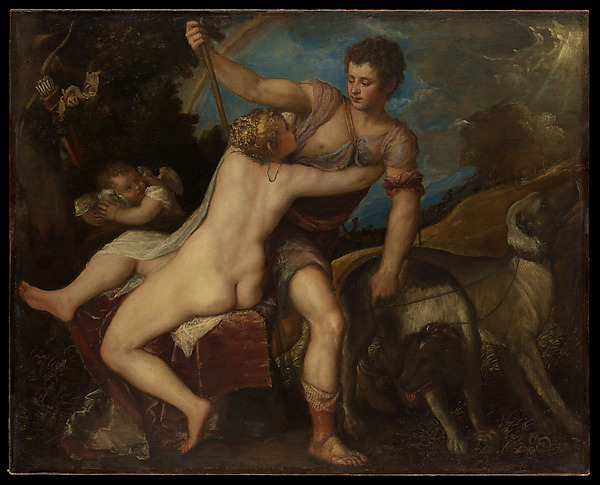
Venus and Adonis, Titian and Workshop, c. 1540s/c. 1560-1565
Titian, retratoTitianItália, 1490–1576

Venus and Adonis

c. 1540s/c. 1560-1565 · Painting

Será possível contemplá-la?

Sim, recebe visitas

Galeria Nacional de Arte

Washington, D.C., Estados Unidos

Sala23 · Edifício Oeste, piso principal

Exposta ao público. Quem o garante vem indicado abaixo.

Verificado
há 3 dias
Neste estado desde
19 de ago. de 2026
Fonte
O museu
No mapaPágina do museu

Sobre a pintura

A composition of Venus and Adonis by the Venetian Renaissance artist Titian has been painted a number of times, by Titian himself, by his studio assistants and by others. In all there are some thirty versions that may date from the 16th century, the nudity of Venus undoubtedly accounting for this popularity. It is unclear which of the surviving versions, if any, is the original or prime version, and a matter of debate how much involvement Titian himself had with surviving versions. There is a precise date for only one version, that in the Prado in Madrid, which is documented in correspondence between Titian and Philip II of Spain in 1554. However, this appears to be a later repetition of a composition first painted a considerable time earlier, possibly as early as the 1520s.

Continuar a ler

The Prado version is set at dawn and shows the young Adonis pulling himself away from Venus, his lover. He carries a feathered spear or "dart", a weapon often used in hunting in the 16th century. The leads of his three hounds are wound around his arm at right. Under the trees behind them at left Cupid lies asleep, with his bow and quiver of arrows hanging from a tree; this is not a time for love. High in the sky, a figure rides a chariot; this is either Venus from later in the story, or Apollo or Sol, representing the dawn. Venus sits on a rock covered with a rich tablecloth with gold braid edges and buttons (not a military jacket, as sometimes thought). Adonis has a horn hanging from his belt; his dress is classical, taken from Roman sculptures.

It is thought that the Roman poet Ovid was the main source, though other literary and visual sources have been suggested. In Book X of Ovid's Metamorphoses Adonis is a beautiful youth, a royal orphan, who spends his time hunting. Venus falls in love with him after one of Cupid's arrows hits her by mistake. They hunt together, but she avoids the fiercer animals, and warns him about them, citing the story of Atalanta. One day Adonis hunts alone and is gored by a wounded wild boar. Venus, in the sky in her chariot, hears his cries but cannot save him. In some versions, the death of Adonis is shown in the distance to the right. In Ovid, it is Venus who leaves first, and Adonis pulling himself away seems to be Titian's invention, for which some criticized him.

Two basic types of the composition were described by Harold Wethey, who called them the "Prado" and "Farnese" types; the Prado type is most common and is described above. Alternative terms are the "three-dog" and "two-dog" types. They are in most respects the same, but the Farnese type has a tighter crop on the subject and a wider shape, losing most of the sky. Adonis' raised hand is just below the picture edge, so the feathers on the spear are not seen, nor is the chariot in the sky, though the sun bursts through clouds in about the same place. There are only two hounds and no gold vessel on the ground at left. Cupid is brought closer to the main couple, and is now awake, holding a dove in his hands.

Wikipédia · CC BY-SA

Pormenores

c. 1540s/c. 1560-1565
14901576
Número de inventário
1942.9.84

O que mostra

ClassicalVenusAdonis

No catálogo

PinturasÓleoPintura italianaPintura venezianaRenascimentoSéculo XVIVenetianPintura mitológica

Fontes

  • Galeria Nacional de Arte
  • Imagem: Galeria Nacional de Arte — Museum open access
Mais obras de Titian

Todas as obras
Venus and Adonis, Titian, 1550s

Venus and Adonis

1550s · Museu Metropolitano de Arte

Filippo Archinto (born about 1500, died 1558), Archbishop of Milan, Titian, mid-1550s

Filippo Archinto (born about 1500, died 1558), Archbishop of Milan

mid-1550s · Museu Metropolitano de Arte

La Mise au tombeau ou Le Transport du Christ vers le tombeau, Titien, 1e quart du XVIe siècle (1500 - 1525)

La Mise au tombeau ou Le Transport du Christ vers le tombeau

1e quart du XVIe siècle (1500 - 1525) · Museu do Louvre

Portrait d'homme, dit L'Homme au gant, Titien, 1e quart du XVIe siècle (1500 - 1525)

Portrait d'homme, dit L'Homme au gant

1e quart du XVIe siècle (1500 - 1525) · Museu do Louvre

Allégorie conjugale (Allégorie de la séparation?), dit à tort Allégorie d'Alphonse d'Avalos, Titien, XVIe siècle (1500 - 1600)

Allégorie conjugale (Allégorie de la séparation?), dit à tort Allégorie d'Alphonse d'Avalos

XVIe siècle (1500 - 1600) · Museu do Louvre

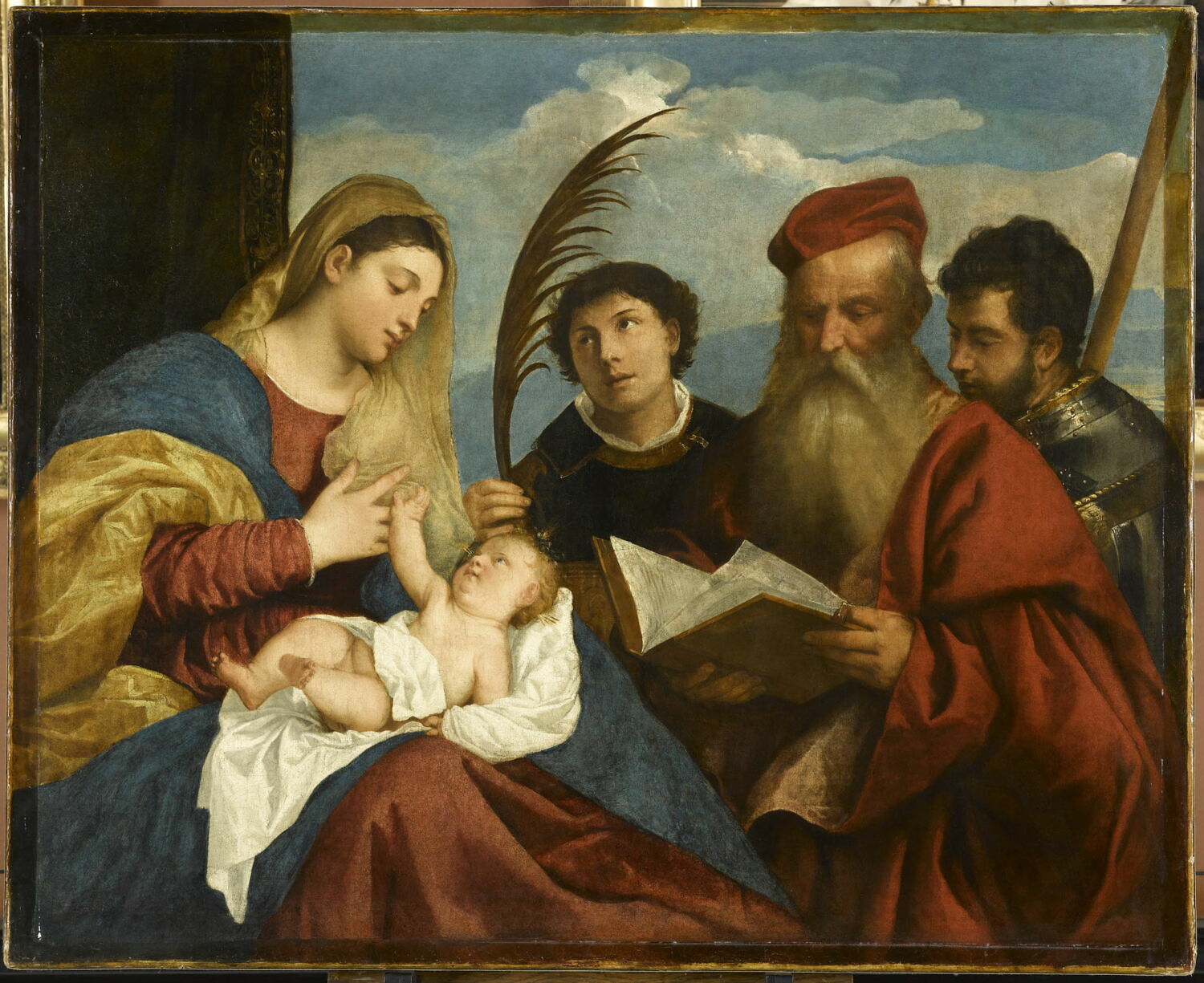
La Vierge à l' Enfant avec saint Étienne, saint Jérôme et saint Maurice, Titien, 1e quart du XVIe siècle (1500 - 1525)

La Vierge à l' Enfant avec saint Étienne, saint Jérôme et saint Maurice

1e quart du XVIe siècle (1500 - 1525) · Museu do Louvre

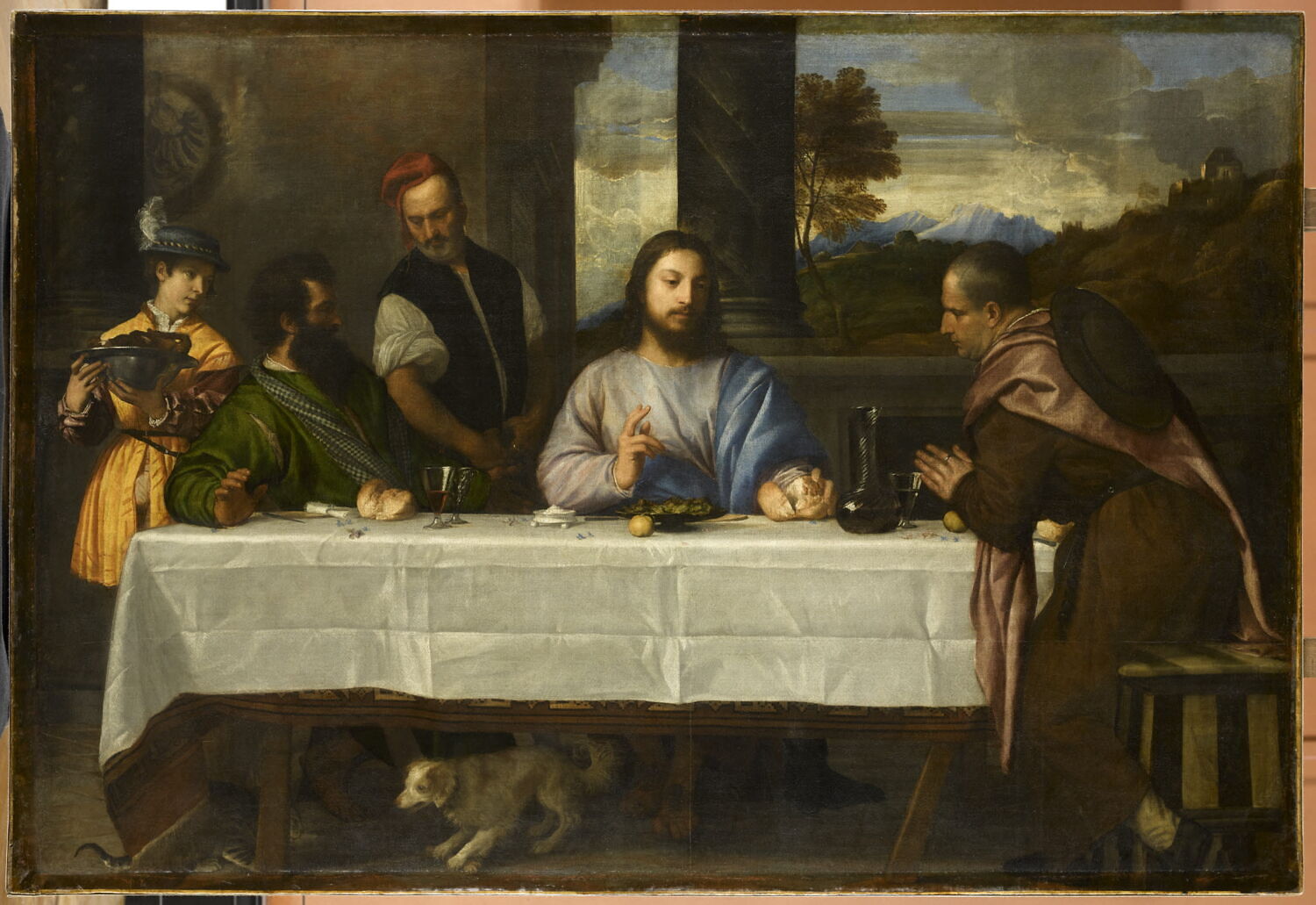
Les Pèlerins d'Emmaüs, Titien, XVIe siècle (1500 - 1600)

Les Pèlerins d'Emmaüs

XVIe siècle (1500 - 1600) · Museu do Louvre

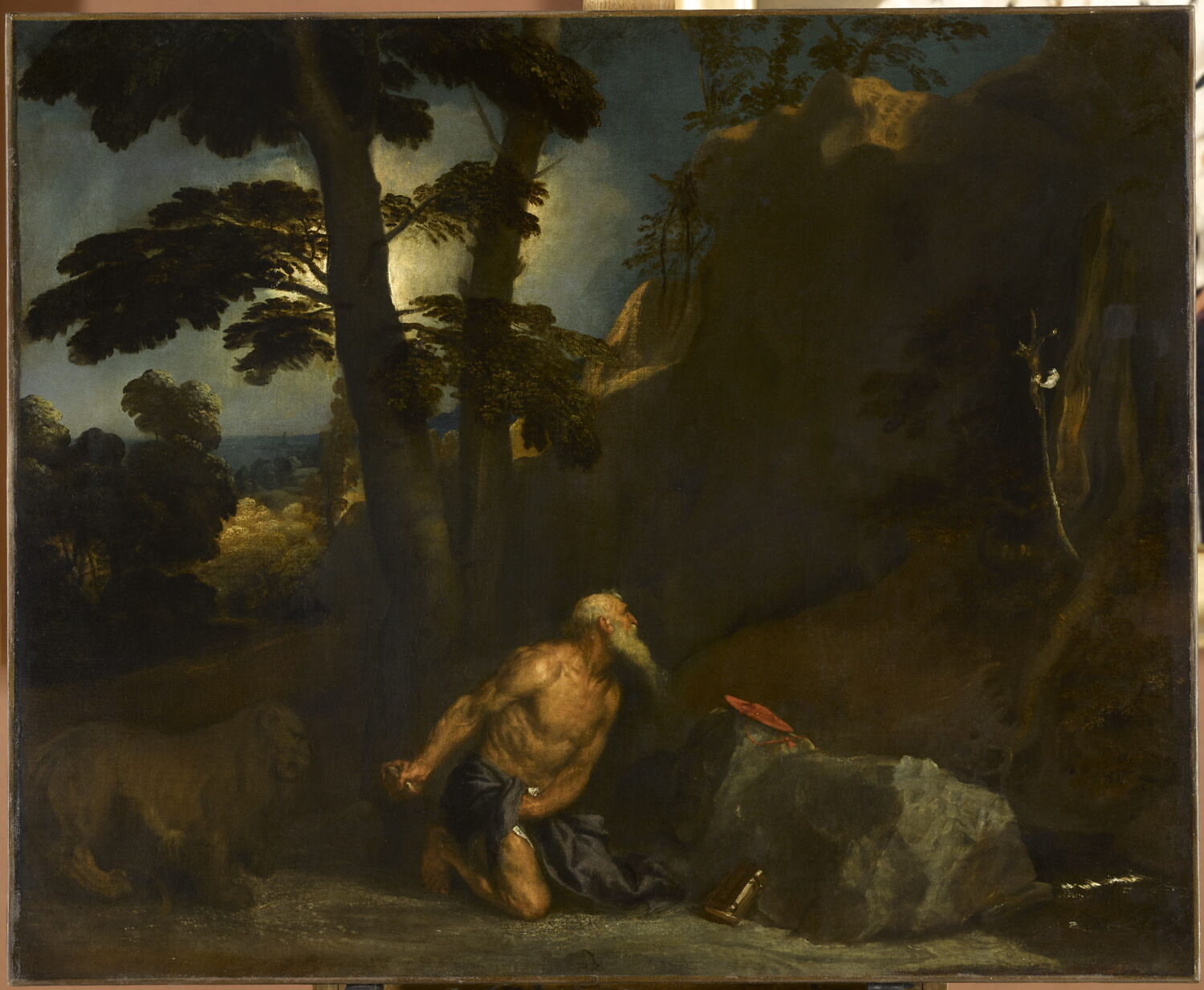
Saint Jérôme pénitent, Titien, XVIe siècle (1500 - 1600)

Saint Jérôme pénitent

XVIe siècle (1500 - 1600) · Museu do Louvre

Na mesma sala · M-023, Galeria Nacional de Arte

Página do museu
Vincenzo Cappello, Titian and Workshop, c. 1550/1560

Titian

Vincenzo Cappello, c. 1550/1560

Doge Andrea Gritti, Titian, c. 1546/1550

Titian

Doge Andrea Gritti, c. 1546/1550

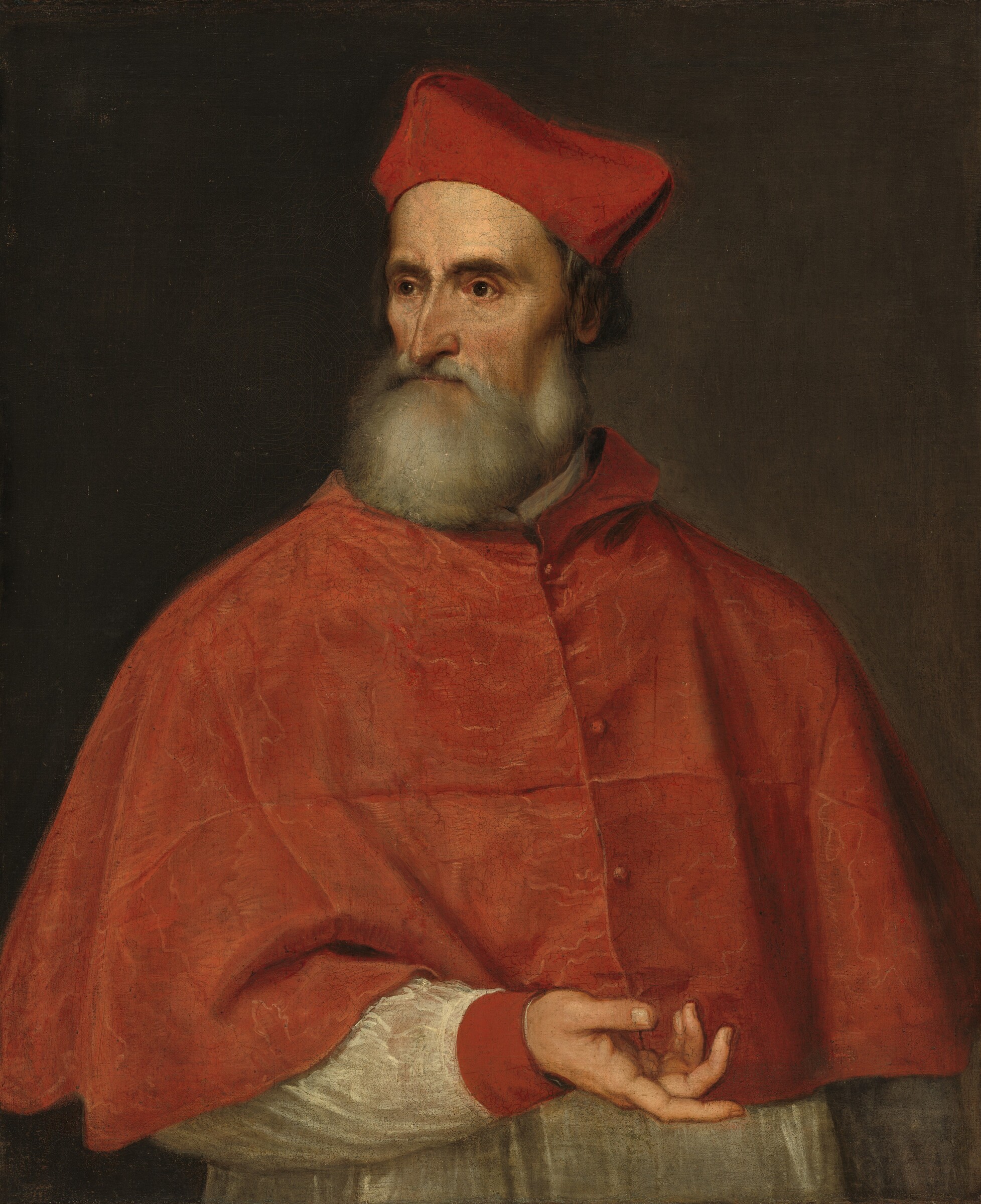
Cardinal Pietro Bembo, Titian, 1539/1540

Titian

Cardinal Pietro Bembo, 1539/1540

Saint Lucy and a Donor, Veronese Workshop, c. 1585/1595

Paolo Veronese

Saint Lucy and a Donor, c. 1585/1595

Venus Blindfolding Cupid, Workshop or Follower of Titian, c. 1566/1570 or c. 1576/1580

anonymous

Venus Blindfolding Cupid, c. 1566/1570 or c. 1576/1580

Andrea de' Franceschi, after Titian, late 16th or early 17th century

anonymous

Andrea de' Franceschi, late 16th or early 17th century

The Annunciation to the Shepherds, Jacopo Bassano, probably 1555/1560

Jacopo Bassano

The Annunciation to the Shepherds, probably 1555/1560

The Baptism of Christ, Paris Bordone, c. 1535/1540

Paris Bordone

The Baptism of Christ, c. 1535/1540

Sobre o mesmo tema · Classical

Todas as obras sobre o tema
Blind Minotaur Led by Marie-Thérèse with a Dove in a Starry Night (Minotaure aveugle guidé par Marie-Thérèse au pigeon dans une nuit étoilée), Pablo Picasso, 1934

Pablo Picasso

Blind Minotaur Led by Marie-Thérèse with a Dove in a Starry Night (Minotaure aveugle guidé par Marie-Thérèse au pigeon dans une nuit étoilée), 1934

Não exposta · Galeria Nacional de Arte

Blind Minotaur Led by Marie-Thérèse with a Dove in a Starry Night (Minotaure aveugle guidé par Marie-Thérèse au pigeon dans une nuit étoilée), Pablo Picasso, 1934

Pablo Picasso

Blind Minotaur Led by Marie-Thérèse with a Dove in a Starry Night (Minotaure aveugle guidé par Marie-Thérèse au pigeon dans une nuit étoilée), 1934

Não exposta · Galeria Nacional de Arte

Blind Minotaur Led by Marie-Thérèse with a Dove in a Starry Night (Minotaure aveugle guidé par Marie-Thérèse au pigeon dans une nuit étoilée), Pablo Picasso, 1934

Pablo Picasso

Blind Minotaur Led by Marie-Thérèse with a Dove in a Starry Night (Minotaure aveugle guidé par Marie-Thérèse au pigeon dans une nuit étoilée), 1934

Não exposta · Galeria Nacional de Arte

Blind Minotaur Led by Marie-Thérèse with a Dove in a Starry Night (Minotaure aveugle guidé par Marie-Thérèse au pigeon dans une nuit étoilée), Pablo Picasso, 1934

Pablo Picasso

Blind Minotaur Led by Marie-Thérèse with a Dove in a Starry Night (Minotaure aveugle guidé par Marie-Thérèse au pigeon dans une nuit étoilée), 1934

Não exposta · Galeria Nacional de Arte

The Eritrean Sibyl, Giorgio Ghisi after Michelangelo, early 1570s

Michelangelo

The Eritrean Sibyl, early 1570s

Não exposta · Galeria Nacional de Arte

Wooden Falsework Supporting a Vault, Jacob Bos, after Antonio da Sangallo, published by Antonio Lafreri, 1561

Michelangelo

Wooden Falsework Supporting a Vault, 1561

Não exposta · Galeria Nacional de Arte

Forma Partis Templi Divi Petri [Exterior Section of Saint Peter's Basilica], Italian 16th Century, after Michelangelo, published by Vincenzo Luchino, 1564

Michelangelo

Forma Partis Templi Divi Petri [Exterior Section of Saint Peter's Basilica], 1564

Não exposta · Galeria Nacional de Arte

Orthographia Partis Exterioris Templi Divi Petri [Exterior View of Saint Peter's Basilica], Étienne Dupérac, after Michelangelo, 1544/1572

Michelangelo

Orthographia Partis Exterioris Templi Divi Petri [Exterior View of Saint Peter's Basilica], 1544/1572

Não exposta · Galeria Nacional de Arte