City guide
Art in Grenoble: Modigliani, Fantin-Latour and the Women of Jacqueline Marval
A rejected self-portrait, a goddess given as a wedding present and a curator who designed pasta advertisements: Grenoble’s museum grew through unusually personal decisions.
2 november 2026 · 7 min lezen · Redactie ART WIKI
A young man emerges from darkness in a white shirt, holding a brush. Henri Fantin-Latour was twenty-three when he painted this Self-Portrait in 1859. He sent it to the Paris Salon and was refused. More than forty years later, he gave it to Grenoble, the city where he had been born. Grenoble’s collection is full of decisions made by particular people, sometimes against the prevailing taste.
Allow a morning at the Musée de Grenoble. Gifts and personal requests shaped the collection as much as purchases did. Behind the painted faces are friendships and letters to curators, sometimes written decades after a canvas was made. Our records establish the museum as the home of the pictures in this guide, without confirming their current availability. Contact the museum to discuss any canvas that brings you to Grenoble, and keep time between encounters to notice how differently each painter uses white.
Flora arrives as a wedding present
Flowers scatter around a nude woman standing above the curve of the globe. In François Gérard’s Flora Caressed by Zephyr, painted in 1802, the wind becomes a presence without requiring a second solid body. Flora folds her arms across her breast and closes her eyes. The flowers carry the movement that her own figure holds in reserve. Try looking first at their scatter, then at her feet: the whole scene balances between a dance and a suspension.
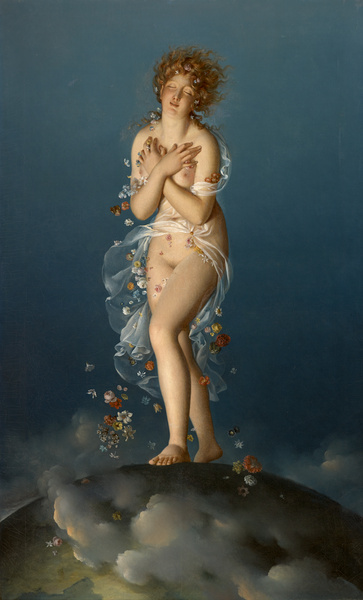
The museum traces the subject to Ovid’s account of Flora and Zephyr, and identifies a more immediate social occasion. Gérard gave the canvas to his friend Madame de Fourcroy, born Adélaïde-Flore Belleville, for her remarriage. Her name matters. A goddess’s realm of flowers could also address an actual woman receiving a present. The painting belonged to a decorative scheme for Charles Gaudin’s Paris house; it entered Grenoble through Léon de Beylié’s gift in 1900.
Hold those settings together while you look. The myth supplies distance, but the gift brings the body back into a private circle of friends, marriage and taste. Gérard’s surface asks for a different sort of attention from the young painter’s shirt in Fantin’s portrait. Neither is an innocent account of how a person happens to stand. Gérard’s figure addressed visitors to a private house; Fantin’s faced the judgement of an exhibition jury.
The rejected portrait comes home
Fantin-Latour kept his Self-Portrait at Twenty-Three until 1901. After the Salon refused it, his friend François Bonvin made room for it in his studio exhibition. Decades later, Grenoble’s curator Jules Bernard wrote to request a work; Fantin answered with this picture. The museum’s account preserves Bernard’s delighted report to the mayor. A collection can grow from something as ordinary, and as difficult, as someone finding the right person to ask.
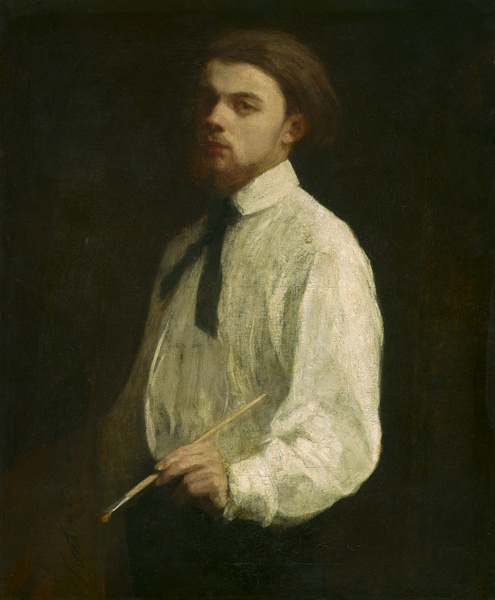
Fantin was born here in 1836 but left with his family at five. The connection is therefore one of return and remembrance, rather than a lifetime spent painting local views. In the portrait, light catches his face, shirt and brush hand while the background remains dark. The brush is a professional claim. The bright cloth is also a painter’s problem: how much light can a patch of white hold before it detaches itself from the body?
His letters describe evenings spent working in front of a mirror after visits to the Louvre. The available model was himself. That practical fact is more useful than inventing a psychological confession for the face. Watch the edge of the shirt against the darkness and the way a hand becomes legible through light. You are looking at someone testing his means, then presenting the test as evidence that he deserves to be taken seriously.
Jacqueline Marval changes the guest list
Four women sit on the floor while a fifth brings refreshments. Jacqueline Marval’s Les Odalisques, painted in 1902–03, spreads its figures across a broad canvas. Their bodies have weight and their gathering has an ordinary activity at its centre. The title brings the inherited fantasy of the odalisque with it, but the tray and the group’s self-contained company keep interrupting that fantasy. From a distance, read the women as a group before examining a single face.
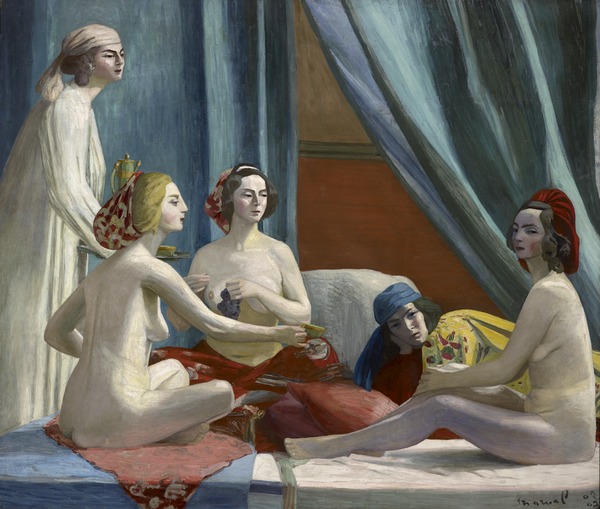
Marval had been Marie Vallet, born at Quaix-en-Chartreuse near Grenoble. Before moving to Paris in 1895 she trained for teaching and worked making waistcoats. Her connection with Jules Flandrin helped open another life in painting. The Ministry of Culture’s biography follows her from that change of profession to participation in New York’s Armory Show in 1913. Her career makes the journey between Grenoble and Paris a two-way exchange rather than a simple departure for the capital.
Together with Flandrin, she introduced Grenoble’s curator Andry-Farcy to painters including Matisse and Picasso, helping the museum obtain gifts. Marval also kept Les Odalisques throughout her life; her sister donated it in 1933. She belongs in this story both as a painter and as someone whose relationships changed what a public museum could acquire. Look again at the women around their refreshments with that knowledge in mind: their maker helped decide who else would enter the collection.
A white collar and an early decision
Lunia Czechowska sits with folded hands and a slightly tilted head in Modigliani’s Woman with a White Collar. Painted in 1917, the portrait was bought from Bernheim-Jeune in 1923. The museum identifies it as the first Modigliani painting acquired by a museum. That fact is easy to pass over now. It means Grenoble made a public commitment at a moment when this particular place in museum history had not yet been filled.
Lunia was a young Polish woman staying with the painter’s dealer Léopold Zborowski and his wife Hanka. Her elongated neck and oval face do not erase the fact that an individual sat before him. Compare her collar with Fantin’s shirt. Both white passages direct the eye towards a face, but the routes feel different: Fantin builds a figure out of the dark, while Modigliani draws you along an extended contour. Give the comparison a few minutes rather than treating it as a resemblance to tick off.
The curator had designed pasta advertisements
Andry-Farcy, appointed in 1919, had worked as an artist, advertising designer and critic. He created the egg-bellied Père Lustucru figure for pasta advertising before directing the museum. His knowledge of newspapers and artistic circles became tools for making a modern collection. The institution itself had begun in 1798 after local citizens petitioned to preserve works seized during the Revolution. In both episodes, people argued for what a public collection ought to do.
Finish by noticing the building, occupied since 1994. Its architects planned indirect overhead light and connections between interior spaces, the city and the surrounding landscape. After the portraits, take that invitation outside. Keep at least two hours for your chosen paintings, add a pause if your concentration fades, and leave time to walk after lunch. Grenoble rewards the visitor who remembers a face and a decision, rather than the visitor who finishes every wall.
Op de omslag: Flore caressée par Zéphyr ; L'Aurore (Ancien titre) — François Gérard. © Ville de Grenoble / musée de Grenoble-J.L. Lacroix; Ministère de la Culture (France), base Joconde
Verder lezen
Art city by city →City guide
Art in Bergamo: Raphael, Lorenzo Lotto and a Walk from the Carrara to Città Alta
A woman hides her name in the moon, and a landlord accepts a painting for the rent. Follow these small transactions from the Carrara into the streets where Lotto worked.
City guide
Art in Dijon: The Dukes’ Tombs, Courbet and the Musée Magnin in One Day
Look beneath the duke’s marble slab: the mourners are doing the real storytelling. Dijon’s art day moves from their folded cloaks to a violent sea and a wedding feast about to go wrong.
City guide
Art in Caen: Perugino, Veronese and Boudin Inside the Castle
A rejected bridegroom, a saint under attack and a beach ruled by clouds: three paintings open up a city that had to rebuild its museum.