City guide
Art in Dijon: The Dukes’ Tombs, Courbet and the Musée Magnin in One Day
Look beneath the duke’s marble slab: the mourners are doing the real storytelling. Dijon’s art day moves from their folded cloaks to a violent sea and a wedding feast about to go wrong.
2 november 2026 · 7 min lezen · Redactie ART WIKI
A hood can hide a face and still tell you that someone is grieving. Around the Tomb of Philip the Bold, the small mourners have sleeves, folds and bent heads with which to express what their faces sometimes conceal. The duke occupies the grand upper level; the human drama moves below. Start your day in Dijon by changing your eye level. The details near the base of a monument can be more absorbing than its royal claim to attention.
Set aside a day for two very different kinds of collecting. The Musée des Beaux-Arts occupies part of the palace of the dukes and Estates of Burgundy. The Musée Magnin preserves the character of a family collection in a private house. Between them, a funeral procession, Courbet’s storm and a disorderly gathering of gods make a varied route. Collection ownership is recorded for these works; their individual display status remains unknown in our data, so confirm essential stops before your visit.
The duke’s funeral takes three sculptors
Philip commissioned his Tomb from Jean de Marville in 1381, but the monument outlived both patron and first sculptor. When the duke died in 1404, only the arcades and two mourners were finished. Claus Sluter took responsibility for completing it; after his death, his nephew Claus de Werve brought the work to completion. The tomb was installed in 1410. It belongs to a succession of hands and decisions, rather than a single burst of invention.

Under the pale arcades, figures seem to move through a miniature cloister. Some turn towards a neighbour; others withdraw beneath their clothing. Do not try to count the mourners before looking at them. Choose two whose bodies behave differently and follow the folds from shoulder to floor. A heavy garment can close a figure off or give it momentum. Grief acquires a different shape each time, even though the procession keeps a common pace.
The monument was made for the Chartreuse de Champmol, not for the palace museum. After the monastery’s suppression it was moved to Saint-Bénigne, then dismantled and partly destroyed in 1793. Reconstruction in the nineteenth century replaced substantial losses, including much of the recumbent duke. The museum’s restoration study shows why the monument should not be read as an untouched medieval survival. The remaining original hands belonged to a smaller effigy; later work changed the proportions of the whole.
Even the act of putting it back together has a recent chapter. In July 2020, a missing figure known as Mourner 17 returned to Dijon after more than two centuries away. That recovery helps explain the peculiar emotional pressure of the ensemble. It represents a community assembled for a funeral, but it also survives as an object repeatedly dispersed and reassembled. The city has had to decide, across successive political worlds, whether the duke’s memory deserved destruction, preservation or repair.
Courbet gives Dijon a dangerous coast
A visitor who has been studying quiet stone folds may need a change of weather. In Gustave Courbet’s The Waterspout, Étretat, dated about 1869–70, waves and clouds compete with the mass of the rocks. The viewpoint is low, near the base of the cliffs. There is little of the comfortable distance that turns a seascape into a view. The water appears to have weight, and the dark sky presses on the space available below it.
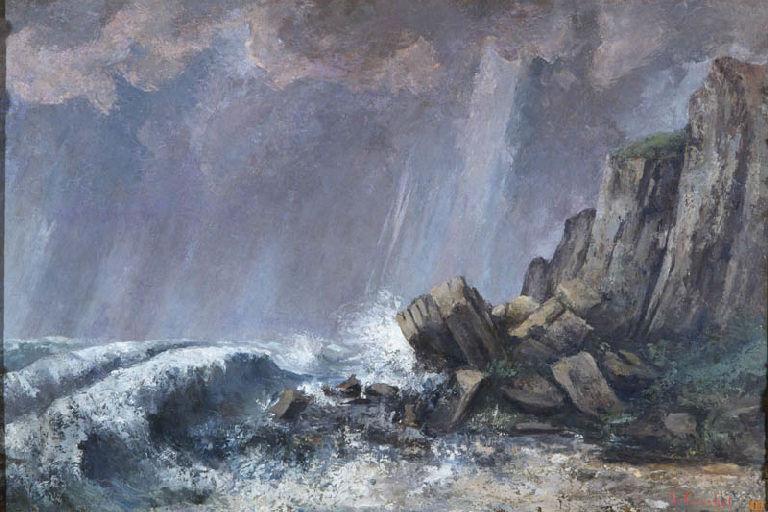
Courbet spent extended periods on the Normandy coast in the 1860s and described these subjects as sea landscapes. According to the collection catalogue, he witnessed a waterspout near Trouville in 1865 or 1866 and returned to the subject in several pictures. The Dijon canvas is therefore more than a record of an attractive seaside destination. It belongs to a sustained attempt to make unstable water as physically convincing as the cliffs against which it breaks.
The surface helps do that work. The catalogue describes colours laid with a palette knife, lending the landscape an almost sculptural relief. Compare a band of foam with the pale drapery you have just studied. One has been carved to hold a movement still; the other has been built from paint to give movement substance. Pierre and Kathleen Granville donated the Courbet in 1969. Their gift connects this storm to another chapter of Dijon’s collecting, centuries after the ducal commissions.
The Magnins bought with a limit in mind
At the Hôtel Lantin, the scale changes from the public monument to the family house. Jeanne and Maurice Magnin grew up here before moving to Paris. Their grandfather had bought the property in 1829; the siblings eventually chose it as the setting for their collection. Notice the staircase as well as the pictures. The seventeenth-century plot was too constrained for the usual arrangement between courtyard and garden, and the house invested its architectural drama in a large stair beneath a decorated dome.
Maurice learned through repeated visits to the Drouot auction rooms. Jeanne trained in painting and wrote museum catalogues and art criticism. They deliberately restricted their spending, making knowledge and patience part of their purchasing power. Some optimistic attributions have since been rejected. Later generations inherited the collector’s mistakes along with his preferences. The house allows you to encounter those choices as a connected history of taste.
It was also adapted with care. In 1930–31 Auguste Perret worked on turning former service spaces into galleries, introducing overhead light while fitting reinforced concrete into an older architectural setting. The apparently domestic museum was itself a construction project. Keep that in mind when a room feels intimate: such effects can result from decisions about light and circulation as well as from the fact that a family once lived there.
An apple arrives at the wedding feast
Jan van Bijlert’s The Feast of the Gods gathers the immortals for the marriage of Thetis and Peleus. Apollo, identifiable by his lyre, occupies the centre, while a reclining Bacchus squeezes grapes towards his mouth and a satyr dances. At the right, Discord introduces the golden apple. The celebration contains its own future quarrel. Before identifying every guest, follow the difference between the seated company and the bodies moving in front of the table.

Part of the canvas has been cut away on the left. Juno’s peacock remains as a clue to an absent presence. The surviving composition consequently asks you to distinguish what can be seen from what has to be reconstructed. Bijlert had encountered Caravaggio’s art in Rome, but the museum explains this later painting through a turn towards clearer drawing and daylight. The unruly foreground and the ordered table make that change more interesting than a simple label of style.
Take the Beaux-Arts slowly in the morning, pause for lunch, then give Magnin a separate hour or more. Its smaller rooms deserve fresh attention after the palace. Check opening arrangements for both before fixing the order, and finish with a short walk rather than a third rushed collection. A folded cloak, a wave against a rock and an apple on a table are enough to keep working in the mind over dinner.
Op de omslag: Tombeau de Philippe le Hardi — Jean de Marville. © François Jay - musée des beaux-arts de Dijon; Ministère de la Culture (France), base Joconde
Verder lezen
Art city by city →City guide
Art in Caen: Perugino, Veronese and Boudin Inside the Castle
A rejected bridegroom, a saint under attack and a beach ruled by clouds: three paintings open up a city that had to rebuild its museum.
City guide
Art in Pau: Where to See Degas, Morisot and Ingres in a Day
A cotton business, a woman sewing and an ambassador on his knees connect Pau’s two museums. Follow the hands, and the city’s art tells some unexpected stories about work and power.
City guide
Art in Le Havre: Monet, Pissarro and Boudin at MuMa and Beyond
A hotel window, London fog and a Paris skating rink lead back to this Norman port. MuMa makes a strong case for spending a day looking at changing light.