City guide
Art in Caen: Perugino, Veronese and Boudin Inside the Castle
A rejected bridegroom, a saint under attack and a beach ruled by clouds: three paintings open up a city that had to rebuild its museum.
2 november 2026 · 7 min lezen · Redactie ART WIKI
A young man braces a stick against his knee and snaps it. Everyone else seems to have accepted the wedding, but he is still protesting. This little outburst in Perugino’s Marriage of the Virgin makes a good beginning in Caen: beneath an orderly surface, something troublesome is happening. The picture’s own journey was troublesome too. Made for a cathedral in Umbria, it reached Normandy through the seizures of the French campaigns in Italy. The serene architecture contains a history of broken attachments.
Plan an art day around the castle, where the Musée des Beaux-Arts and the Musée de Normandie share the enclosure. The first supplies the paintings for this route; the second gives the city around them a longer history. Begin with a wedding, then examine an assault on a saint. A Norman beach gives the eye a rest after those crowded encounters. Between them, take time outside. In Caen, the building housing the collection is part of the story of its survival.
The castle: a collection brought back from hiding
During the Second World War, 360 paintings were moved out of the museum to places including an abbey and a priory. Many objects left behind were lost when bombing destroyed the old premises in 1944. The museum’s account records 540 paintings and 400 drawings among the losses, as well as archives and inventories. These figures make the usual phrase “permanent collection” sound precarious. A museum can lose the documents that explain its possessions at the same moment that it loses the possessions themselves.
The replacement museum opened inside the castle in 1970. Its neighbour, the Musée de Normandie, had opened here seven years earlier. A site successively used as a princely residence, royal fortress and infantry barracks acquired a different public purpose. The castle does not provide an untouched medieval wrapping for old paintings. It is a place repeatedly adapted, and the modern gallery belongs to that sequence. Before going indoors, let the difference between the museum building and the fortifications register.
Perugino: the wedding Perugia tried to reclaim
A ring explains the choice of subject. Perugino’s Marriage of the Virgin was commissioned for the chapel associated with the supposed wedding ring of Mary in Perugia Cathedral. The image therefore accompanied an object people believed had participated in the sacred event. What now asks for a visitor’s visual attention once belonged to a particular devotional setting. The ceremony painted on the panel and the relic kept in the chapel reinforced one another.
The disappointed suitors come from the marriage legend: Joseph’s rod blossoms, identifying him as the chosen husband, while the other men are left with dry sticks. Perugino places the joining of hands beneath the distant temple doorway. Look from one to the other and the painting seems to draw a straight line between a small human action and a much larger order. Then return to that bent knee. A rejected man introduces a flash of bad temper into all the measured space.
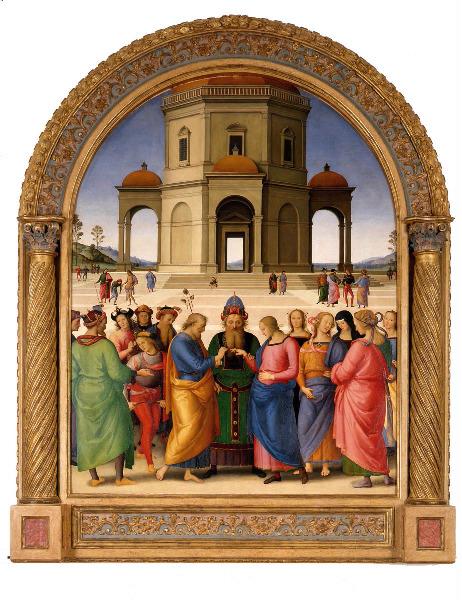
The panel was assigned to Caen in 1804 after its removal from Italy. Between 1814 and 1816, Perugia’s municipality attempted to recover it, without success. Those attempts belong beside the date and painter’s name when thinking about this collection. The picture was never simply a beautiful thing that happened to travel. One city lost an image bound to a local relic; another gained a foundation of its public museum. Both histories remain attached to the same painted wood.
Spend a second interval on the empty paving in Marriage of the Virgin. The space between the foreground crowd and the temple could seem excessive if the purpose were merely to report a wedding. Instead, it slows the eye down. Small figures recede into the distance; the doorway admits a further glimpse beyond the building. The ceremony feels public and intimate at once. That rhythm is worth carrying into the next picture, where scarcely any breathing space survives.
Veronese: a saint with nowhere to retreat
A horse’s foot makes an unlikely weapon. In Veronese’s Temptation of St Anthony, a muscular assailant raises one while a woman grips the fallen saint. The scene takes temptation out of the realm of quiet thought and makes it a physical emergency. Painted in 1552 for Cardinal Ercole Gonzaga’s programme at Mantua Cathedral, it comes from a young painter already willing to push bodies hard against the limits of his composition.
The woman’s hands deserve a closer inspection: the fingers become claws. Her apparent beauty belongs to the attack. Anthony has to resist both bodily violence and desire, and the compression of the figures makes the two inseparable. Where Perugino gave a wedding ample air, Veronese denies his hermit an easy escape. A viewer can follow the conflict without first recognising the saint’s attributes. The uncomfortable arrangement of shoulders, arms and torsos does much of the storytelling.
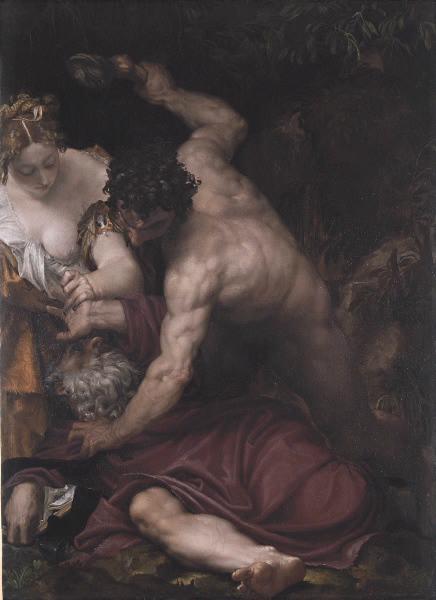
The picture had an afterlife in fiction. Barbey d’Aurevilly referred to it in “A Woman’s Revenge”, one of his Diaboliques stories, when describing a woman’s provocative bearing. That borrowing is a useful reminder to look beyond a religious subject label. A gesture devised for a cathedral could become a novelist’s way of describing a person in the street. Paintings travel through readers and writers as well as through confiscations, purchases and museum transfers.
Boudin: the beach without a grand occasion
A cart and a few people occupy the sand beneath a sky that takes most of the canvas. Boudin’s The Beach at Deauville, dated 1893, reduces the human gathering to a small interruption in the weather. Older catalogues called it the beach at Tourgéville; the museum explains that Boudin’s views of this stretch of coast circulated under both place names. The change of title is less dramatic than the change of attention. Nobody here competes with the clouds for long.
Boudin had helped younger painters take changing outdoor light seriously, with Monet among those affected by his example. Seen after the two altarpieces, his beach can loosen the demands of a museum visit. There is no central miracle to decode and no principal figure whose identity settles the picture. Try following the horizon, then the uneven density of the clouds. The eye can wander without losing the thread; the thread is the weather itself.

Finish outside the galleries. The castle, established around 1060 in William the Conqueror’s Caen, connects the art day to the making of the city. Give the paintings a generous morning, leave lunch unscheduled and decide afterwards how much energy remains for the neighbouring history museum. Our records identify these pictures as collection holdings without confirming their current availability, so ask about the three you most want to see before travelling. On the day, keep enough time for the walk across the enclosure: after Boudin, the real sky deserves a turn.
Op de omslag: Marriage of the Virgin — Le Perugin. © Musée des Beaux-Arts de Caen, cliché Martine Seyve; Ministère de la Culture (France), base Joconde
Verder lezen
Art city by city →City guide
Art in Pau: Where to See Degas, Morisot and Ingres in a Day
A cotton business, a woman sewing and an ambassador on his knees connect Pau’s two museums. Follow the hands, and the city’s art tells some unexpected stories about work and power.
City guide
Art in Le Havre: Monet, Pissarro and Boudin at MuMa and Beyond
A hotel window, London fog and a Paris skating rink lead back to this Norman port. MuMa makes a strong case for spending a day looking at changing light.
City guide
Art in Saint-Germain-en-Laye: The Lady of Brassempouy, a Royal Château and Maurice Denis
A face carved from mammoth ivory starts a day that crosses thirty thousand years. Follow it with a royal château that was rebuilt twice over and the hospital Maurice Denis made his home.