City guide
Art in Pau: Where to See Degas, Morisot and Ingres in a Day
A cotton business, a woman sewing and an ambassador on his knees connect Pau’s two museums. Follow the hands, and the city’s art tells some unexpected stories about work and power.
2 november 2026 · 7 min lezen · Redactie ART WIKI
Cotton slips through a man’s fingers while another man reads the newspaper. Nothing in Edgar Degas’s A Cotton Office in New Orleans announces a catastrophe. The men are dressed, the business has furniture, the day appears to be continuing. Yet the family firm depicted here filed for bankruptcy in 1873, the year of the painting. It is a disquieting first encounter for an art day in Pau, a city far from the American port where Degas found this subject among his own relatives.
The route connects the Musée des Beaux-Arts, on rue Mathieu-Lalanne, and the Château de Pau. Between the commercial room painted by Degas and a royal anecdote painted by Ingres, pause over Berthe Morisot’s sewing woman. The hands move from pricing a commodity to stitching fabric. In the royal scene, a gesture performs an act of homage. The connection is small enough to keep in mind while walking, and more useful than trying to memorise several centuries of French painting.
Degas: a family business in white fibre
Michel Musson, seated in the foreground of A Cotton Office in New Orleans, examines a sample. Degas’s uncle acted for southern planters; the painter’s brothers René and Achille bought cotton for French merchants. René reads the paper, while Achille leans against a window frame. The room is therefore both a workplace and an extended family portrait. Degas had arrived in late 1872 and stayed with his American relatives for several months. An intimate visit brought him close to an international trade.
The white heap on the table pulls the scattered figures together. Follow it across the canvas as a transaction proceeds from handling the cotton to conversation and paperwork. The suits and newspapers encourage an impression of civilised routine. The cotton has already been separated from the people who grew and gathered it. That separation matters. The industry had depended on enslaved labour, and after the Civil War exploitation continued through sharecropping. The office makes its own part of this system look orderly.
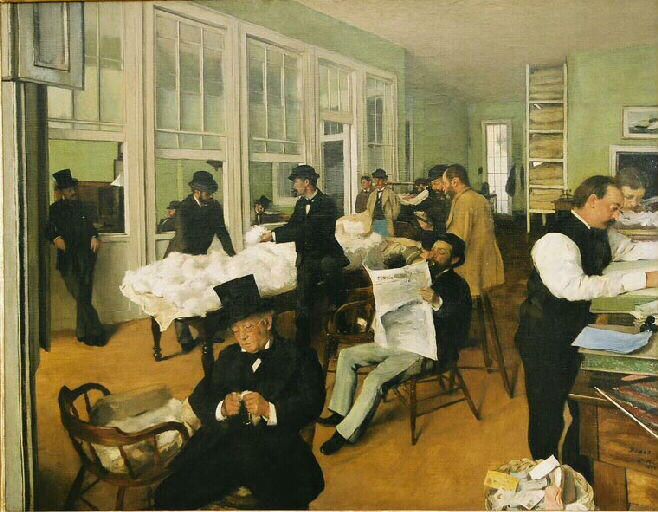
There is a further financial irony. Degas hoped that a Manchester textile manufacturer would buy the painting, but the sale failed. Pau acquired it in 1878 for 2,000 francs, using resources made available through Émile Noulibos’s bequest. In his letter of thanks to curator Charles Le Cœur, Degas admitted that being chosen by a museum was a new experience. The picture that did not find its intended industrial buyer became the first of his paintings purchased for a public collection.
Pau’s fine arts museum had been founded only in 1864. Its present Art Deco building dates from 1931, so the acquisition belongs to an earlier chapter than the architecture surrounding the collection. The purchase was made while Degas was still working, with no guarantee that future visitors would cross the city for him. This is one reason to resist treating a regional museum as a convenient gathering of names already approved elsewhere. Sometimes the decision came before the consensus.
Morisot: sewing is not a holiday
Pasie’s lowered head could belong to a summer daydream, but her hands have a task. In Pasie Sewing in the Garden at Bougival, Berthe Morisot paints a member of her household staff outdoors, on a bench near a basket. White roses occupy the greenery behind her. The garden provides beauty and light; it has not released the sitter from work. After the cotton merchants, the presence of cloth in another pair of hands makes an unobtrusive connection between public commerce and domestic labour.
Morisot and her husband Eugène Manet rented a house in Bougival from 1881 to 1884; the painting dates from the first of those years. Pasie appeared repeatedly in Morisot’s work. Here the face receives a delicacy different from the loosely brushed plants and clothing. At the corners, bare canvas remains visible. Instead of filling every surface to the same degree, Morisot allows attention to gather and disperse. The unfinished-looking edges make the sitter’s concentration more, rather than less, persuasive.

Look especially at the boundary between the sleeve and its surroundings. A museum visit often trains us to identify objects quickly, then move on. Morisot makes that habit less satisfying: the pleasure lies in watching painted marks almost become a solid thing, then loosen again. Her subject is neither anonymous decoration nor an occasion for a grand moral lesson. Pasie has a name, an occupation and a posture that withdraws her from our inspection. The picture reached Pau in 1907 as a gift from Morisot’s son-in-law, Ernest Rouart.
Ingres: a king honoured through an absent hand
At the château, a different pair of hands holds a sword. Ingres’s Don Pedro of Toledo Kissing Henri IV’s Sword tells an anecdote about a Spanish ambassador encountering a page who carries the French king’s weapon. The ambassador kneels to honour it. The sovereign need not stand in front of him: the sword carries his reputation. Painted in 1819 as a gift for Ingres’s friend Jean Alaux, the small canvas turns diplomacy into a moment of almost private devotion.
Treat the episode as a story from Henri IV’s legend, rather than a witnessed report. Ingres returned to the subject several times; the earliest version, exhibited in 1814, is lost. The Pau picture preserves an early form of his fascination with historical anecdote. Its scale is part of the attraction. Political prestige, usually expressed through enormous portraits and battle scenes, is concentrated into the meeting of a bent body and an object. The king’s authority seems to pass through the sword to the man carrying it.

Henri IV was born in this château in 1553, but much of the setting encountered by later visitors was remade long afterwards. Louis-Philippe began a major restoration in 1838, recreating Renaissance interiors for a nineteenth-century court. He wanted to strengthen his connection to his Bourbon ancestor. He never made the visit himself before exile in 1848. Remembering that frustrated intention gives the palace an extra human dimension: a monarch prepared a dynastic homecoming that his own reign did not survive.
A promenade kept for the town
The grounds have a story with different protagonists. When parts of the royal estate were offered for sale during the Revolution, citizens formed a society to buy and preserve them as a public promenade. In 1815 they offered the property to Louis XVIII, with the condition that local people could continue to walk there. The park therefore belongs in the route for more than fresh air. Its survival also records an organised act of attachment by the town.
Build the day around the château’s visit arrangements, then give Degas and Morisot an unhurried interval at the fine arts museum. Before setting out, confirm that the paintings you want to see will be accessible on your date, as well as checking the opening hours. Afterwards, take the boulevard des Pyrénées from the château side towards the Palais Beaumont. Leave that last walk without a target number of sights. After so many painted hands doing something, there is a particular pleasure in having nothing left to perform.
Op de omslag: A Cotton Office in New Orleans — Edgar Degas. © SEGURA Patrick; Ministère de la Culture (France), base Joconde
Verder lezen
Art city by city →City guide
Art in Le Havre: Monet, Pissarro and Boudin at MuMa and Beyond
A hotel window, London fog and a Paris skating rink lead back to this Norman port. MuMa makes a strong case for spending a day looking at changing light.
City guide
Art in Saint-Germain-en-Laye: The Lady of Brassempouy, a Royal Château and Maurice Denis
A face carved from mammoth ivory starts a day that crosses thirty thousand years. Follow it with a royal château that was rebuilt twice over and the hospital Maurice Denis made his home.
City guide
Art in Amiens: El Greco, Frans Hals and Fragonard, from the Musée de Picardie to the Cathedral
A museum financed through lotteries holds a preacher who fought the theatre and a stranger who may never recover his name. Across town, blue dye helped pay for a Gothic cathedral.