City guide
Art in Colmar: The Isenheim Altarpiece, Cranach and Monet at Unterlinden
Begin with a pointing finger and a wounded body. Colmar’s art leads from a monastery hospital to a room full of unease, then out into Monet’s evening light.
2 november 2026 · 7 min lezen · Redactie ART WIKI
A finger points across a black sky towards a body on a cross. It belongs to John the Baptist, who was already dead when the Crucifixion took place. Grünewald lets him enter the scene anyway. In the Isenheim Altarpiece, the gesture matters more than chronological consistency: look here, at this suffering body. A visit to Colmar can begin with that finger, rather than a view of its timbered houses. It changes the terms of the day.
Give the Musée Unterlinden an unhurried morning, then leave time for the streets around it. Within one collection, a hospital commission leads to a Lutheran painter’s troubling interior and a sunset painted far from Alsace. The building itself supplies another journey, from a medieval convent to former municipal baths and a modern extension. These works belong to the museum in our records; individual display status is unconfirmed, so check access to a particular picture before making it the sole purpose of your trip.
A hospital’s answer to pain
The Antonites at Isenheim cared for people suffering from Saint Anthony’s fire. We now associate this disease with ergot poisoning from contaminated grain; the monastery treated it within a world of remedies, relics and prayer. Its altarpiece belongs to that setting. Grünewald painted the wings and Nicolas of Haguenau made the sculpture. The single object joins two crafts, and the contrast between painted flesh and carved bodies is part of its force. Read both names before looking.
The Isenheim Altarpiece originally changed with the opening of its wings. The closed state centred on the Crucifixion; opening the outer wings revealed scenes including the Annunciation and Resurrection; opening further disclosed the sculptural shrine and episodes of Saint Anthony. Imagine these changes as an event. An image familiar from one day could disappear behind another. A modern visitor’s ability to study separate parts needs that small act of reconstruction, or the ensemble becomes a collection of unrelated dramatic pictures.
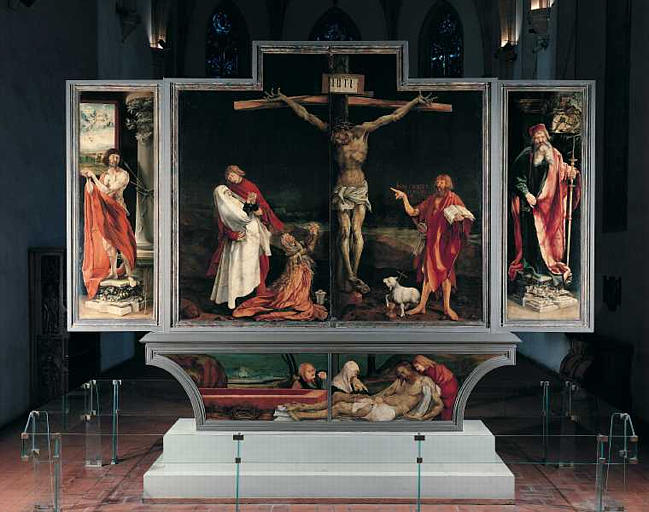
Follow the hands in the Crucifixion, then the cloth in the Resurrection. Pain contracts the fingers; the risen figure seems released from the weight that made the earlier body so terrible. Smarthistory’s account connects the hospital setting with the possibility of identification and consolation. That remains an interpretation of the imagery, not a record of what every patient felt. You need not turn the wounds into a retrospective diagnosis to understand how urgently this painting addresses a vulnerable human body.
Colour has its own recent history here. A restoration completed in 2022 removed the effects of yellowed varnishes and later overpainting on the sculpture. Someone arriving with an old reproduction in mind may find a different balance of tones. The work reached the former Unterlinden convent in 1852, after its removal from Isenheim during the Revolution. Colmar became its custodian through that upheaval; the museum is the destination of a journey, not the commission’s original home.
Schongauer and the man at the saint’s feet
Before Grünewald’s commission, another head of the Isenheim community had already put his name into a painting. In Martin Schongauer’s Orlier Altarpiece, Jean d’Orlier kneels at Saint Anthony’s feet. The surviving wings date from about 1470–75. Their lost centre makes the act of looking incomplete: two painted leaves now have to suggest a larger object that can no longer be recovered simply by opening a door.
Schongauer was born in Colmar. His Annunciation occupies the outsides of these wings, while the inner faces carry the Nativity and the donor with his saint. Spend a moment on that change of scale between the kneeling patron and his protector. D’Orlier commissioned the image, yet enters it from below. Beside the terror of the later hospital altarpiece, this is a quieter negotiation between human need, institutional authority and heavenly help. The two commissions make Isenheim a community with a history, rather than the backdrop to one painter’s achievement.
Cranach leaves the knife in her hand
A seated woman has wings, a knife and a piece of wood. Around her, children play; in the distant sky, riders gather against darkness. Lucas Cranach the Elder’s Melancholia, dated 1532, offers the unsettling experience of a room whose inhabitants do not seem to share the same weather. The children have their games. The winged woman has her small, repetitive occupation. The sky has something else entirely.
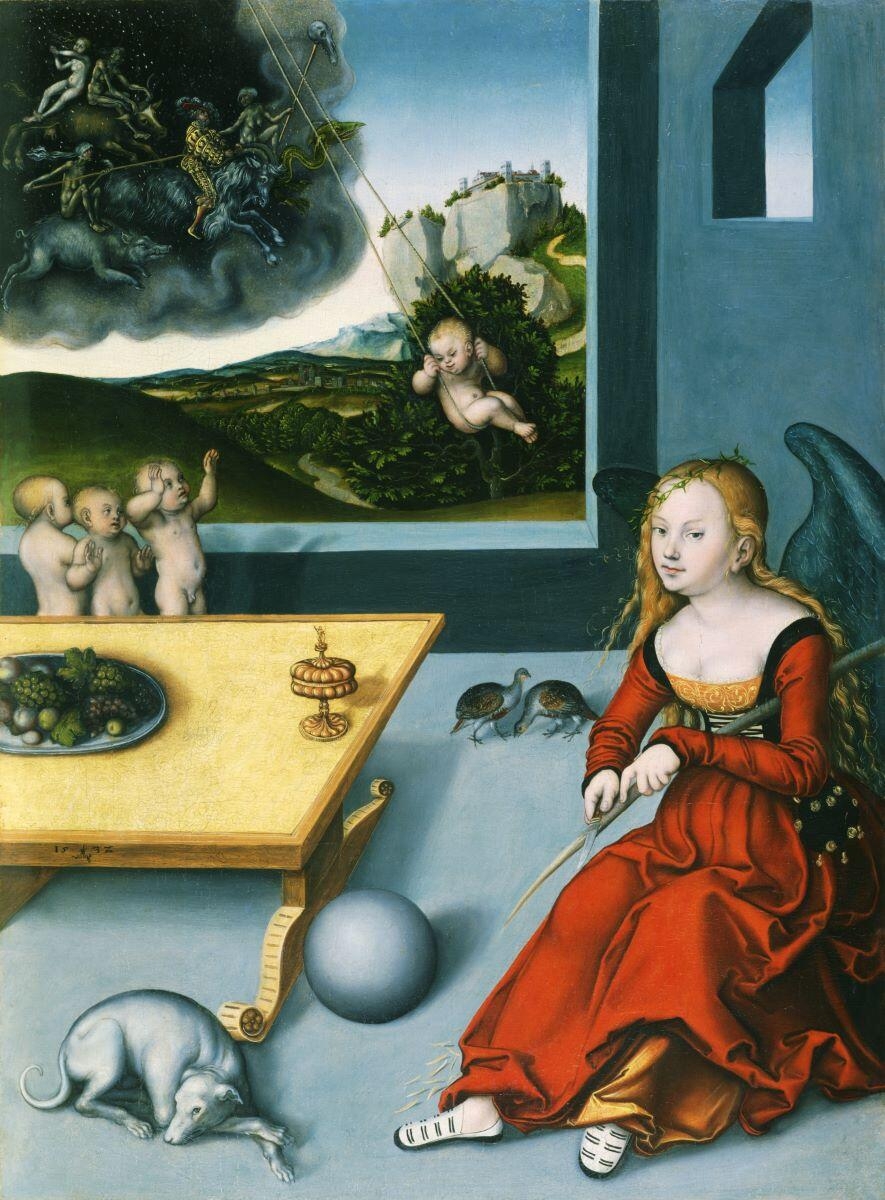
Cranach knew Luther personally. The museum reads the painting in relation to the reformer’s view of melancholy as a danger associated with the devil, while acknowledging that some motifs remain unexplained. The woman whittling a stick is one of them. Resist a guidebook that gives every object a neat translation. Uncertainty belongs to the picture’s subject as well as to its scholarship. Look back from the distant riders to the children and ask how much of their apparent safety the room can really guarantee.
Monet waits for the light to change
By the time you reach The Valley of the Creuse, Sunset, human figures have given way to a river and its enclosing slopes. Monet worked around Fresselines in spring 1889, returning to related viewpoints as the light changed. This landscape entered the museum through a purchase in 1975. Its presence shifts the collection’s geography from the Upper Rhine to central France, and its tempo from religious events to the passing of an evening.
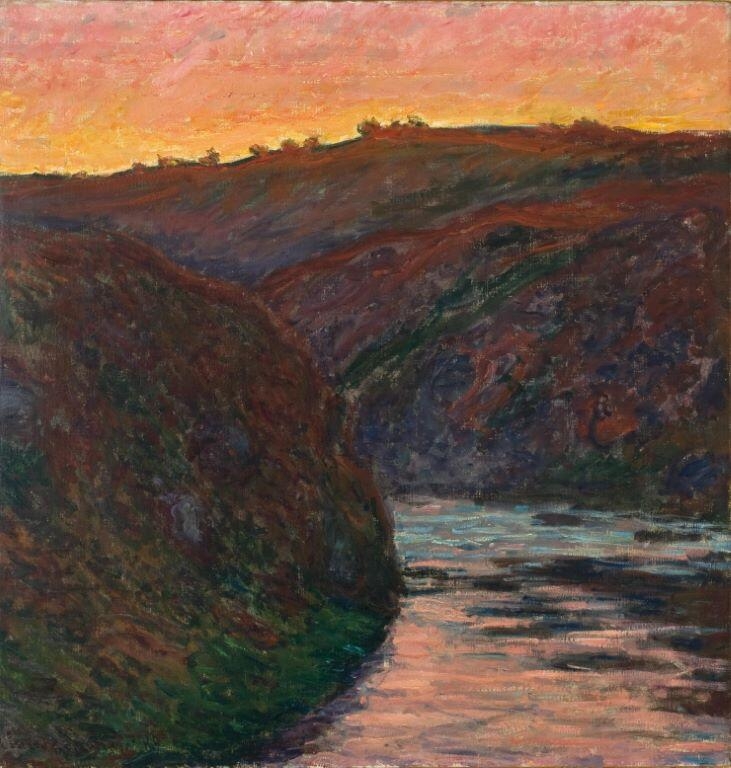
Start with the river instead of the sky. The museum’s account draws attention to Monet’s concentration on earth and water; the sunset has spread through the substance of the landscape. Follow a patch of colour until it becomes a slope, then let it become paint again. After so many hands carrying tools, clasped in prayer or pierced by nails, this change of attention can feel almost physical. There is no gesture to decode. The difficulty is simply allowing your eyes enough time.
Come back above ground
Outside, the museum’s expansion has altered the city on a smaller scale. Herzog & de Meuron connected the convent and the newer complex beneath the square, while the former baths became part of the project. A space once occupied by buses and parking recovered a section of the Sinn canal. Take the underground connection in one direction and return through the square if your visit permits: the two routes explain the architecture better than a single façade photograph.
Reserve a generous half day for Unterlinden and keep the afternoon loose. Ask about the specific pictures you hope to see, choose three or four sustained stops, and take a break before revisiting the altarpiece. Leave the last stretch for a walk without another ticket deadline; after Grünewald’s hands and Cranach’s knife, ordinary daylight is a useful companion.
Op de omslag: Isenheimaltaar — Nicolas de Haguenau. © musée d'Unterlinden de Colmar; Ministère de la Culture (France), base Joconde
Verder lezen
Art city by city →City guide
Art in Grenoble: Modigliani, Fantin-Latour and the Women of Jacqueline Marval
A rejected self-portrait, a goddess given as a wedding present and a curator who designed pasta advertisements: Grenoble’s museum grew through unusually personal decisions.
City guide
Art in Bergamo: Raphael, Lorenzo Lotto and a Walk from the Carrara to Città Alta
A woman hides her name in the moon, and a landlord accepts a painting for the rent. Follow these small transactions from the Carrara into the streets where Lotto worked.
City guide
Art in Dijon: The Dukes’ Tombs, Courbet and the Musée Magnin in One Day
Look beneath the duke’s marble slab: the mourners are doing the real storytelling. Dijon’s art day moves from their folded cloaks to a violent sea and a wedding feast about to go wrong.