Paul KleeDuitsland, 1879–1940
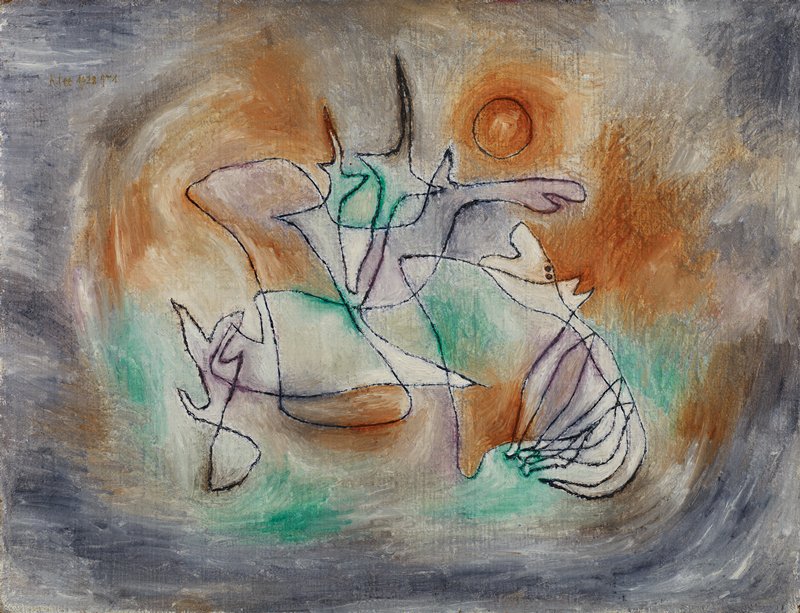
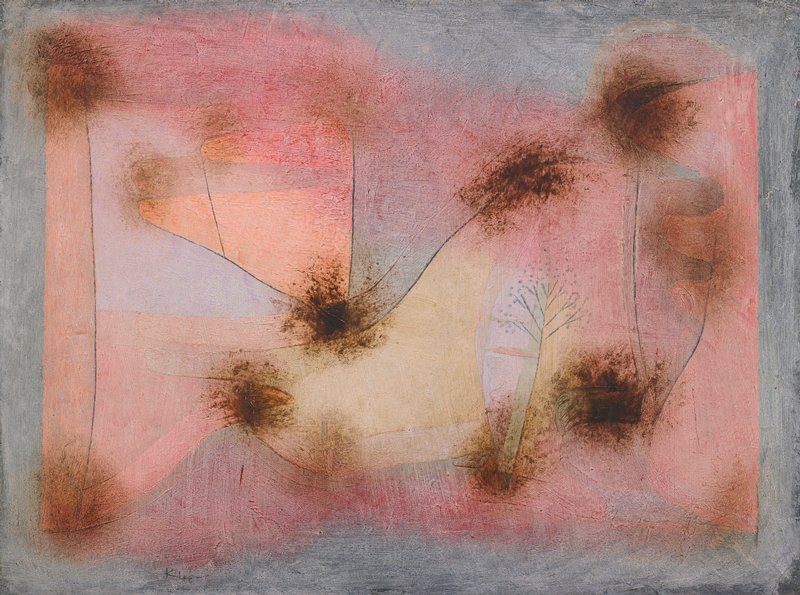
Railway Station
Mag men het zien?
Ontvangt momenteel niet

Art Institute of Chicago
Chicago, Verenigde Staten
Het hoort bij de collectie, maar is momenteel niet tentoongesteld.
- Gecontroleerd
- Ongewijzigd sinds
- Bron
- Het museum
Gegevens
- Inventarisnummer
- 1955.609
In de catalogus
Bronnen
- Art Institute of Chicago
- Afbeelding: Art Institute of Chicago — © the artist or rights holder
Intussen, in het leven van Paul Klee
Het hele leven1910
First solo exhibition, in Bern
Klee’s first solo exhibition, “56 Works by Klee”, opened in Bern; his watercolours, etchings and drawings were then shown in Zurich, Winterthur and Basel. His style was so unusual even for avant-garde artists that both critics and painters were bewildered.
January 1911
Meeting Alfred Kubin
In December 1910 Alfred Kubin asked Klee to select prints for his collection, and in January 1911 they met in person: Klee shared his plan to illustrate Voltaire’s “Candide”, and Kubin, who greatly liked his sarcasm and irony, became one of the artist’s first significant collectors. At Kubin’s suggestion Klee became a founder of the Munich artists’ society Sema (whose members also included Egon Schiele, Max Oppenheimer, Edwin Scharff and Robert Genin), and in the same year, through Kubin, he met the art critic Wilhelm Hausenstein.
autumn 1911
Meeting Macke and Kandinsky; the “Blue Rider”
In the autumn of 1911 Klee met August Macke and Wassily Kandinsky; of Kandinsky he noted that he felt a deep trust in him and saw an exceptionally beautiful and lucid mind. In the winter he joined the editorial team of the almanac “Der Blaue Reiter”, founded by Kandinsky and Franz Marc, and within a few months became one of its most important and independent members, though never fully integrated.
12 February – 18 March 1912
The second “Blue Rider” exhibition: 17 drawings
Seventeen of Klee’s graphic works were shown at the second exhibition of the “Blue Rider” editors, at Hans Goltz’s Munich gallery; it was called “Black-White” because it included only graphic works and watercolours. His ink drawing “Steinhauer” was also reproduced in the almanac, whose only issue appeared in May 1912; Klee’s meeting with Hans Arp dates from the same period.
2 – 18 April 1912
Second trip to Paris: Kahnweiler, Uhde, Picasso
With his wife, Klee visited Daniel-Henry Kahnweiler’s gallery, saw the collection of Wilhelm Uhde and works by Braque, Derain, Matisse, Picasso, Rousseau and Vlaminck. He also met Henri Le Fauconnier and Karl Hofer.
11 April 1912
Robert Delaunay’s studio: discovering abstraction
On 11 April Klee visited Robert Delaunay’s studio in Paris and discovered abstract painting detached from natural forms; his understanding of light and colour changed substantially. In December he began translating Delaunay’s essay “On Light” (La Lumière) for Herwarth Walden’s magazine Der Sturm, and in 1914, under Delaunay’s influence, he painted “Abstraction. Coloured Circles Interwoven with Coloured Ribbons”.