Paul KleeDuitsland, 1879–1940
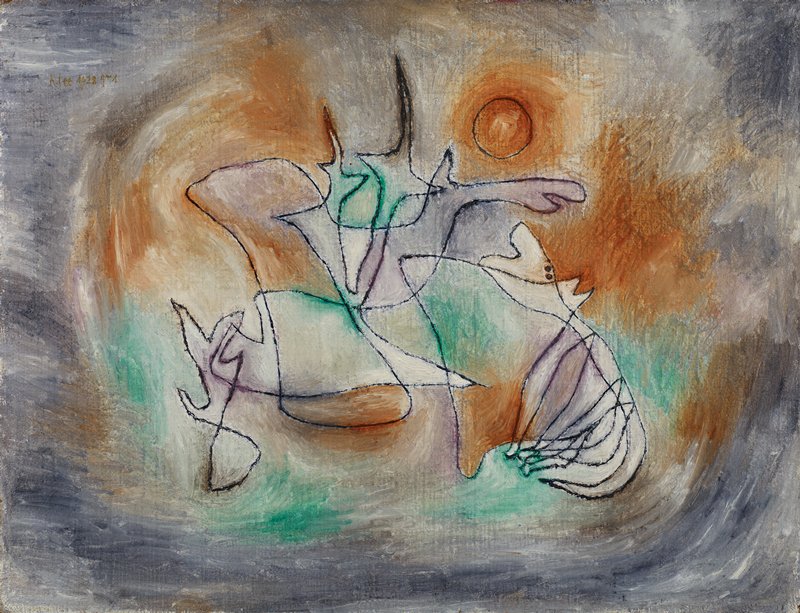
Fleeing Ghost
Kan ik het zien?
Ja, nu te zien
Waar is „Fleeing Ghost” nu? Art Institute of Chicago, Zaal 393, Chicago. Ja, nu te zien. Gecontroleerd 16 november 2026.

Chicago, Verenigde Staten
Gesloten· gaat open om 11:00
Publiek tentoongesteld.
- Gecontroleerd
- Ongewijzigd sinds
- Bron
- Het museum
Over het schilderij
Paul Klee’s artistic skills were diverse: he was a painter, printmaker, critic, and theoretician. He taught at the Bauhaus for most of the famed school’s existence; initially head of the bookbinding department, he also supervised the glass-painting workshop. His greatest influence, however, was as a lecturer for the basic design course on the theory of form in art. In lectures, Klee developed his ideas about the "polyphony" of painting, which was based on his interest in simultaneous sensational effects that could be created by various layered formal elements. He believed that this type of creative experimentation could "issue forth a transformed beholder of art" and thus pave the way for total abstraction.
Art Institute of ChicagoCC BY 4.0
Gegevens
- Inventarisnummer
- 1991.1500
In de catalogus
Bronnen
- Art Institute of Chicago
- Afbeelding: Art Institute of Chicago — © the artist or rights holder
In het leven van Paul Klee
Het hele leven1921–1931
The preliminary course on the “theory of form”
Klee developed a preliminary course in the “theory of form” that began with the “point as the beginning of all beginnings”, moving through space, and the “cosmic egg” from which line, spiral, square, circle and cube are born. Students listened to lectures illustrated with Klee’s own abstract watercolours and then painted their own, trying to express movement, balance, flight and tension.
1928–1929
A journey to Egypt
Egypt impressed Klee less than Tunisia, yet in the desert he felt an almost mystical bond with the land: he was drawn to the proportions of the ancient funerary monuments and to the esoteric numerology by which they were built. His later “Ad Parnassum” was influenced by the trip.
1929
The first major monograph on Klee
In 1929 the first major monograph on Klee’s work was published; it was written by Will Grohmann, a confidant of the artist.
1931
Leaving the Bauhaus for the Düsseldorf Academy
Teaching at the Bauhaus shifted ever more from painting towards an architectural aesthetic, which no longer suited Klee: in 1931 he gave up his post there and became a professor at the Düsseldorf Academy of Art.