Fernand LégerFrancia, 1881–1955
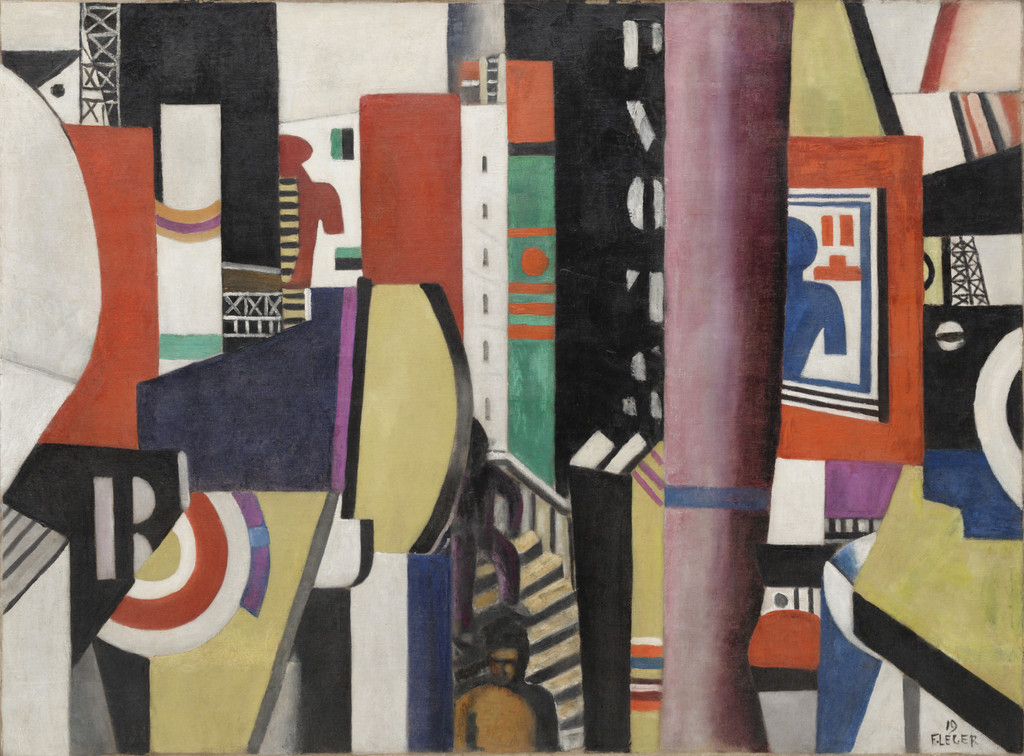
The Railway Crossing (Sketch)
Si può vedere?
Non esposta al momento
Dove si trova «The Railway Crossing (Sketch)» oggi? Collezione: Art Institute of Chicago, Chicago. Non esposta al momento. Verificato 12 ottobre 2026.

Chicago, Stati Uniti
Appartiene alla collezione, ma al momento non è esposta.
- Verificato
- Ultimo cambio di stato
- Fonte
- Il museo
Sul dipinto
Fernand Léger first saw the work of Georges Braque and Pablo Picasso at the Paris gallery of Daniel-Henry Kahnweiler. Around 1909 Léger began to paint in a Cubist style, although his compositions in this mode are more colorful and curvilinear than works by Braque and Picasso of the same period, with their angular forms and subdued tones. An artist with far-ranging interests and talents, Léger later became a designer for theater, opera, and ballet, as well as a book illustrator, filmmaker, muralist, ceramist, and teacher.
Leggi
Typically, Léger would develop a major composition by preparing studies in a variety of media. The Railway Crossing is an oil study for The Level Crossing (1919; private collection, Basel, Switzerland). When he took up this subject in 1919, he made a number of drawings and oil sketches, including the present work. Like many of his contemporaries, Léger was fascinated by the machine age. He maintained that machines and industrial objects were as important to his art as figures. References to such elements pervade The Railway Crossing. In the midst of a complex scaffolding of cylinders and beams, an arrow appears on a brightly outlined signboard. A network of solid volumes and flat forms seems to circulate within the shallow space, just as pistons move within a motor. The precise definition of his forms and the brilliance of his palette express Léger’s belief that the machine, along with the age it created, was one of the triumphs of modern civilization.
— Entry, Master Paintings in the Art Institute of Chicago, 2013, p. 118.
This is one of thirty-five works that comprise the Winterbotham Collection. Click here to learn more about the collection.
Art Institute of ChicagoCC BY 4.0
Scheda
- Numero di inventario
- 1953.341
Che cosa raffigura
In catalogo
Fonti
- Art Institute of Chicago
- Immagine: Art Institute of Chicago — © the artist or rights holder
Nella vita di Fernand Léger
Tutta la vitaDecember 1919
Marriage to Jeanne Lohy
In December 1919 Léger marries Jeanne-Augustine Lohy; she remains his wife until her death in 1950.
1920
Friendship with Le Corbusier, “The Mechanic” and “The Great Lunch”
In 1920, at the founding of the journal “L'Esprit nouveau”, Léger befriends Le Corbusier, who remains a lifelong friend. In the same year he paints the canvases “The Mechanic” and “The Great Lunch”, and from this year he exhibits at the Indépendants for many years.
1921
Meeting van Doesburg and Mondrian
In 1921 Léger meets van Doesburg and Mondrian.
1921
Gance's “La Roue” and Malraux's “Lunes en papier”
In 1921, together with Blaise Cendrars, Léger works on Abel Gance's film “La Roue” and illustrates André Malraux's book “Lunes en papier”. He is so drawn to cinema that he considers for a time giving up painting for filmmaking.