Charles DemuthStati Uniti, 1883–1935
Spring
Si può vedere?
Non esposta al momento
Dove si trova «Spring» oggi? Collezione: Art Institute of Chicago, Chicago. Non esposta al momento. Verificato 16 novembre 2026.

Chicago, Stati Uniti
Appartiene alla collezione, ma al momento non è esposta.
- Verificato
- Ultimo cambio di stato
- Fonte
- Il museo
Sul dipinto
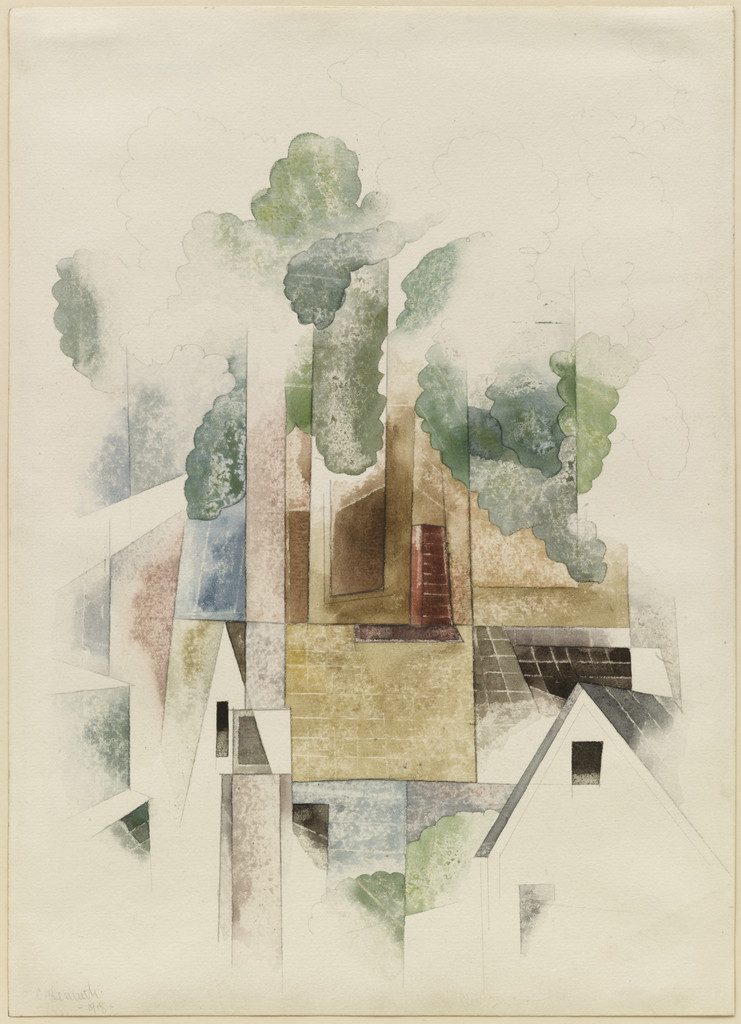
Charles Demuth’s Spring, painted in 1921, is in the Art Institute of Chicago, Chicago. Sample cards advertising new seasonal fabrics supply the subject. Their overlapping planes imitate collage while preserving the canvas’s flat surface, following Synthetic Cubism. Demuth had seen examples in New York and Paris but tried the method only here. The title gives the commercial subject a seasonal meaning: changing weather is announced through new merchandise instead of nature. Pablo Picasso had been the first to develop this method of making a painted collage.
Con le parole del museo
In Spring Charles Demuth depicted the sample cards used to advertise new spring fabrics. Pablo Picasso was the first to create such painted collages—a practice called Synthetic Cubism. Although Demuth saw examples of the style in both New York and Paris, he only experimented with it once, in this work. Here his subject allowed him to construct the ideal modernist painting by using overlapping planes that remain faithful to the canvas’s inherent flatness. However, the sample cards also connect his picture to everyday concerns. By titling his painting Spring, Demuth wryly highlighted the new reality of American life, in which the changing of seasons was heralded not by nature but by commerce.
Art Institute of ChicagoCC BY 4.0
Scheda
- Numero di inventario
- 1989.231
In catalogo
Fonti
- Art Institute of Chicago
- Immagine: Art Institute of Chicago — © the artist or rights holder
Nella vita di Charles Demuth
Tutta la vita1907–1921
Encounters modernism on trips to Europe
On trips to Europe between 1907 and 1921 he is introduced to modernism; in Paris he studies at the Académie Colarossi and the Académie Julian and joins the avant-garde scene, where his homosexuality is accepted. Before that he had studied in Philadelphia, at the Pennsylvania Academy of the Fine Arts under Thomas Anshutz, where he befriended the future poet William Carlos Williams — the two remained close for life.
1907–1921
Meets Hartley, and through him Stieglitz
In Paris he walks up to a table of American artists and asks to join them, and so meets Marsden Hartley; his humour, rich in double entendres, makes him a regular member of their group. Through Hartley he meets Alfred Stieglitz and joins the Stieglitz group; he is also a regular guest at Gertrude Stein’s salon.
by 1920
Diabetes drains his creative energy
By 1920 diabetes has begun to severely drain his artistic energy. He will be one of the first people in the United States to receive insulin, but complications of diabetes will cause his death in 1935.