Vincent van GoghPaesi Bassi, 1853–1890
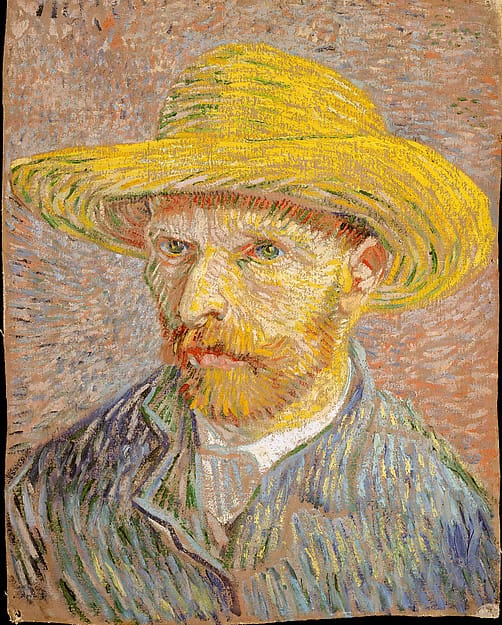
Self-Portrait
Si può vedere?
Sì, esposta ora
Dove si trova «Self-Portrait» oggi? Art Institute of Chicago, Sala 241, Chicago. Sì, esposta ora. Verificato 23 novembre 2026.

Chicago, Stati Uniti
Aperto· fino alle 20:00
Esposta al pubblico.
- Verificato
- Ultimo cambio di stato
- Fonte
- Il museo
Sul dipinto
Vincent van Gogh painted Self-Portrait in 1887; it is in the Art Institute of Chicago, Chicago. This small image was made on prepared board during his two years in Paris, when he produced at least twenty-four self-portraits. Closely dabbed green, blue, red and orange marks respond to Seurat's Pointillism but serve a more emotional expression. The artist's dark green eyes dominate the patterned surface. He had moved to Paris in 1886, where his brother Theo dealt in paintings. The portrait is displayed in gallery 241.
Con le parole del museo
In 1886 Vincent van Gogh left his native Holland and settled in Paris, where his beloved brother Theo was a dealer in paintings. Van Gogh created at least twenty-four self-portraits during his two-year stay in the energetic French capital. This early example is modest in size and was painted on prepared artist’s board rather than canvas. Its densely dabbed brushwork, which became a hallmark of Van Gogh’s style, reflects the artist’s response to Georges Seurat’s revolutionary pointillist technique in A Sunday on La Grande Jatte—1884. But what was for Seurat a method based on the cool objectivity of science became in Van Gogh’s hands an intense emotional language. The surface of the painting dances with particles of color—intense greens, blues, reds, and oranges.
Leggi
Dominating this dazzling array of staccato dots and dashes are the artist’s deep green eyes and the intensity of their gaze. “I prefer painting people’s eyes to cathedrals,” Van Gogh once wrote to Theo. “However solemn and imposing the latter may be—a human soul, be it that of a poor streetwalker, is more interesting to me.” From Paris, Van Gogh traveled to the southern town of Arles for fifteen months. At the time of his death, in 1890, he had actively pursued his art for only five years.
This is one of thirty-five works that comprise the Winterbotham Collection. Click here to learn more about the collection.
Art Institute of ChicagoCC BY 4.0
Scheda
Che cosa raffigura
In catalogo
Fonti
- Art Institute of Chicago
- Immagine: Wikimedia Commons — Public domain (PD-Art)
Nella vita di Vincent van Gogh
Tutta la vita1886
Si trasferisce a Parigi dal fratello Theo
Van Gogh lasciò Anversa per raggiungere a Parigi il fratello Theo, mercante d'arte. Cominciò così un periodo parigino molto fecondo e intenso: vi dipinse circa duecentotrenta quadri, più che in qualsiasi altro luogo.
1887
L'amicizia con Paul Gauguin
Theo e Vincent strinsero amicizia con Paul Gauguin, appena arrivato a Parigi.
1888
Ad Arles, sognando uno «Studio del Sud»
Il pubblico ancora non accettava né comprava i suoi dipinti e nel febbraio 1888 Van Gogh partì per Arles, nel sud della Francia, per fondare uno «Studio del Sud», una confraternita di artisti affini in cui diede a Gauguin il ruolo guida. Theo sostenne il piano con denaro.
23 October 1888
Gauguin arriva ad Arles
Dopo molte suppliche Gauguin arrivò ad Arles e a novembre i due dipinsero insieme: Gauguin ritrasse Van Gogh ne «Il pittore di girasoli» e la loro prima uscita comune fu agli Alyscamps. Su suggerimento di Gauguin Vincent dipinse a memoria, realizzando «Ricordo del giardino a Etten».
23 December 1888
L'orecchio tagliato
Dopo un alterco la sera del 23 dicembre, Van Gogh, che sembrava sentire voci, si tagliò l'orecchio sinistro, in tutto o in parte, con un rasoio e lo consegnò, avvolto in carta, a una donna in un bordello. La mattina dopo un poliziotto lo trovò privo di sensi; in ospedale gli fu diagnosticata una «mania acuta con delirio generalizzato».
1889
Volontariamente nel manicomio di Saint-Paul
Van Gogh lasciò Arles ed entrò volontariamente nel manicomio di Saint-Paul-de-Mausole, ex monastero a Saint-Rémy-de-Provence, accompagnato dal pastore protestante Frédéric Salles. Delle sue due celle con finestre sbarrate una divenne studio, e la clinica e il suo giardino divennero i principali soggetti dei suoi dipinti.