Jasper JohnsStati Uniti, 1930
Perilous Night
Si può vedere?
Non esposta al momento
Dove si trova «Perilous Night» oggi? Collezione: Art Institute of Chicago, Chicago. Non esposta al momento. Verificato 23 novembre 2026.

Chicago, Stati Uniti
Appartiene alla collezione, ma al momento non è esposta.
- Verificato
- Ultimo cambio di stato
- Fonte
- Il museo
Sull’opera
Jasper Johns began his career in the mid-1950s by re-creating, with great precision, such familiar images as targets, letters, numbers, and flags. Although his subject matter has become less commonplace, he continues to “borrow” from the public domain. Perilous Night, for instance, owes its title to a pivotal and expressive piece of music written by the American composer John Cage (1912–1992) in 1945. Both score and cover sheet are rendered on the right-hand side of the drawing with Johns’s characteristically fluid handling of ink. On the sheet’s left side is a freehand rendition—abstracted, reversed, and turned ninety degrees—of a single, terror-stricken soldier from the Resurrection panel of Matthias Grünewald’s sixteenth-century masterwork the Isenheim Altarpiece (Unterlinden Museum, Colmar).
Leggi
Between the soldier and the musical score is a black imprint of Johns’s right arm, evidence perhaps of the creative power that can merge two disparate images into a cogent statement. The overcome soldier witnessing the Resurrection of Christ and a piece of music marking a key transition in a composer’s career both point to “perilous nights” that can change the course of a human life. Characteristically, Johns also explored the same subject in different media. This somberly colored drawing derives from a painting of the same name (1982; National Gallery of Art, Washington, DC).
Art Institute of ChicagoCC BY 4.0
Scheda
- Numero di inventario
- 1989.82
Che cosa raffigura
In catalogo
Fonti
- Art Institute of Chicago
- Immagine: Art Institute of Chicago — © the artist or rights holder
Nella vita di Jasper Johns
Tutta la vita1967–1980
Consulente artistico della Merce Cunningham Dance Company
Johns sostenne a lungo la Merce Cunningham Dance Company, contribuendo a raccogliere fondi e attenzione e aiutando Rauschenberg con scene e costumi negli anni Cinquanta, e dal 1967 al 1980 ne fu consulente artistico.
1973–1987
Una fattoria con studio a pareti di vetro a Stony Point
Dal 1973 al 1987 Johns tenne una fattoria rustica degli anni Trenta con uno studio a pareti di vetro a Stony Point, New York.
1980
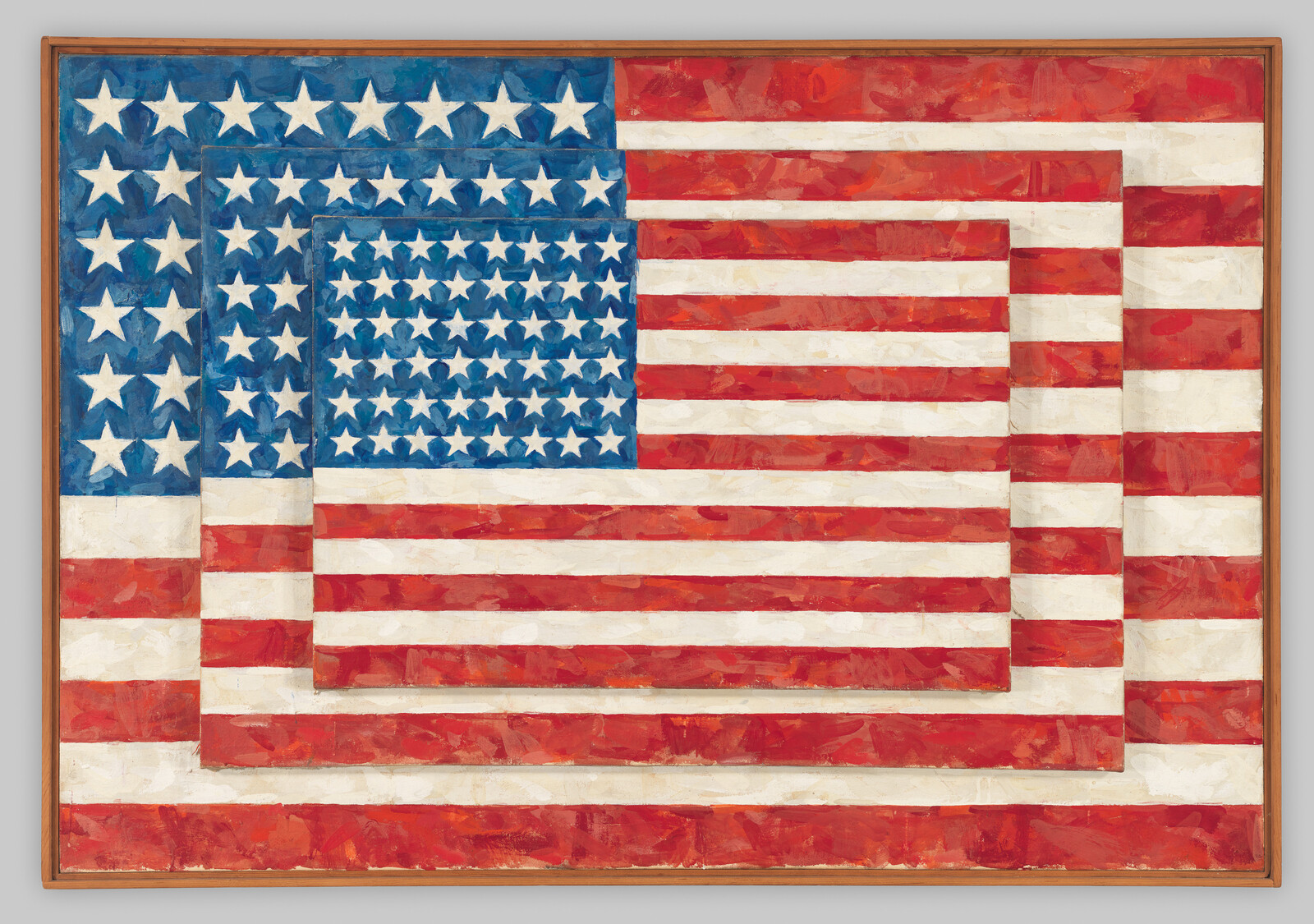
Il Whitney acquista «Three Flags» per un milione di dollari
Nel 1980 il Whitney Museum of American Art pagò un milione di dollari per Three Flags (1958), allora il prezzo più alto mai pagato per l'opera di un artista vivente.