Andrea del SartoItalia, 1486–1530
Domenico da Gambassi
Si può vedere?
Sì, esposta ora
Dove si trova «Domenico da Gambassi» oggi? Art Institute of Chicago, Sala 205, Chicago. Sì, esposta ora. Verificato 29 settembre 2026.

Chicago, Stati Uniti
Chiuso· apre alle 11:00
Esposta al pubblico.
- Verificato
- Ultimo cambio di stato
- Fonte
- Il museo
Sul dipinto
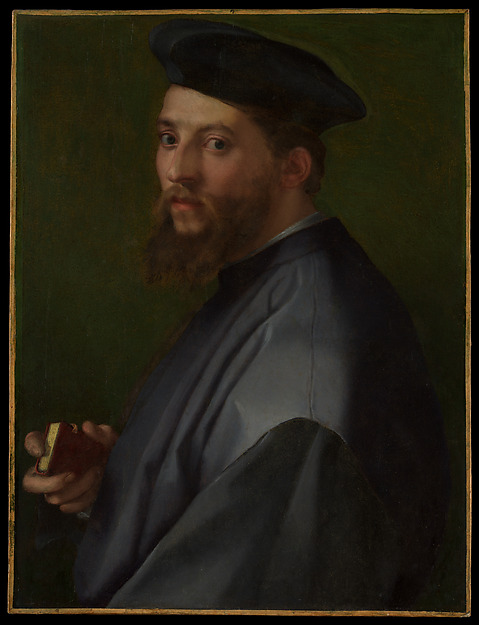
Il Ritratto di Becuccio Bicchieraio (o Ritratto di Domenico da Gambassi) è un'opera a olio su tavola dell'artista italiano Andrea del Sarto, verosimilmente parte della perduta predella della Pala di Gambassi, insieme al ritratto di sua moglie. Oggi l'opera è custodita, insieme al suo pendant, nella Art Institute of Chicago (Stati Uniti d'America).
Con le parole del museo
This casually posed and loosely rendered portrait originally made up part of the lower section, or predella, of an altarpiece for a church in Gambassi, near Florence. The images of the patron, Domenico, and his wife, Lucrezia, flanked additional, now-lost paintings. The painted strapwork around the portraits, discovered during recent conservation treatment, once formed part of a decorative pattern that would have extended throughout the predella; it indicates how all the individual paintings were interconnected. Andrea del Sarto added highlights at the bottom of each roundel, mimicking the natural light of the church, to create the illusion of the paintings being set within a three-dimensional frame.
Art Institute of ChicagoCC BY 4.0
Scheda
- Numero di inventario
- 1964.1097a
Che cosa raffigura
In catalogo
Fonti
- Art Institute of Chicago
- Immagine: Art Institute of Chicago — CC0
Nella vita di Andrea del Sarto
Tutta la vitaby 1523
Prosperity: pupils, servants and unprofitable commissions
By 1523 Andrea has improved his finances so far that he keeps not only pupils but servants as well and can afford to take on commissions that promise no income.
1523–1524
The plague: flight to the Mugello valley
The plague epidemic of 1523–1524 forces Andrea and his wife to flee Florence and take refuge in the countryside of the Mugello valley. There in 1524 he paints for the convent of St Peter an “Entombment” (now in the Pitti Gallery): the composition seems borrowed from Fra Bartolomeo and the poses are theatrical, but the soft shadows, highlights and saturated colours are an achievement.
1524
Michelangelo brings the young Vasari to him
Michelangelo, who is said to have thought very highly of Andrea’s talents, introduces the thirteen-year-old Giorgio Vasari to Andrea’s studio in 1524; Vasari later becomes his pupil. In his “Lives” Vasari is highly critical of his teacher, alleging that although Andrea had all the prerequisites of a great artist he lacked ambition and the divine fire of inspiration that animated Leonardo, Michelangelo and Raphael.
1527
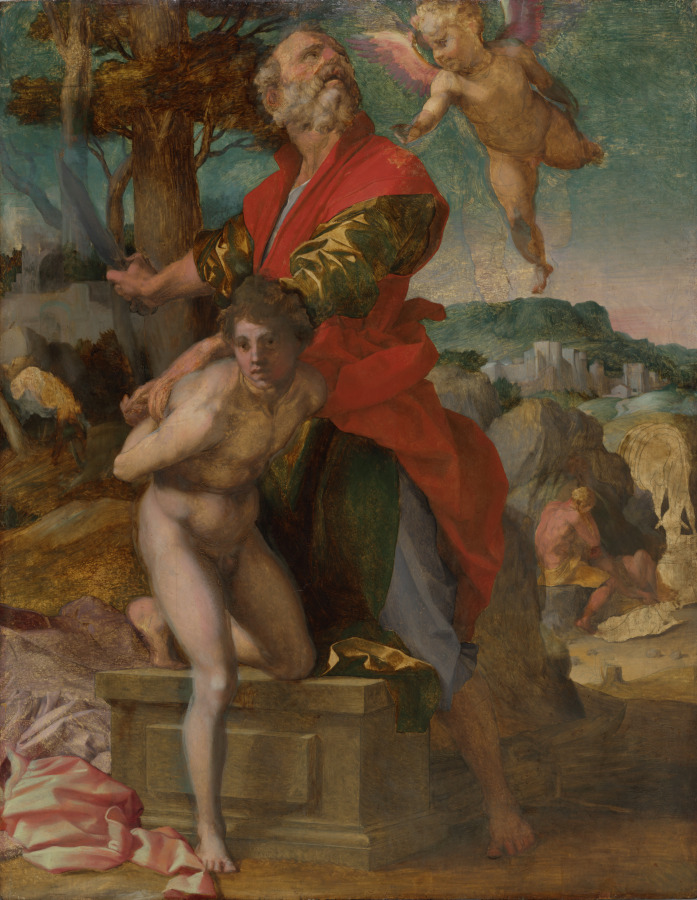
The expulsion of the Medici and the “Sacrifice of Isaac”
After the Medici family is expelled from Florence once again in 1527, Andrea goes on working on commissions from the Signoria; at that time he paints the “Sacrifice of Isaac”, intended as a gift to the French king François I.