Piet MondrianPaesi Bassi, 1872–1944
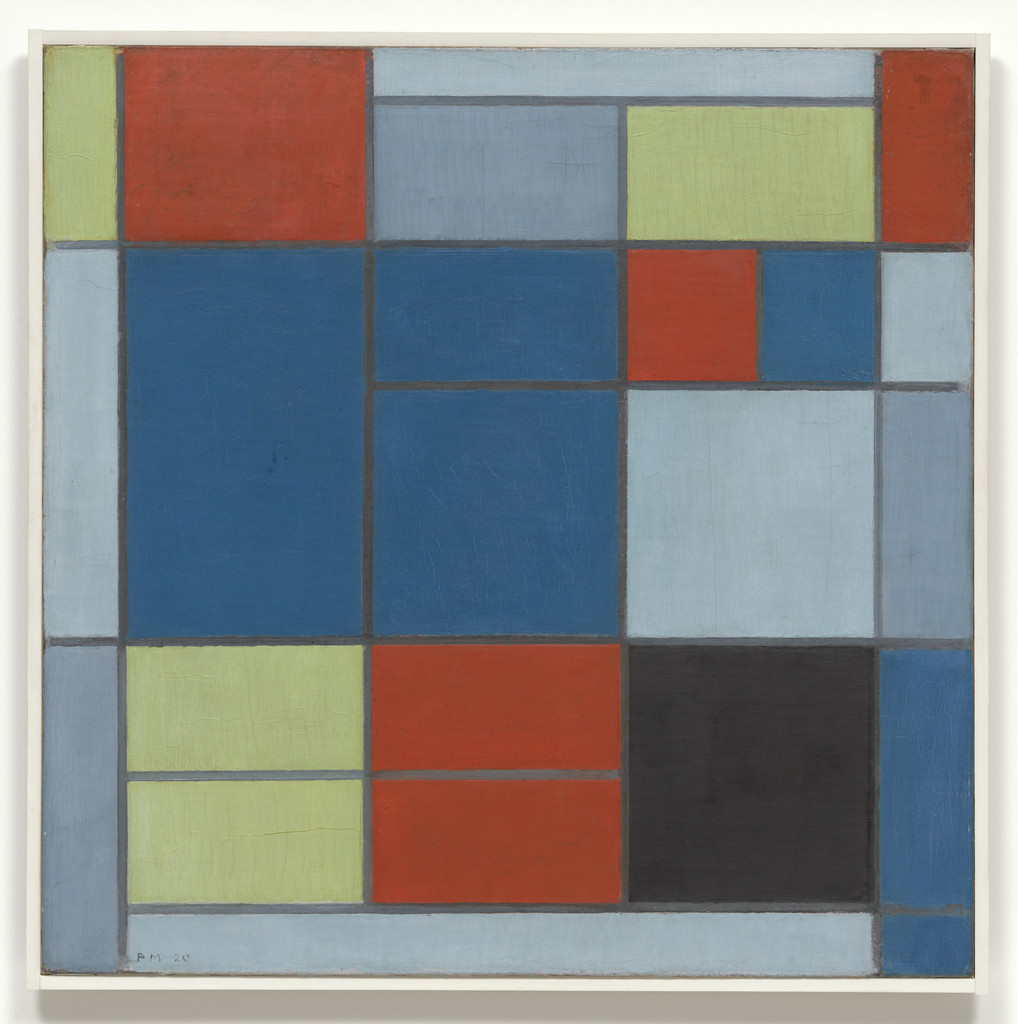
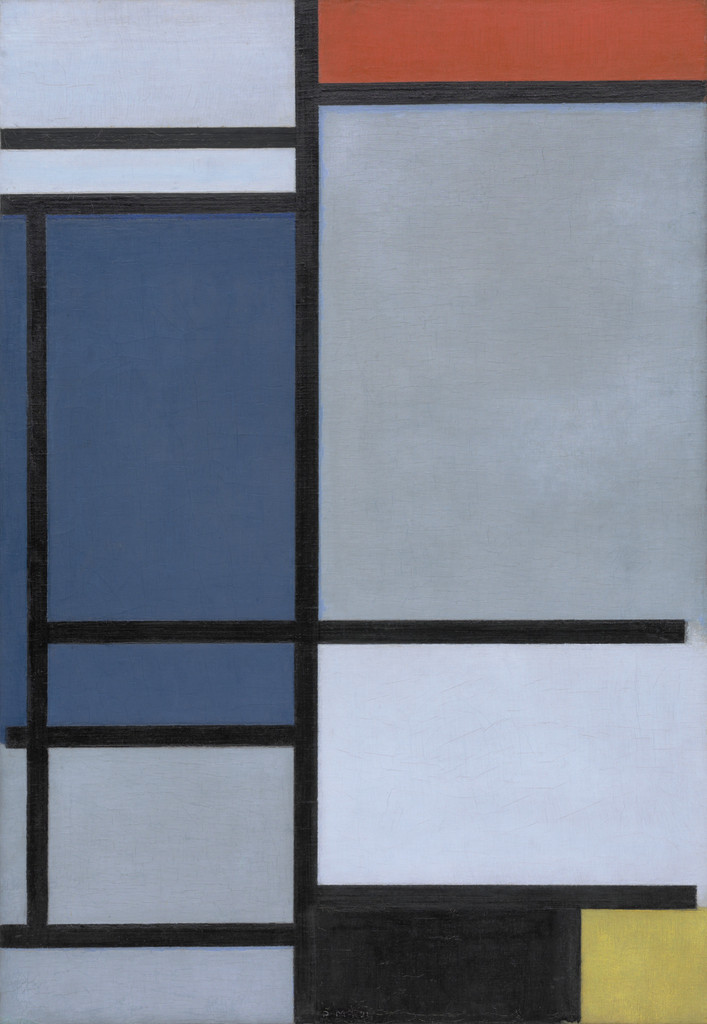
Composition with Blue, Black, Yellow, and Red
Si può vedere?
Sì, esposta ora
Dove si trova «Composition with Blue, Black, Yellow, and Red» oggi? Harvard Art Museums, Gallery 1520, floor 1, Modern and Contemporary Art, Cambridge. Sì, esposta ora. Verificato 29 settembre 2026.

Esposta al pubblico.
- Verificato
- Ultimo cambio di stato
- Fonte
- Il museo
Sul dipinto
Mondrian’s adherence to the aesthetic theories of neoplasticism, a utopian approach that ascribes the power of spiritual progress and social change to geometric abstract painting, restricted him to the most basic artistic elements — horizontal and vertical lines — and to primary colors along with white, black, and gray. From these limited means, the Dutch artist and principal member of the de Stijl movement created works that carefully balanced each line and field of color to achieve a harmonious composition. In this painting brushed fields of soft gray and primary color contrast with the glossy varnished black lines. The fact that none of the lines extends completely across the picture lends the composition a sense of harnessed dynamism. Although Mondrian was never officially affiliated with the Bauhaus, he was an important part of its broader network. In 1925 his influential theories on design became the subject of the fifth volume in the school’s Bauhaus Books series.
Harvard Art Museums
Scheda
- Numero di inventario
- 2000.1
In catalogo
Fonti
- Harvard Art Museums
- Immagine: Wikimedia Commons — Public domain
Nella vita di Piet Mondrian
Tutta la vita1918–1921
Theosophical declarations of 1918 and 1921
In 1918 Mondrian wrote that he had got everything from Blavatsky's “Secret Doctrine”, and in a letter to Rudolf Steiner in 1921 he argued that Neoplasticism was the art of the foreseeable future for all true Anthroposophists and Theosophists.
1919–1920
The first grid paintings
From late 1919 Mondrian produced grid-based paintings, and in 1920 the style for which he became renowned began to appear: at first thin grey lines fading towards the edges of the canvas, with the forms filled with primary colours.
1919–1938
Return to Paris
In 1919 Mondrian left the Netherlands for Paris for the second and last time and at once turned to his studio: to hide its flaws he tacked large single-colour placards to the walls, accented by compositions of smaller coloured paper rectangles. From then on, periods of painting alternated with experiments in regrouping the papers on the walls.
1920
Translations of “Neoplasticism”: French and Polish
In 1920 his text was translated into French and published as “Le Néoplasticisme”; in letters of late 1926 and early 1927 Mondrian mentioned several times that he was busy laying out a Polish translation, prepared with Polish avant-garde artists, for which Henryk Stażewski designed the cover.
1920–1921
The mature manner: thick black lines
In late 1920 and 1921 Mondrian's paintings reached what casual observers take for their definitive form: thick black lines separating larger and fewer forms, more and more of which are left white.