 Marcel DuchampFrancia, 1887–1968
Ruota di bicicletta
Bicycle Wheel
Si può ammirare?
Al momento non riceve

Museum of Modern Art
New York, Stati Uniti
Appartiene alla collezione, ma al momento non è esposta.
- Verificato
- 12 giorni fa
- Fonte
- I dati di collezione del museo stesso
About the sculpture
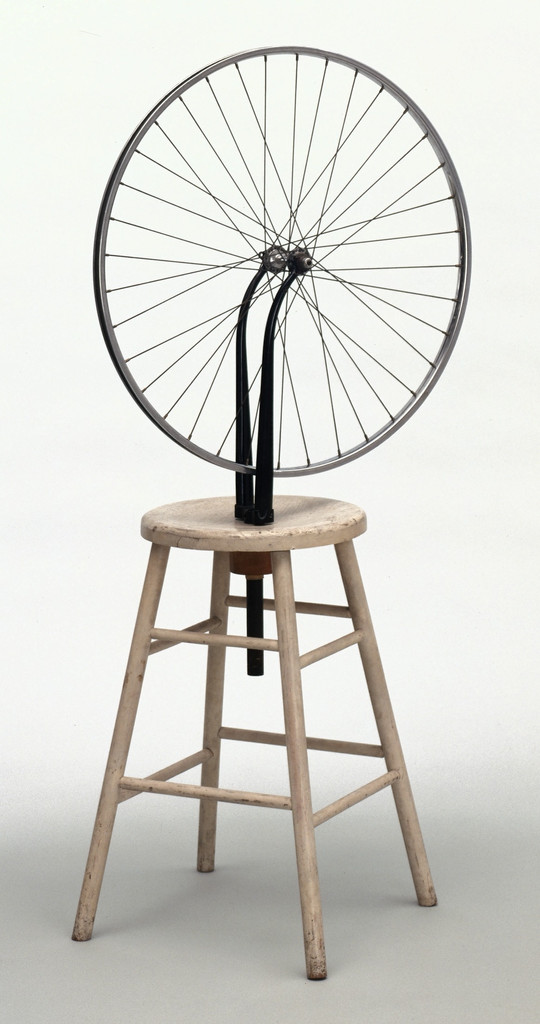
Ruota di bicicletta (titolo originale Roue de bicyclette, noto anche in inglese come Bicycle Wheel) è un'opera realizzata dallo scultore dadaista Marcel Duchamp nel 1913 a New York; è composta da una ruota di bicicletta, fissata su uno sgabello in legno per mezzo di una forcella.Viene considerata il primo esempio di ready-made, ovvero oggetti di uso comune che, decontestualizzati, divengono opere d'arte. La prima versione dell'opera andò perduta quando la sorella dell'autore, Suzanne, mise ordine nel suo studio; ne venne realizzata una replica del 1951 esposta poi a New York nel Museum of Modern Art.
Una replica venne realizzata dalla Galleria Schwarz di Milano sotto la supervisione di Duchamp nel 1964 che poi venne acquisita dal museo Pompidou nel 1986.
Scheda
- Numero di inventario
- 595.1967.a-b
Fonti
- Museum of Modern Art: the museum's own open data · acquisita 12 giorni fa
- Immagine: Museum of Modern Art — © the artist or rights holder
Nel frattempo, nella vita di Marcel Duchamp
Tutta la vita1912
Takes the “Nude” back from the Salon des Indépendants
Through Duchamp’s brothers, Albert Gleizes asked him to withdraw the painting or at least rename it (as Duchamp later told it); he quietly refused, but went straight to the show and took the canvas home by taxi. “It was really a turning point in my life,” he recalled, adding that after this he would not be very much interested in groups.
novembre 1912 · Formazione
École des chartes
1913
The Armory Show: the scandal of the “Nude”
At the first major exhibition in New York of the modern trends coming out of Paris, American viewers accustomed to realistic art were scandalised and the Nude stood at the centre of the controversy; it helped secure the sale of all four of Duchamp’s paintings in the show.
1915
Emigration to the United States
When the First World War began, Duchamp, exempted from service because of a heart murmur, felt uncomfortable in Paris, and the sale of all four of his paintings at the Armory Show let him finance the trip: in 1915 he left for New York. To his surprise he found himself a celebrity there and quickly befriended the patron Katherine Dreier and the artist Man Ray.
1917
“Fountain” rejected by the Independents’ show
A urinal signed with the pseudonym “R. Mutt” was submitted to the exhibition of the Society of Independent Artists, which displayed everything submitted without a jury; the committee insisted that it was not art and rejected it. The Dadaists were outraged and Duchamp resigned from the Society’s board.
1923
Back in Paris, and into chess
Back in Paris in 1923 he was in essence no longer a practising artist: his main interest became chess, which he studied for the rest of his life to the exclusion of most other activities.