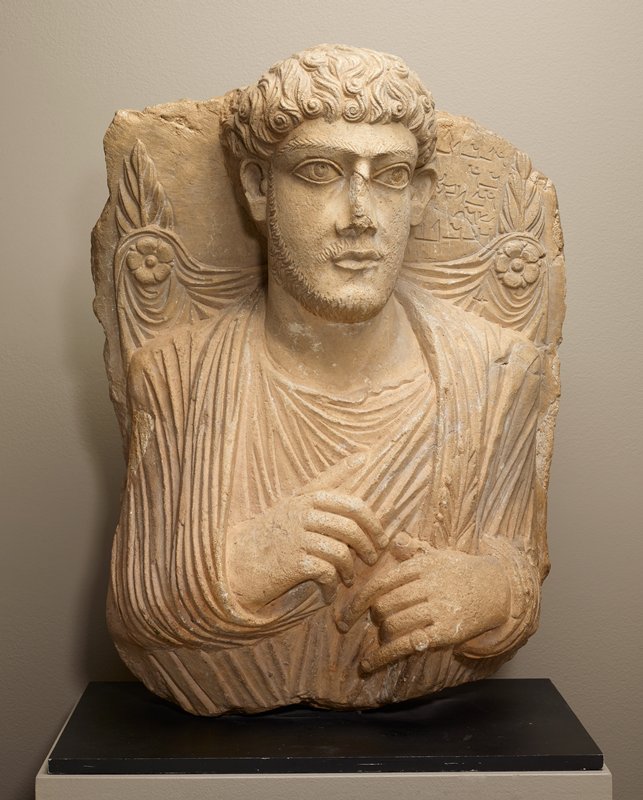
Funerary Relief
Peut-on la contempler ?
Elle ne reçoit pas en ce moment

Minneapolis, États-Unis
Elle appartient à la collection, mais n’est pas présentée en ce moment.
- Vérifié
- Dans cet état depuis
- Source
- Le musée
À propos de la sculpture
Palmyra, an oasis city in the Syrian Desert, was located on a section of the Silk Route, one of the great trade routes connecting Europe and Asia. In about 30 CE, Palmyra came under Roman control as part of the province of Syria and became a wealthy and significant city.
Many of the surviving sculptures from ancient Palmyra are funerary reliefs. Collective underground tombs were laid out in deep burial niches, called loculi, dug deep into the high sidewalls. Each niche was sealed with a stone carved in high relief with a bust of the deceased, sometimes carved against a curtained background. The figure's eyes are prominent, and the features are strictly regular.
Lire la suite
Reliefs like this one, with a background curtain and palm fronds, are found in examples dating from at least the late 2nd century. The rigidly frontal presentation also has a religious meaning, alluding to the experience of ecstatic vision or the participation in the afterlife.
Minneapolis Institute of Art
Notice
- Numéro d’inventaire
- 2008.28.2
Au catalogue
Sources
- Minneapolis Institute of Art
- Image : Minneapolis Institute of Art — public domain