 Roy LichtensteinÉtats-Unis, 1923–1997
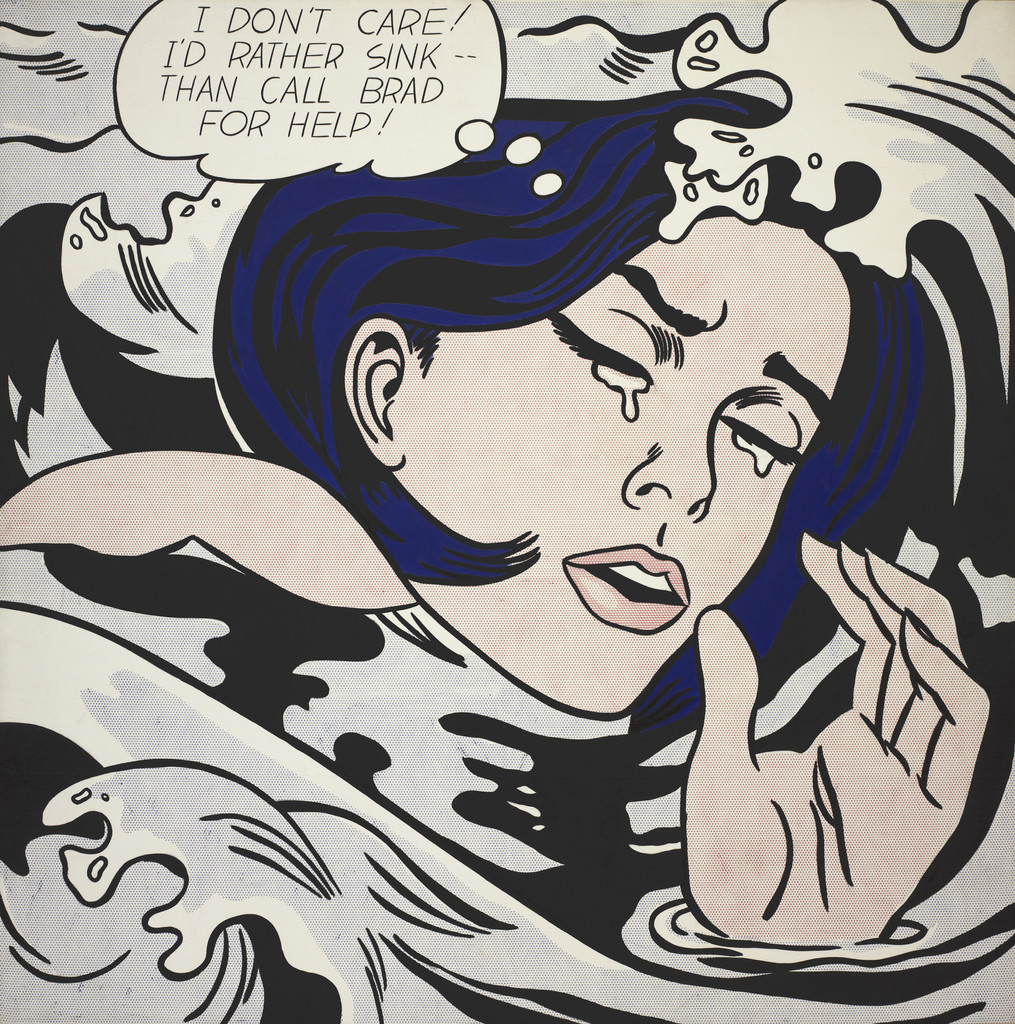
Drowning Girl
Peut-on la contempler ?
Elle ne reçoit pas en ce moment

New York, États-Unis
Elle appartient à la collection, mais n’est pas présentée en ce moment.
- Vérifié
- Source
- Le musée
À propos du tableau
Drowning Girl (aussi connu sous le nom de I Don't Care! I'd Rather Sink) est un tableau de Roy Lichtenstein de 1963, basé sur une œuvre originale de Tony Abruzzo. Le tableau est considéré comme l'une des principales œuvres de Roy Lichtenstein avec Look Mickey et Whaam!. Peinture représentative du mouvement pop art, Drowning Girl est acquise par le Museum of Modern Art de New York en 1971.
Utilisant la peinture à l'huile et la peinture acrylique sur toile, le tableau s'inspire d'une case d'une bande dessinée de DC Comics de 1962, dont il reprend les éléments graphiques et narratifs. On y trouve également des références à La Grande Vague de Kanagawa de Hokusai ainsi qu'aux peintres modernistes Jean Arp et Joan Miró. Son graphisme, utilisant notamment des points Benday, fait écho au thème de la reprographie cher à Roy Lichtenstein.
Lire plus
Drowning Girl présente une femme en pleurs dans une mer agitée. Reprenant les codes de la bande dessinée, un phylactère énonce: « I Don't Care! I'd Rather Sink — Than Call Brad For Help! » (en français: « Je m'en fiche ! Je préfère couler — plutôt que d'appeler Brad à l'aide ! »). Le tableau a été décrit comme un « chef-d’œuvre du mélodrame ». Il est l'une des premières œuvres de Roy Lichtenstein à dépeindre une femme dans une situation tragique, un thème récurrent pour l'artiste au milieu des années 1960. C'est également l'une des peintures de Roy Lichtenstein à mentionner un certain Brad, qui n'apparaît pas sur la toile.
Notice
- Numéro d’inventaire
- 685.1971
Au catalogue
Sources
- Museum of Modern Art
- Image : Museum of Modern Art — © the artist or rights holder
Pendant ce temps, chez Roy Lichtenstein
La vie entière1961
The turn to Pop Art: a challenge from his son
In 1961 Lichtenstein began his first Pop paintings, using cartoon images and techniques derived from commercial printing; the first work to use hard-edged figures and Ben-Day dots on a large scale was “Look Mickey”. The push came from his son, who, as the artist told it, pointed to a Mickey Mouse comic book and doubted that his father could paint as well.
1961
Leo Castelli begins showing his work
In 1961 Leo Castelli began displaying Lichtenstein’s work at his gallery in New York.
1962
The Castelli show sells out before it opens
Lichtenstein’s first one-man show at the Castelli gallery took place in 1962: the entire collection was bought by influential collectors before it even opened. The Leo Castelli Gallery has represented him exclusively since then.
1963–1964
Leaves Rutgers and returns to New York
In September 1963 Lichtenstein took a leave of absence from Douglass College at Rutgers; in 1964 he moved back to New York to be at the centre of the art scene and resigned from Rutgers to concentrate on his painting.
1964
The first American to exhibit at the Tate Gallery
Lichtenstein became the first American to exhibit at the Tate Gallery in London, in the show “’54–’64: Painting and Sculpture of a Decade”.
1964
Life magazine asks: “Is He the Worst Artist in the U.S.?”
When Lichtenstein’s work was first exhibited, many critics challenged its originality and called it vulgar and empty; a Life magazine article of 1964 was headed “Is He the Worst Artist in the U.S.?”. The artist replied that the closer his work is to the original, the more threatening and critical its content.


![Untitled [pyramid], Roy Lichtenstein, c. 1970](https://whitneymedia.org/assets/artwork/61776/2019_234_14_cropped.jpg)
![Untitled [pyramid], Roy Lichtenstein, c. 1970](https://whitneymedia.org/assets/artwork/61778/2019_234_16_cropped.jpg)
![Untitled [pyramid], Roy Lichtenstein, c. 1970](https://whitneymedia.org/assets/artwork/61777/2019_234_15_cropped.jpg)
![Untitled [pyramid], Roy Lichtenstein, c. 1970](https://whitneymedia.org/assets/artwork/61763/2019_234_1_cropped.jpg)