 Marcel DuchampFrancia, 1887–1968
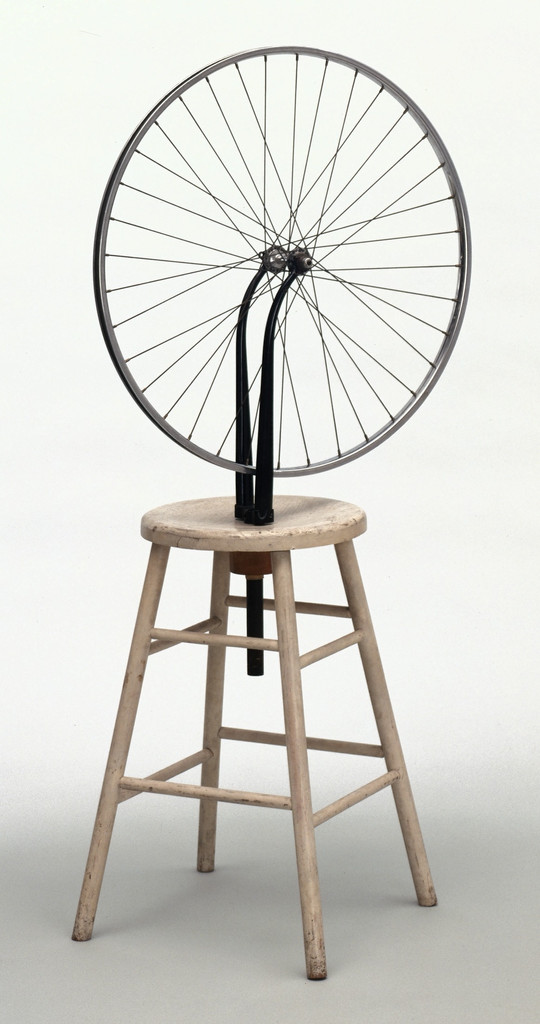
Rueda de bicicleta
Bicycle Wheel
¿Se puede contemplar?
Por ahora no recibe

MoMA
Nueva York, Estados Unidos
Pertenece a la colección, pero ahora mismo no está expuesta.
- Comprobado
- hace 12 días
- Fuente
- Los datos de colección del propio museo
About the sculpture
d (originalmente en francés, Roue de bicyclette) es un objeto de arte encontrado del artista francés Marcelino Duchamp, que consiste en una rueda de bicicleta en su horquilla sobre un taburete de madera.
En 1913, en su estudio en París, él montó la rueda invertida verticalmente (es decir, la parte que tradicionalmente va arriba hacia abajo, y viceversa) sobre un taburete alto de madera. Posteriormente, negó que su invención tuviera un propósito, aunque es conocida como la primera de sus obras de arte encontrado. “Disfruto mirándolas”, afirmó. “Tanto como disfruto al ver el movimiento del fuego en la chimenea”. No fue hasta que comenzó a crear arte encontrado unos años después en Nueva York que decidió que la Rueda de bicicleta pertenecía a esta categoría; allí realizó la segunda versión.
Read on
La versión original de 1913 y la versión de 1916/1917 se perdieron. Duchamp recreó otra versión más en 1951. También se le atribuye a esta obra, ser la primera escultura cinética.
Ficha
- Número de inventario
- 595.1967.a-b
Fuentes
- MoMA: the museum's own open data · obtenido hace 12 días
- Imagen: MoMA — © the artist or rights holder
Mientras tanto, en la vida de Marcel Duchamp
La vida entera1912
Takes the “Nude” back from the Salon des Indépendants
Through Duchamp’s brothers, Albert Gleizes asked him to withdraw the painting or at least rename it (as Duchamp later told it); he quietly refused, but went straight to the show and took the canvas home by taxi. “It was really a turning point in my life,” he recalled, adding that after this he would not be very much interested in groups.
noviembre de 1912 · Formación
École des chartes
1913
The Armory Show: the scandal of the “Nude”
At the first major exhibition in New York of the modern trends coming out of Paris, American viewers accustomed to realistic art were scandalised and the Nude stood at the centre of the controversy; it helped secure the sale of all four of Duchamp’s paintings in the show.
1915
Emigration to the United States
When the First World War began, Duchamp, exempted from service because of a heart murmur, felt uncomfortable in Paris, and the sale of all four of his paintings at the Armory Show let him finance the trip: in 1915 he left for New York. To his surprise he found himself a celebrity there and quickly befriended the patron Katherine Dreier and the artist Man Ray.
1917
“Fountain” rejected by the Independents’ show
A urinal signed with the pseudonym “R. Mutt” was submitted to the exhibition of the Society of Independent Artists, which displayed everything submitted without a jury; the committee insisted that it was not art and rejected it. The Dadaists were outraged and Duchamp resigned from the Society’s board.
1923
Back in Paris, and into chess
Back in Paris in 1923 he was in essence no longer a practising artist: his main interest became chess, which he studied for the rest of his life to the exclusion of most other activities.