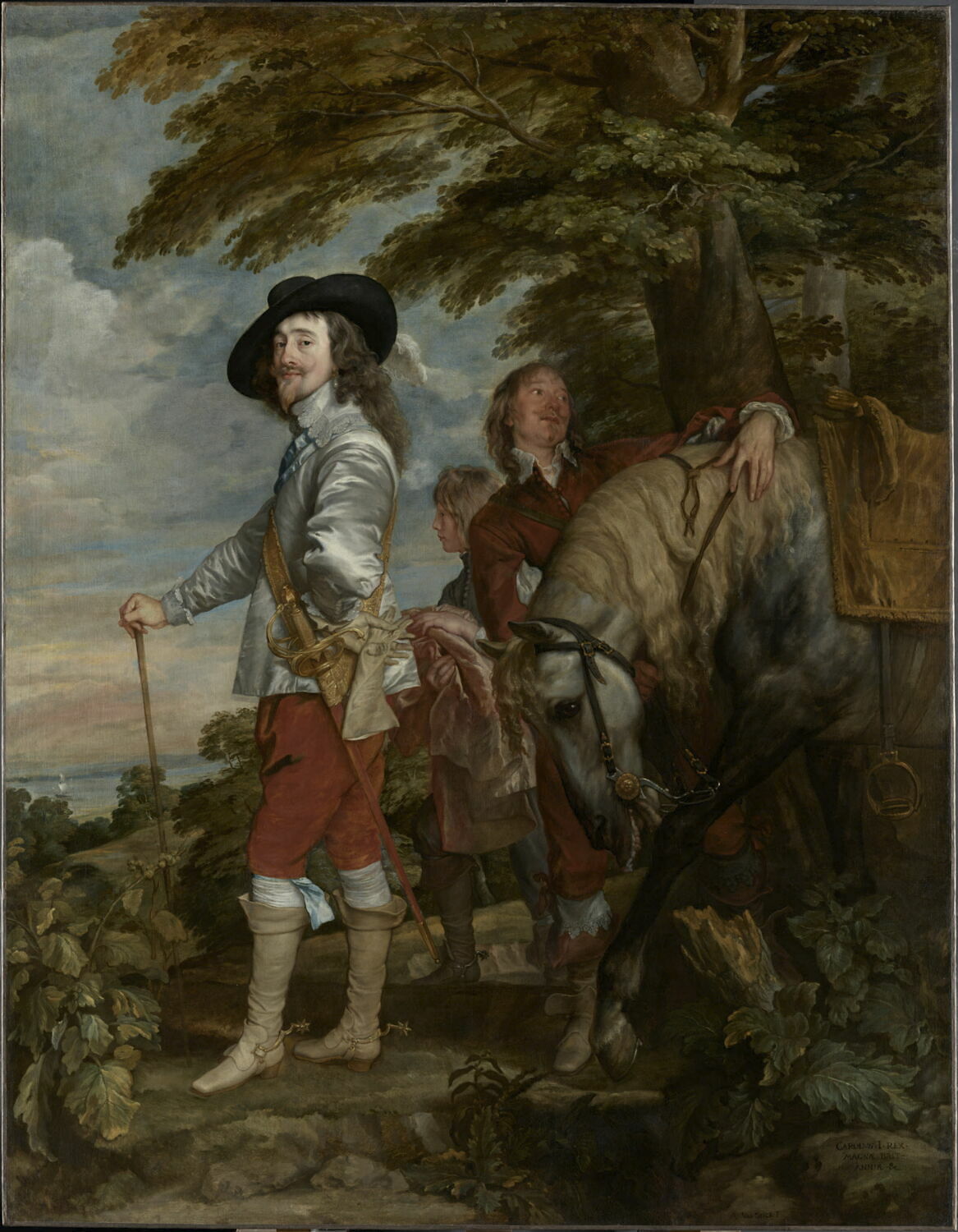
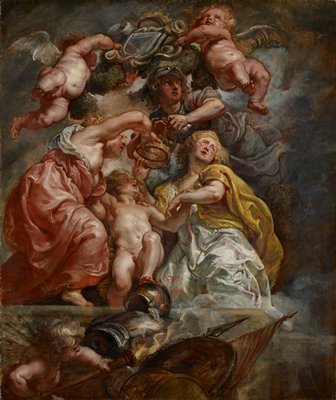
 Peter Paul RubensThe Union of England and Scotland (Charles I as the Prince of Wales)
Browse
Flemish painting
Flemish painting connects the crowded towns of the southern Netherlands with churches, merchants and courts far beyond them. Its range runs from Rogier van der Weyden’s compressed religious scenes to Rubens’s portraits and Van Dyck’s English kings. Look closely and a large public picture can reveal a very small private interest: the patrons of one altarpiece left their crossbows in its corners.
7,258 works from 202 museums1,446 on view nowClear all
Peter Paul RubensThe Union of England and Scotland (Charles I as the Prince of Wales) Anthony van DyckThe Betrayal of Christ
 Peter Paul RubensDaniel in the Lions' Den
 Peter Paul RubensThe Meeting of Abraham and Melchizedek
 Peter Paul RubensLandscape with a Rainbow
 Peter Paul RubensThe Union of Earth and Water (Antwerp and the Scheldt)
 Peter Paul RubensThe Feast of Herod
 Peter Paul RubensHagar Leaves the House of Abraham
 Peter Paul RubensMucius Scaevola before Lars Porsenna
 Peter Paul RubensCongratulations on the Arrival of Prince Ferdinand (Adventus Seren. Princ. Gratulatio)
 Peter Paul RubensVenus and Adonis (Rubens, 1614)
 Peter Paul RubensMercury Moving away (Mercurius Abituriens)
 Peter Paul RubensLion Hunt
 Peter Paul RubensBirth of the Dauphin
 Anthony van DyckPortrait of a Nobleman, possibly Adriaan van der Borcht
 Anthony van DyckLucas van Uffel (died 1637)
 Peter Paul RubensThe Fall of Phaeton
 Peter Paul RubensPortrait of Marchesa Brigida Spinola-Doria
 Peter Paul RubensCoronation and Assumption of the Virgin
 Peter Paul RubensTemple of Janus (Templum Jani)
 Peter Paul RubensAdoration of the Shepherds (Hermitage)
 Peter Paul RubensLandscape with Cymon and Iphigenia
 Peter Paul RubensStatue of Ferdinand II in a niche
 Peter Paul RubensPortrait of Charles de Longueval
 Peter Paul RubensUniting of Great Britain
 Peter Paul RubensRubens, Helena Fourment (1614–1673), and Their Son Frans (1633–1678)
 Peter Paul RubensDecius Mus Addressing the Legions
 Peter Paul RubensAgrippina and Germanicus
 Peter Paul RubensThe Meeting of David and Abigail
 Peter Paul RubensStatue of Ceres
 Peter Paul RubensPortrait of Lady-in-Waiting to the Infanta Isabella
 Peter Paul RubensArch of Hercules, the Right Side (Hercules Prodicius, pars anterior)
 Peter Paul RubensNessus and Dejanira
 Peter Paul RubensMarie de' Medici as Athena Pallas
 Peter Paul RubensFeast in the House of Simon the Pharisee
 Peter Paul RubensChrist Child Blessing
 Peter Paul RubensPerseus and Andromeda
 Anthony van DyckMaria Stuart en Willem II
 Anthony van DyckQueen Henrietta Maria
 Peter Paul RubensHead of One of the Three Kings: Melchior, The Assyrian King
 Peter Paul RubensCrown of Thorns
 Peter Paul RubensМужская голова в профиль
 Peter Paul RubensDeath of Henry IV and the Proclamation of the Regency
 Peter Paul RubensArch of Ferdinand, the Reverse Side (Arcus Ferdinandi, pars posterior)
 Peter Paul RubensArrival in Lyon
 Peter Paul RubensDescent from the Cross
 Peter Paul RubensVision of St Ildefonso
 Peter Paul RubensHead of an Old Woman
Flemish painting
A guild of crossbowmen wanted a painting for its chapel in Leuven. Rogier van der Weyden gave them a scene of almost unbearable closeness: Christ’s body has just been lowered from the cross, and his mother collapses beside him. Yet the guild also had a place in this sacred event. Tiny crossbows appear among the decorative tracery at the upper corners. The men who paid for the picture could recognise their own organisation before looking towards the grief at its centre.
Why does Flemish painting cross so many borders?
The label needs some flexibility. Rogier was born in Tournai and became the official painter of Brussels; Rubens and Van Dyck belong to the artistic history of Antwerp. These are connected histories rather than the boundaries of a present-day country neatly projected backwards. Rogier worked for the Burgundian dukes, and his paintings travelled to Spain. Van Dyck eventually made an English monarch his principal subject. A painting can be Flemish through its maker and training while serving ambitions formed somewhere else.

A crowd inside a shallow box
In The Descent from the Cross, in the Prado collection in Madrid, the figures seem packed into a shallow golden enclosure. Christ and the Virgin bend along related lines, bringing death and fainting into the same visual sentence. Almost life-size bodies make the restricted space feel still narrower. This is a useful picture for slowing down: follow one supporting hand, then find the person whose weight it carries. Grief becomes a problem of bodies that other bodies must hold.
Rogier gives the mourners different tasks and different ways of suffering. Someone supports the Virgin; someone grips the dead man; another person can only weep. The figures resemble painted sculpture, yet their gestures keep the group from settling into a row of separate statues. Even the empty golden background has a job. Without a distant landscape to escape into, the eye keeps returning to the people. The tiny emblems and the large bodies belong to two scales of attention, both carefully accommodated.