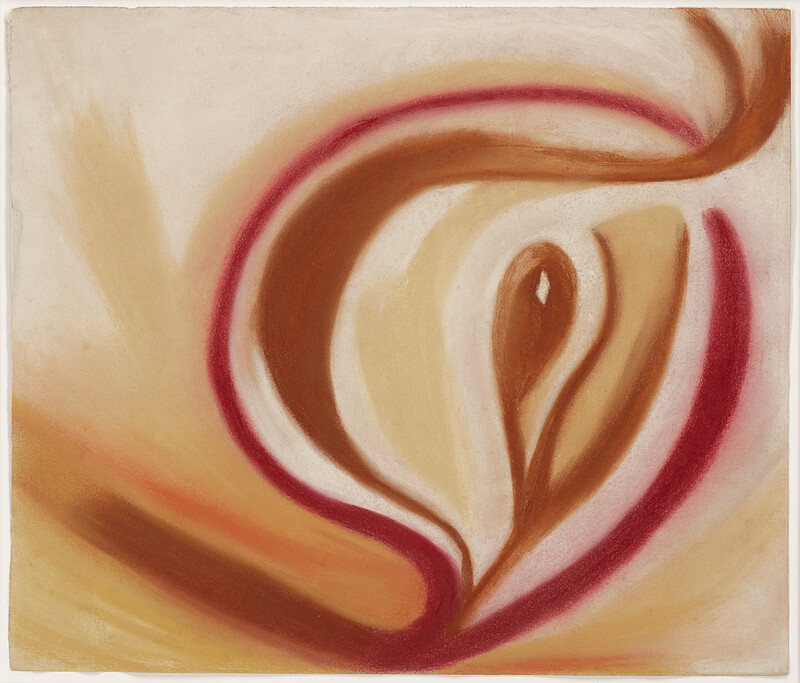
Elisabeth Stoffers was one of the very few women artists to produce abstract art before 1920. Sidelined in art school for being a woman and told by her husband to spend less time on art and more time mothering their children, her short-lived art career seemed to be over by 1914. Sixty-six years later, her family unexpectedly discovered that she had left behind an unknown body of work: 32 strikingly modern abstract pastels dated from 1915-1918.
Read on
It seems that in her work, she deeply engaged with the writings of British theosophist Annie Bessant, particularly Thought-Forms: A Record of Clairvoyant Investigation, co-authored with Charles W. Leadbeater. Published in 1905, this book which had profound effect on early 20th-century art. It was translated into several languages, including a Dutch edition already published in 1905. Theosophy conceives of human beings as complex energy fields rather than purely physical bodies. Thought-Forms argues that thoughts have shape and color and are formed by emotions, experience, meditations, and music. Art historically, Stoffers's exploration is pioneering, within a year or two of Mondrian's first sharp grid, Malevich's "Black Square, " Matisse's "Yellow Curtain, " etc. Had her work become public knowledge, Stoffers might now be remembered as the Dutch Georgia O'Keeffe.