 Vasily KandinskyFrench, 1866–1944
Uber das Geistige in der Kunst
Can I see it?
Not on view at present
Where is “Uber das Geistige in der Kunst” now? Collection: Minneapolis Institute of Art, Minneapolis. Not on view at present. Checked September 29, 2026.

Minneapolis, United States
It belongs to the collection, but is not on display at present.
- Checked
- In this state since
- Source
- The museum
About the work
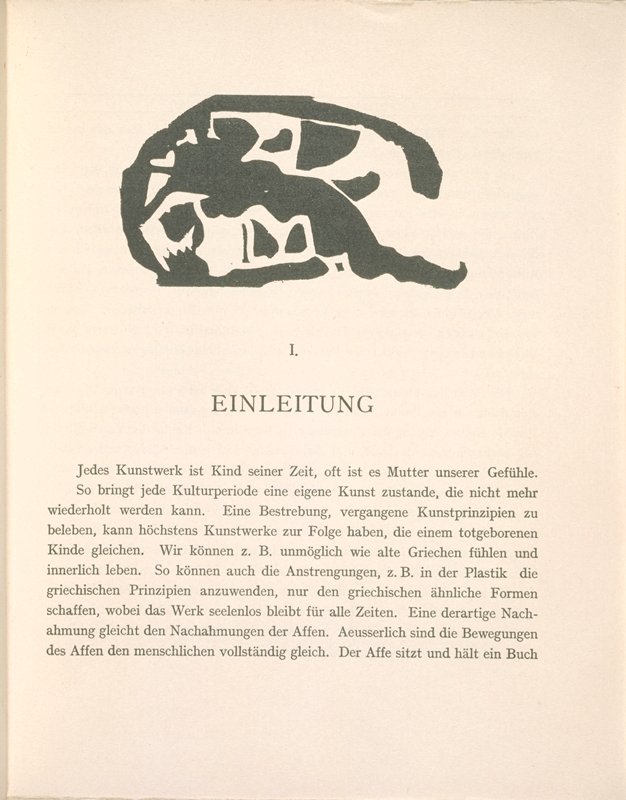
In 1911, Russian-born theorist and pioneer of abstract art Vassily Kandinsky published Concerning the Spiritual in Art, which ranks among the most significant documents in 20th-century art. Kandinsky writes, “All means [in painting] are sacred when they are dictated by inner necessity. All means are reprehensible when they do not spring from the fountain of inner necessity.” In this treatise, he calls for a spiritual revolution in painting that permits artists to abstractly express their own inner lives through form and color, and to value spirituality over naturalistic or materialistic representations.
Minneapolis Institute of Art
Details
- Accession number
- 2000.14
In the catalog
Sources
- Minneapolis Institute of Art
- Image: Minneapolis Institute of Art — © Minneapolis Institute of Art
In the life of Vasily Kandinsky
The whole life1910
London: the Allied Artists' Exhibition
Kandinsky took part in Frank Rutter's Allied Artists' Exhibition at the Royal Albert Hall in London; the artist Spencer Frederick Gore singled out his work for praise in a review in The Art News.
1910–1911
The treatise “Concerning the Spiritual in Art”
The treatise defended and promoted abstract art and affirmed that all forms of art are equally capable of reaching spirituality; colour in a painting can be autonomous, apart from the depiction of an object. Kandinsky distinguished three kinds of painting: impressions, improvisations and compositions.
1910–1912
The Izdebsky Salons and the Knave of Diamonds
With the Neue Künstlervereinigung Kandinsky took part in two international Izdebsky Salons in Russian cities, from December 1910 to May 1911; in 1910 and 1912 he also exhibited with the Knave of Diamonds.
1911
The birth of the Blue Rider
After the earlier association dissolved Kandinsky formed the Blue Rider with August Macke, Franz Marc, Albert Bloch and Gabriele Münter. The group issued an almanac and held two exhibitions; the war ended further plans.
1911
His first solo exhibition
His first solo exhibition took place in the same years, when the Blue Rider was being born.
1914
The war: back to Russia via Switzerland and Sweden
The outbreak of World War I ended the Blue Rider's plans for further almanacs and exhibitions and sent Kandinsky back to Russia via Switzerland and Sweden; he returned to Moscow in 1914.

_MET_DP236124.jpg?width=1280)