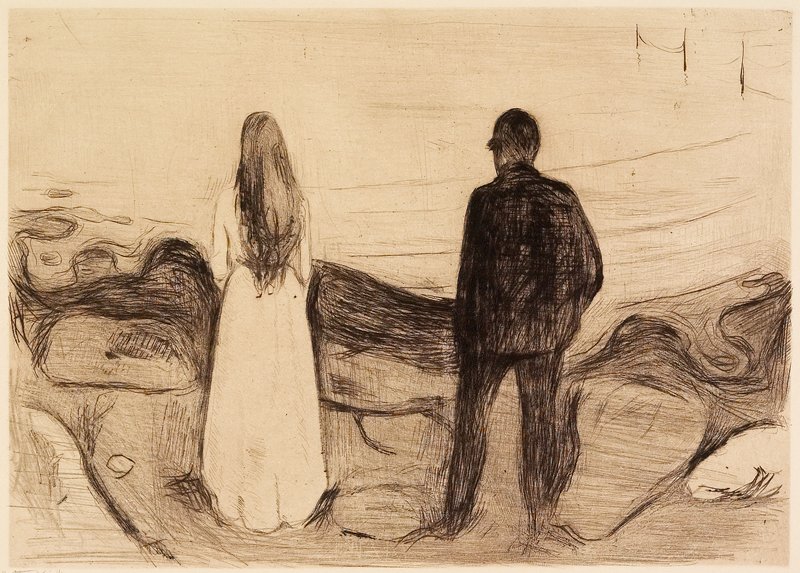
 Edvard MunchNorwegian, 1863–1944
Two Human Beings, The Lonely Ones
Can I see it?
Not on view at present
Where is “Two Human Beings, The Lonely Ones” now? Collection: Minneapolis Institute of Art, Minneapolis. Not on view at present. Checked September 29, 2026.

Minneapolis, United States
It belongs to the collection, but is not on display at present.
- Checked
- In this state since
- Source
- The museum
Details
- Accession number
- 2004.94.2
In the catalog
Sources
- Minneapolis Institute of Art
- Image: Minneapolis Institute of Art — © Minneapolis Institute of Art
In the life of Edvard Munch
The whole life1892
The Berlin Circle: Strindberg and Przybyszewski
He immersed himself in the life of Berlin's artistic "underground," growing close to August Strindberg, Stanisław Przybyszewski, and Dagny Juel, who became his muse.
November 1892
"The Munch Affair": Scandal in Berlin
At the invitation of Adelsteen Normann he exhibited at the Union of Berlin Artists; the show provoked fierce controversy and was closed within a week. The conflict led to a split in the Union and the formation of the Berlin Secession.
December 1893
The "Love" Exhibition: Beginning of "The Frieze of Life"
At an exhibition on Unter den Linden he showed, among other works, six paintings under the title "Studies for a Series: Love" — the beginning of the cycle later named "The Frieze of Life — a Poem about Life, Love and Death."
1896
Meetings with Gauguin and the Symbolists in Paris
During an important stay in Paris he met Gauguin, Émile Bernard, Maurice Denis, and Symbolist poets, notably Mallarmé. At this time he turned to etching, woodcut, and lithography.
May 1896
Exhibition at the Maison de l'Art Nouveau
Siegfried Bing showed 60 of Munch's works, including "The Kiss," "The Scream," "Madonna," and "The Sick Child." The exhibition introduced the French public to the artist's work.
1898
Beginning of the Affair with Tulla Larsen
An affair began with Tulla (Mathilde) Larsen, a wealthy young Norwegian woman. Initially warm, the relationship in time began to weigh on Munch because of Tulla's ardor and possessiveness.