Albrecht DürerGerman, 1471–1528
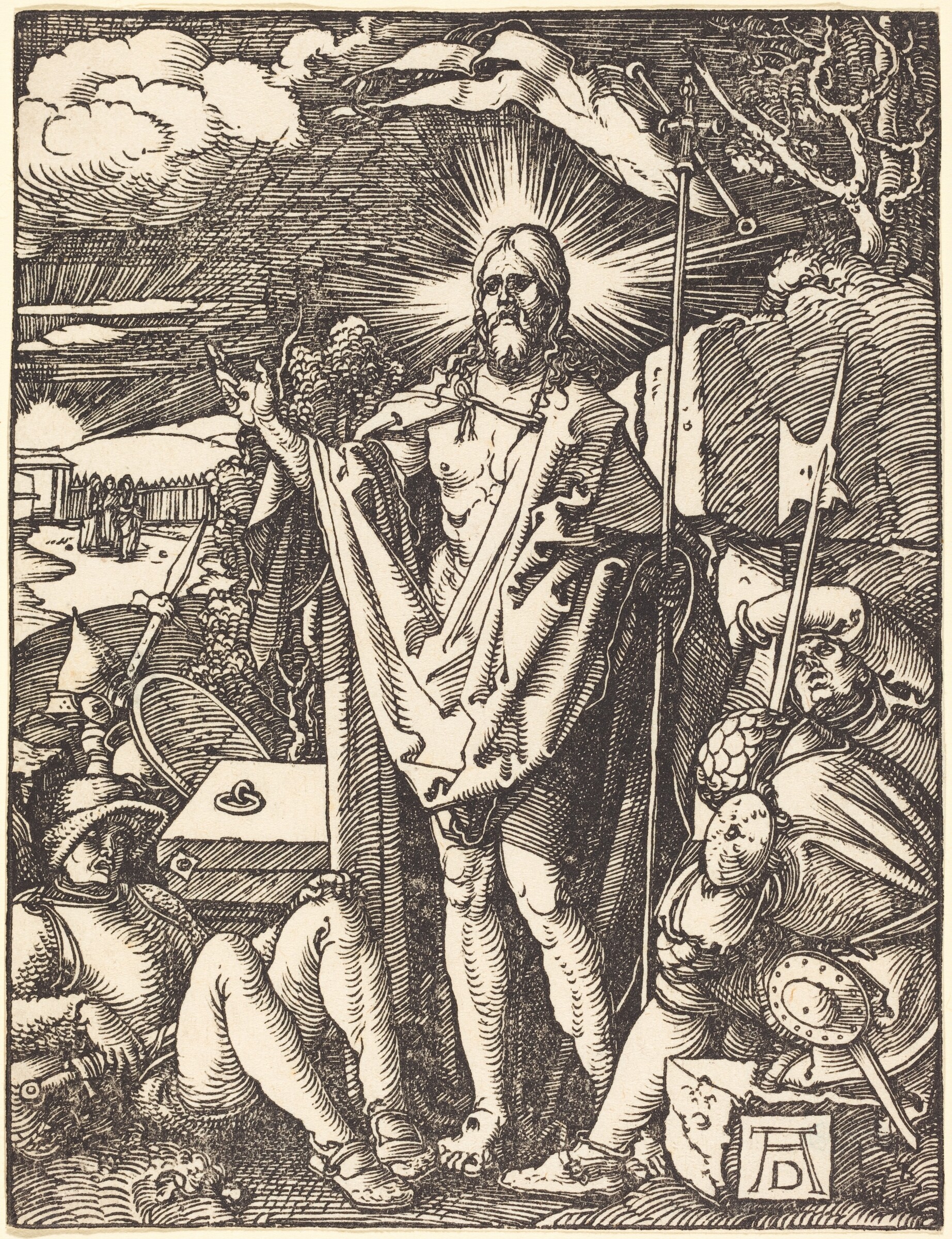
The Resurrection
May one see it?
Not receiving at present

Washington, D.C., United States
It belongs to the collection, but is not on display at present.
- Checked
- In this state since
- Source
- The museum
About the work
This print belongs to a group of woodcuts showing the events of Christ’s Passion. The series was published with Latin verses on the back of each sheet, but this particular impression was printed as a “proof” before the text was added. Here, Albrecht Dürer showed Christ emerging from his tomb while the soldiers assigned to guard him sleep. Christ’s muscular, heroic body demonstrates Dürer’s awareness of visual models from the classical past and from Italy, a knowledge he helped to spread in the north through prints such as this. Here, the ideal body of Christ represents his resurrected state.
National Gallery of Art
Particulars
- Accession number
- 1943.3.3569
What it shows
In the catalog
Comings and goings
Not on view at present
National Gallery of Art · Sep 29, 2026 — now · Verified
Was not on view
The Cleveland Museum of Art · Sep 29, 2026 — Sep 29, 2026 · Verified
Was not on view
National Gallery of Art · Sep 29, 2026 — Sep 29, 2026 · Verified
Was not on view
The Cleveland Museum of Art · Sep 28, 2026 — Sep 29, 2026 · Verified
Was not on view
National Gallery of Art · Sep 28, 2026 — Sep 28, 2026 · Verified
Was not on view
The Cleveland Museum of Art · Sep 27, 2026 — Sep 28, 2026 · Verified
Was not on view
National Gallery of Art · Sep 26, 2026 — Sep 27, 2026 · Verified
Was not on view
The Cleveland Museum of Art · Aug 19, 2026 — Sep 26, 2026 · Verified
Sources
- The Cleveland Museum of Art
- Image: National Gallery of Art — Museum open access
Meanwhile, in the life of Albrecht Dürer
The whole life1507–1528 · Workplace
Nuremberg
1509
Elected to Nuremberg's Greater Council
Dürer was elected a nominated member of Nuremberg's Greater Council; in that role he may have taken part in the city's artistic projects.
1509
Buys a large house in Nuremberg
Dürer bought a large house from the heirs of the astronomer Bernhard Walther; it housed his workshop, and his widow lived there after his death until 1539.
1511
Publishes the Great Passion and the Life of the Virgin
Dürer published two woodcut series as books, the Great Passion and the Life of the Virgin, with a second edition of the Apocalypse and the 37 woodcuts of the Little Passion. His post-Venetian woodcuts developed chiaroscuro modelling.
1512
Emperor Maximilian I becomes his chief patron
From 1512 Emperor Maximilian I was Dürer's chief patron. For him Dürer and his workshop produced the Triumphal Arch, a giant woodcut 295 × 357 cm printed from 192 blocks and modelled on the triumphal arches of ancient Rome.
3 January 1512
Nuremberg's privilege against forgeries
Nuremberg's city council granted Dürer a privilege for the sale of his prints, with penalties for anyone who forged them.
![Madonna and Child [obverse], Albrecht Dürer, c. 1496/1499](https://api.nga.gov/iiif/878db7e6-10ae-4cae-ba5d-6d6f5c413ae8/full/!2400,2400/0/default.jpg)
![Lot and His Daughters [reverse], Albrecht Dürer, c. 1496/1499](https://api.nga.gov/iiif/7565a449-f82a-414b-9bda-c93f55a51b4d/full/!2400,2400/0/default.jpg)


![Ginevra de' Benci [obverse], Leonardo da Vinci, c. 1474/1478](https://api.nga.gov/iiif/8f29e3c9-a289-4d53-abf0-31a66e9e98fa/full/!2400,2400/0/default.jpg)
![Wreath of Laurel, Palm, and Juniper with a Scroll inscribed Virtutem Forma Decorat [reverse], Leonardo da Vinci, c. 1474/1478](https://api.nga.gov/iiif/ff62e8d0-45c4-498f-ad36-6358de827e04/full/!2400,2400/0/default.jpg)