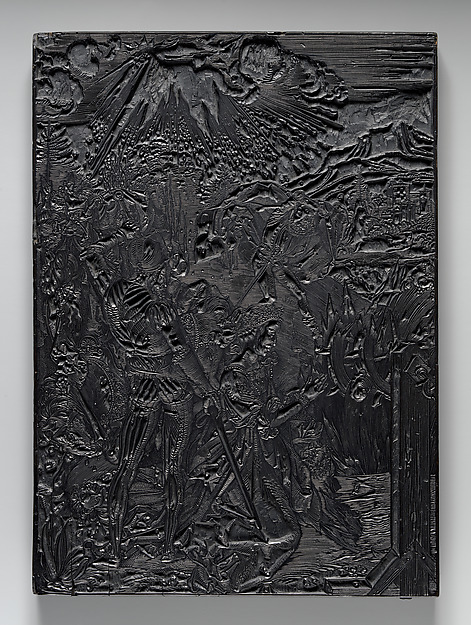
Albrecht DürerGerman, 1471–1528
The Standard Bearer
May one see it?
Not receiving at present

Art Institute of Chicago
Chicago, United States
It belongs to the collection, but is not on display at present.
- Checked
- 4 hours ago
- In this state since
- Sep 29, 2026
- Source
- The museum's own collection data
Particulars
- Accession number
- 1938.1461
What it shows
In the catalog
Comings and goings
Not on view at present
Art Institute of Chicago · Sep 29, 2026 — now · Verified
Was not on view
National Gallery of Art · Sep 29, 2026 — Sep 29, 2026 · Verified
Was not on view
Art Institute of Chicago · Sep 28, 2026 — Sep 29, 2026 · Verified
Was not on view
National Gallery of Art · Sep 28, 2026 — Sep 28, 2026 · Verified
Was not on view
Art Institute of Chicago · Sep 27, 2026 — Sep 28, 2026 · Verified
Was not on view
National Gallery of Art · Sep 26, 2026 — Sep 27, 2026 · Verified
Was not on view
Art Institute of Chicago · Aug 19, 2026 — Sep 26, 2026 · Verified
Sources
- Art Institute of Chicago: the museum's own open data · fetched 4 days ago
- Image: Art Institute of Chicago — CC0
Meanwhile, in the life of Albrecht Dürer
The whole life1500
Jacopo de' Barbari and the secret of proportion
The Venetian Jacopo de' Barbari, whom Dürer had met in Venice, came to Nuremberg, and Dürer said he learned much from him about perspective, anatomy and proportion. Feeling that de' Barbari would not explain everything he knew, Dürer began studies of his own that became a lifelong preoccupation.
1501–1502
In the circle of Nuremberg's humanists
Through his lifelong friend Willibald Pirckheimer, Dürer entered the circle of Nuremberg's humanists. He engraved illustrations for Conrad Celtis's editions of Hrotsvitha (1501) and of his Four Books of Love (1502), and decorated 14 books in Pirckheimer's library with drawings.
1502
Death of his father
Albrecht Dürer the Elder died, and his son took on the care of his mother and his two younger brothers, Endres and Hans.
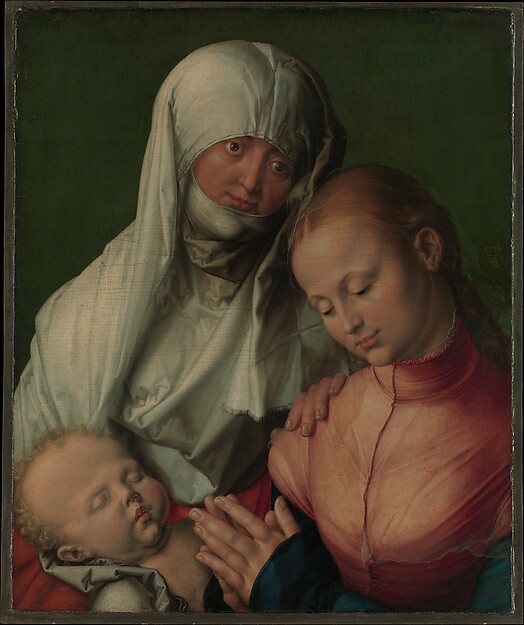
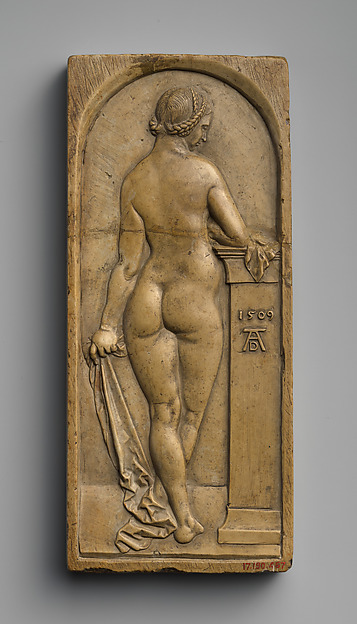
![Madonna and Child [obverse], Albrecht Dürer, c. 1496/1499](https://api.nga.gov/iiif/878db7e6-10ae-4cae-ba5d-6d6f5c413ae8/full/!2400,2400/0/default.jpg)
![Lot and His Daughters [reverse], Albrecht Dürer, c. 1496/1499](https://api.nga.gov/iiif/7565a449-f82a-414b-9bda-c93f55a51b4d/full/!2400,2400/0/default.jpg)