 Albrecht DürerGerman, 1471–1528
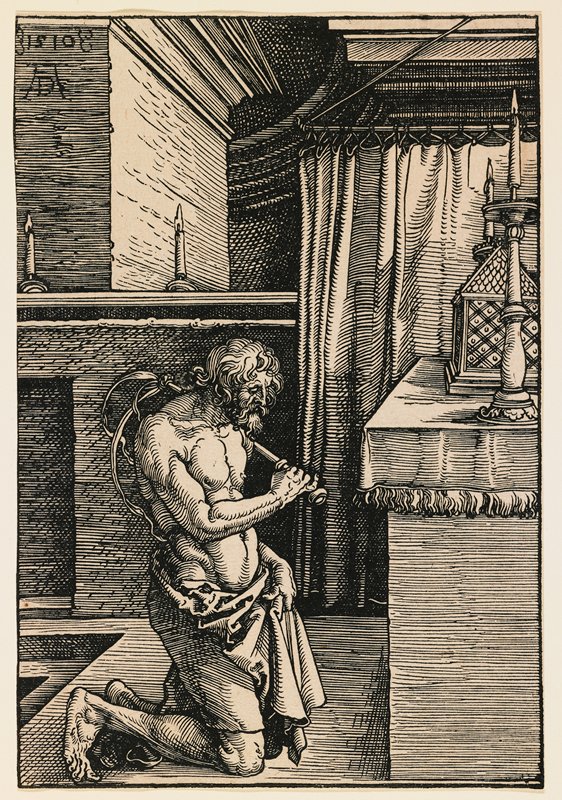
The Penitent
May one see it?
Not receiving at present

Minneapolis Institute of Art
Minneapolis, United States
It belongs to the collection, but is not on display at present.
- Checked
- In this state since
- Source
- The museum
About the work
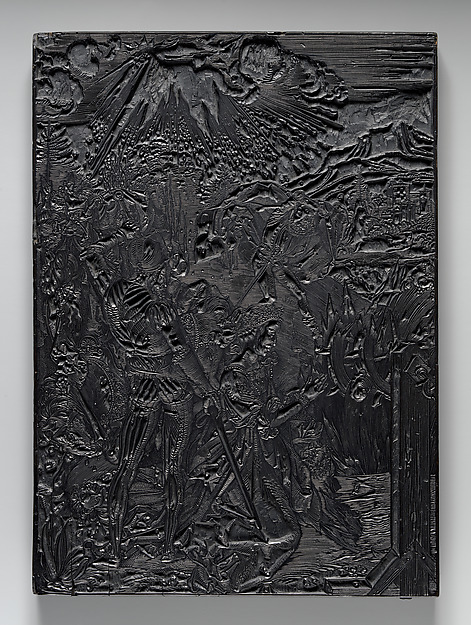
Albrecht Dürer was the leading artist of the German Renaissance. Extremely influential in many fields, he is widely recognized as one of the greatest printmakers of all time. Among his achievements are his advances in the depiction of human anatomy, emotion, and perspectival space, all of which are brilliantly rendered in this small print.
Read on
Though the image obviously shows a repentant man flagellating himself, more specific identification remains elusive. The image is sometimes described as a self-portrait; indeed, the man's features are not unlike the artist's, and Dürer did have a penchant for self-portraiture, both explicit and disguised. The ark on the altar has prompted another plausible suggestion—that the figure is David, the Old Testament king who repented and whose penitential prayer is Psalm 51. If so, Dürer appears to have followed the spirit rather that the letter of the second book of Samuel 11-12, which records the story of the king's repentance after his sinful treatment of Bathsheba, and her husband Uriah. The account makes no mention of self-flagellation. Still, the lack of Christian symbols couple with a temple-like setting suggest an Old Testament subject.
Minneapolis Institute of Art
Particulars
- Accession number
- 2009.47.1
In the catalog
Sources
- Minneapolis Institute of Art
- Image: Minneapolis Institute of Art — public domain
Meanwhile, in the life of Albrecht Dürer
The whole life1507–1528 · Workplace
Nuremberg
1509
Elected to Nuremberg's Greater Council
Dürer was elected a nominated member of Nuremberg's Greater Council; in that role he may have taken part in the city's artistic projects.
1509
Buys a large house in Nuremberg
Dürer bought a large house from the heirs of the astronomer Bernhard Walther; it housed his workshop, and his widow lived there after his death until 1539.
1511
Publishes the Great Passion and the Life of the Virgin
Dürer published two woodcut series as books, the Great Passion and the Life of the Virgin, with a second edition of the Apocalypse and the 37 woodcuts of the Little Passion. His post-Venetian woodcuts developed chiaroscuro modelling.
1512
Emperor Maximilian I becomes his chief patron
From 1512 Emperor Maximilian I was Dürer's chief patron. For him Dürer and his workshop produced the Triumphal Arch, a giant woodcut 295 × 357 cm printed from 192 blocks and modelled on the triumphal arches of ancient Rome.
3 January 1512
Nuremberg's privilege against forgeries
Nuremberg's city council granted Dürer a privilege for the sale of his prints, with penalties for anyone who forged them.
![Madonna and Child [obverse], Albrecht Dürer, c. 1496/1499](https://api.nga.gov/iiif/878db7e6-10ae-4cae-ba5d-6d6f5c413ae8/full/!2400,2400/0/default.jpg)
![Lot and His Daughters [reverse], Albrecht Dürer, c. 1496/1499](https://api.nga.gov/iiif/7565a449-f82a-414b-9bda-c93f55a51b4d/full/!2400,2400/0/default.jpg)