 Paulus PotterDutch, 1625–1654
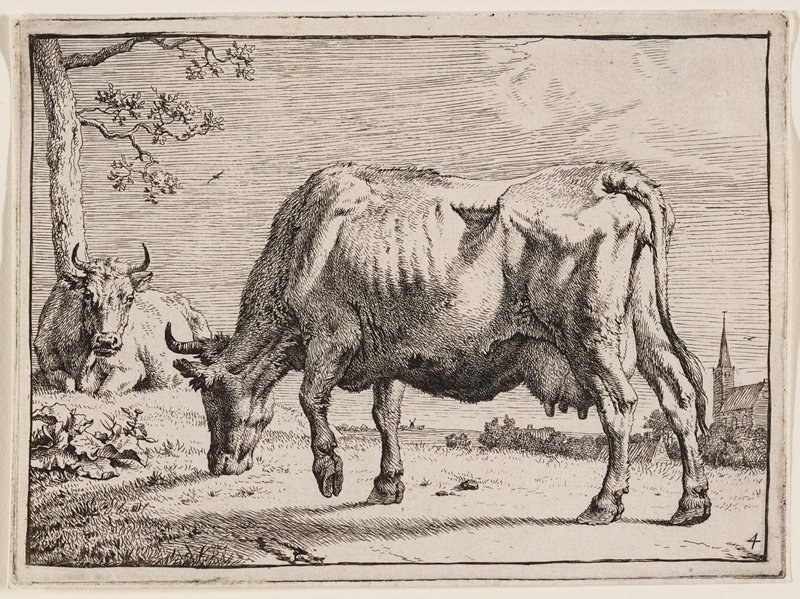
The Grazing Cow
Can I see it?
Not on view at present
Where is “The Grazing Cow” now? Collection: Minneapolis Institute of Art, Minneapolis. Not on view at present. Checked September 29, 2026.

Minneapolis, United States
It belongs to the collection, but is not on display at present.
- Checked
- In this state since
- Source
- The museum
About the work
Paulus Potter was among the most prominent of the many artists who specialized in depicting animals in 17th-century Holland. The Grazing Cow is typical of his work. Its low vantage point imparts monumentality to his subject. Here the cow seems to tower above the steeple of a village church. Raking light produces dramatic shadows that reveal the beast’s complex anatomy, which takes on architectural force. The great mass of the body is suspended from a clearly defined superstructure of bones. The shadows themselves are described with the utmost delicacy and variety. Some have said that Potter’s art is devoted to light as much as it is to animals.
Minneapolis Institute of Art
Details
- Accession number
- 2015.90.1
In the catalog
Sources
- Minneapolis Institute of Art
- Image: Minneapolis Institute of Art — public domain
In the life of Paulus Potter
The whole life1649
Moves to The Hague: a house from van Goyen
Potter rents a house in The Hague from the painter Jan van Goyen and joins the local painters' guild; for several years he lives next door to van Goyen.
1649–1652 · Workplace
The Hague
3 July 1650
Marries Adriana van Balckeneynde
Potter marries Adriana van Balckeneynde, daughter of the Hague master carpenter and building contractor Claes Dircksz, who lived nearby; his father-in-law introduces him to the Dutch elite. None of their children will reach adulthood.
1 May 1652
Moves to Amsterdam at Tulp's invitation
At the invitation of the physician Nicolaes Tulp, who already owned a number of his paintings, Potter goes to Amsterdam. Impressed by the artist's civilized behaviour and politeness, Tulp has him paint his son Dirck as a noble equestrian, life-size, with the head painted on a portrait originally intended for someone else.
1652–1654 · Workplace
Amsterdam