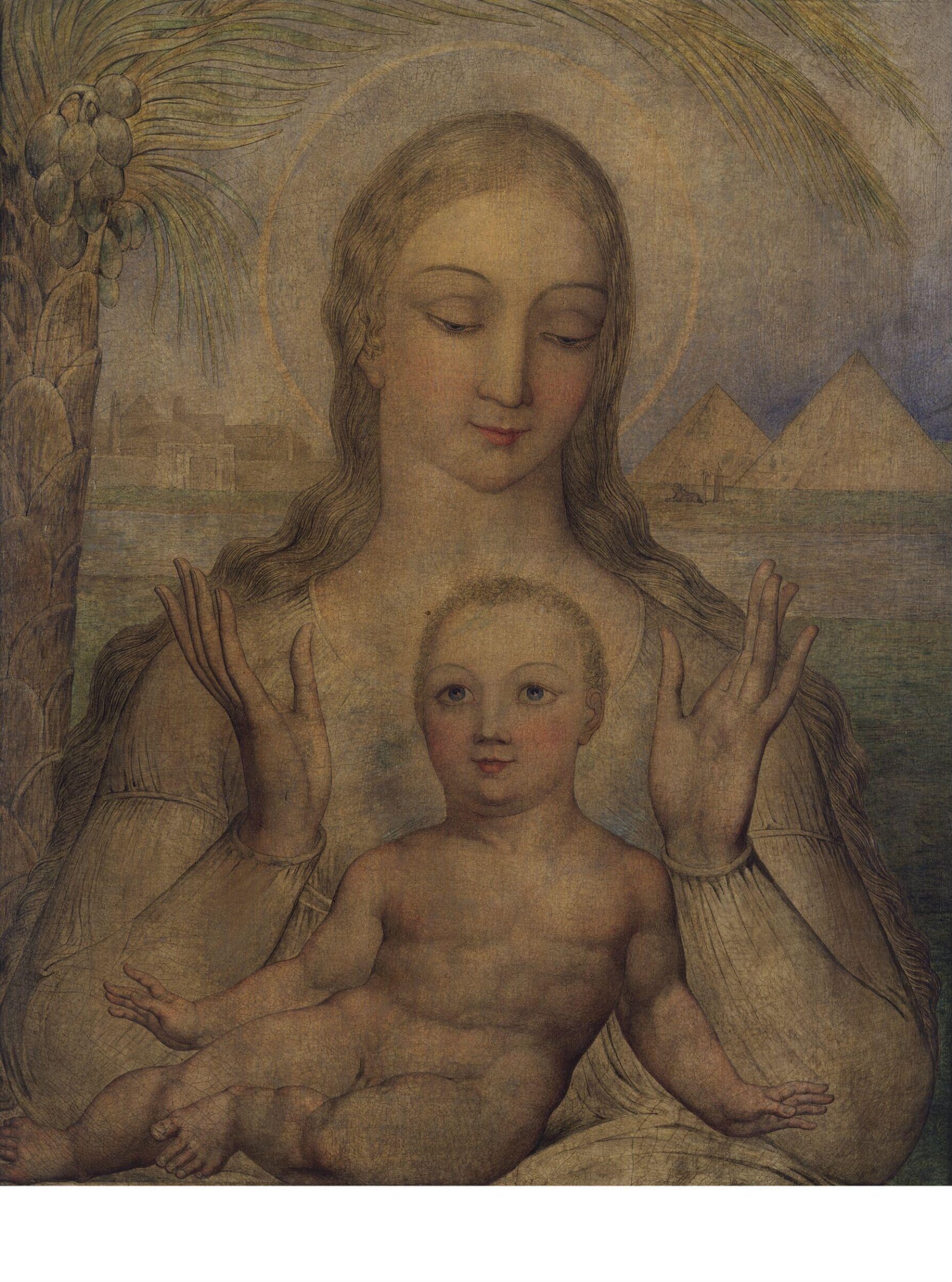
William BlakeBritish, 1757–1827
The Ghost of a Flea
May one see it?
Unknown

London, United Kingdom
The owner is known; whether it is on view today is not.
- In this state since
- Source
- The museum
About the painting
The Ghost of a Flea is a miniature painting by the English poet, painter and printmaker William Blake, held in the Tate Gallery, London. Measuring only 8.42 by 6.3 inches (21.4 by 16.0 centimetres), it is executed in a tempera mixture with gold, on a mahogany-type tropical hardwood panel. It was completed between 1819 and 1820, as part of a series depicting "Visionary Heads" commissioned by the watercolourist and astrologist John Varley (1778–1842). Fantastic, spiritual art was popular in Britain from around 1770 to 1830, and during this time Blake often worked on unearthly, supernatural panels to amuse and amaze his friends.
Read on
At 21.4 cm × 16.2 cm the work is a greatly reduced miniature portrait. Blake generally worked on a small scale; most of his illuminated pages, engravings and many of his paintings are only inches high. Although Ghost of a Flea is one of Blake's smallest works, it is monumental in its imagination. Its tiny scale achieves drama in contrasting the muscular bulk and apparent power of the creature against its incarnation in the panel as an insect.
Particulars
- Accession number
- NG5889
In the catalog
Sources
- Wikidata
- Image: The National Gallery — William Blake · Public domain · Wikimedia Commons
Meanwhile, in the life of William Blake
The whole life1780–1808
Exhibits six times at the Royal Academy
Despite his antagonism towards Reynolds, Blake submitted works to the Royal Academy on six occasions between 1780 and 1808.
October 1803 – 1820 · Residence
South Molton Street
1809
An exhibition in his brother's shop: nothing sold
Blake set up an independent exhibition in his brother's haberdashery shop at 27 Broad Street in Soho to market his version of “The Canterbury Pilgrims” along with other works. It was very poorly attended, sold none of the temperas or watercolours, and its only review, in The Examiner, was hostile.
1818
Meets John Linnell
In 1818 George Cumberland's son introduced Blake to a young artist named John Linnell; through him Blake later met Samuel Palmer and received the commission for the Dante illustrations.
after 1818
The Shoreham Ancients: meeting Samuel Palmer
Through Linnell Blake met Samuel Palmer, who belonged to a group of artists who called themselves the Shoreham Ancients; the group shared Blake's rejection of modern trends and his belief in a spiritual and artistic New Age.
1820 · Residence
Fountain Court