 Pablo PicassoSpanish, 1881–1973
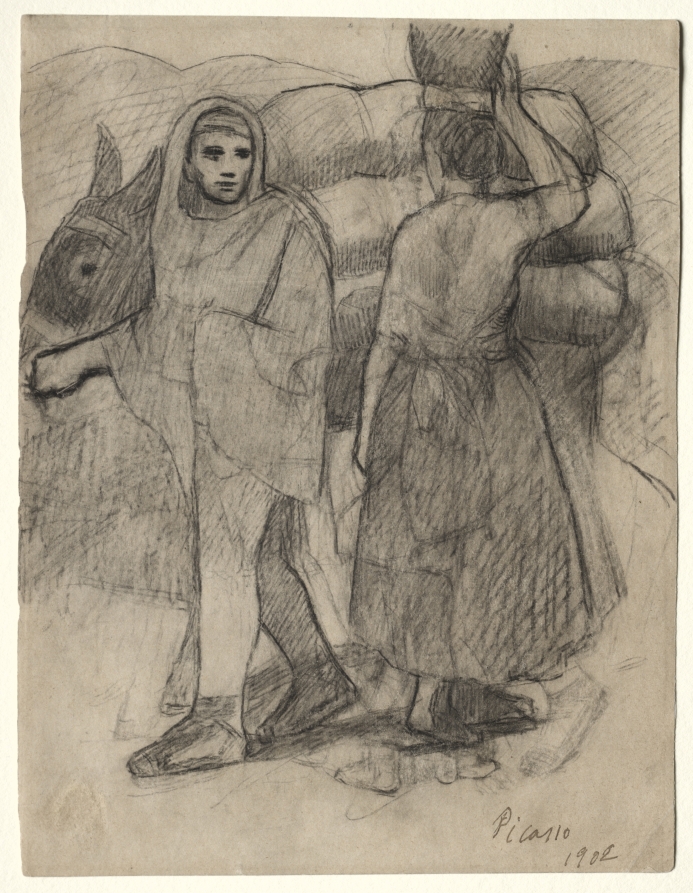
The Donkey Driver
May one see it?
Not receiving at present

The Cleveland Museum of Art
Cleveland, United States
It belongs to the collection, but is not on display at present.
- Checked
- 2 days ago
- In this state since
- Aug 19, 2026
- Source
- The museum's own collection data
About the work
Created during Pablo Picasso's Blue Period, a time when the artist focused on disenfranchised members of society, this drawing depicts a man and woman in what apperas to be Catalan costume. The subject may relate to Picasso's Spanish heritage or his study in Paris of drawings by the elder artist Puvis de Chavannes, who likewise focused on agrarian life. Picasso drew and reworked his composition in black chalk, leaving changes to the image fully evident as he worked.
The Cleveland Museum of Art
Particulars
- Accession number
- 1958.12
In the catalog
Sources
- The Cleveland Museum of Art: the museum's own open data · fetched 5 days ago
- Image: The Cleveland Museum of Art — © Estate of Pablo Picasso / Artists Rights Society (ARS), New York
Meanwhile, in the life of Pablo Picasso
The whole life1895–1904 · Workplace
Barcelona
1900
First Solo Exhibitions
Picasso's first two solo exhibitions were held at the Barcelona café Els Quatre Gats.
1900
First Trip to Paris
Together with the painter Casagemas, Picasso came to Paris for the first time, visited the World's Fair, and became acquainted with the work of the Impressionists.
17 February 1901
Suicide of Carlos Casagemas
The suicide of his close friend Carlos Casagemas deeply shook the young Picasso and became one of the impulses behind the Blue Period.
1901–1904
The Blue Period
The Blue Period began — somber paintings in blue-green tones with themes of poverty and sorrow; Picasso divided his time between Barcelona and Paris.
1904
Move to Paris, Beginning of the Rose Period
Picasso settled in the Bateau-Lavoir residence in Montmartre; the sorrow of the Blue Period gave way to images of the theater and the circus — the Rose Period began.