
 Edgar DegasFrench, 1834–1917
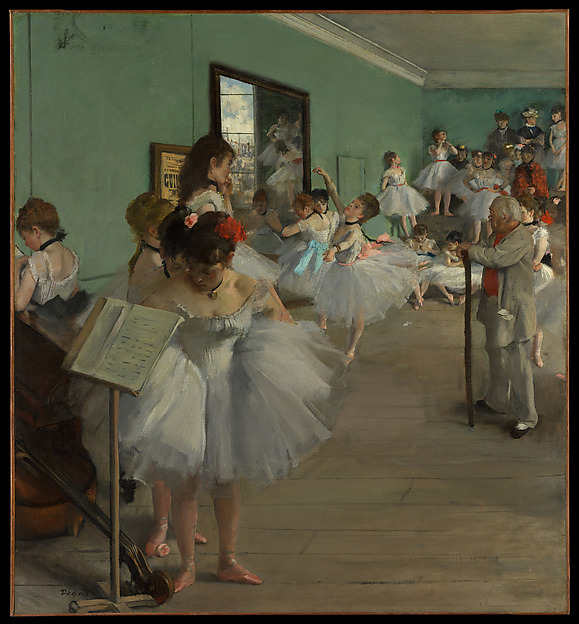
The Dance Lesson
May one see it?
Yes, receiving visitors

National Gallery of Art
Room83 · West Building, Main FloorWashington, D.C., United States
On public display.
- Checked
- 4 hours ago
- In this state since
- Aug 19, 2026
- Source
- The museum's own collection data
About the painting
The Dance Lesson (sometimes known as The Dancing Lesson) is an oil on canvas painting by the French artist Edgar Degas created around 1879. It is currently kept at the National Gallery of Art in Washington, D.C. There is at least one other work by Degas by this title, also made in about 1879, which is a pastel.
Particulars
- Accession number
- 1995.47.6
What it shows
In the catalog
Sources
- National Gallery of Art: the museum's own open data · fetched 4 days ago
- Image: National Gallery of Art — Museum open access
Meanwhile, in the life of Edgar Degas
The whole life1870s
From “de Gas” back to plain “Degas”
The archives disproved the legend of an ancient noble line: the artist's paternal ancestors were bakers, and the name “de Gas” was invented by his father, who commissioned a false genealogy. In the 1870s Edgar returned to the plain spelling, Degas.
second half of the 1870s
Pastel becomes his main medium
Degas increasingly chose pastel, often combining it with monotype, lithography, etching or gouache. To keep the colour from darkening under ordinary fixatives he devised his own method of fixing and applied pastel in layers.
1877
Friendship with Mary Cassatt
Degas invited Mary Cassatt to show in the third Impressionist exhibition, having admired her portrait “Ida” at the Salon of 1874. He introduced her to pastel and engraving, while she helped him sell paintings and promoted his reputation in the United States.
autumn 1879 – April 1880
The prints journal: Degas abruptly withdraws
In the autumn and winter of 1879–1880 Degas and Cassatt worked closely together on a prints journal; he owned a small printing press. In April 1880 Degas abruptly withdrew, and without his support the project folded.
by 1880
The end of his financial crisis
By 1880 Degas had fully overcome his financial crisis and become a respected figure in the Paris art world; the Impressionist exhibitions, which proved commercially useful to him, helped.
1881
“The Little Dancer of Fourteen Years” on show
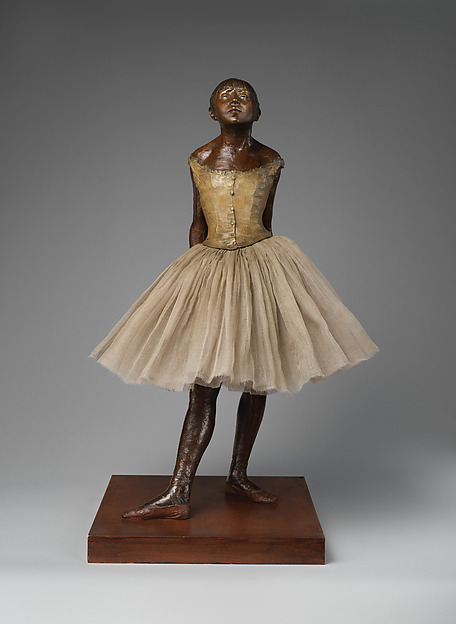
The nearly life-size wax figure with real hair and a cloth tutu, modelled on Marie van Goethem, provoked a strong reaction: critics found its realism extraordinary, but many denounced the dancer as ugly. It was the only sculpture Degas showed in his lifetime.


![Scenes from the Passion of Christ: The Descent into Limbo [right panel], Andrea Vanni, 1380s](https://api.nga.gov/iiif/4205a539-eadd-4486-89a7-3cff9c1ba428/full/!2400,2400/0/default.jpg)


