 Edgar DegasFrench, 1834–1917
The Collector of Prints
May one see it?
Yes, receiving visitors

The Metropolitan Museum of Art
Room815New York, United States
On public display.
- Checked
- 4 hours ago
- In this state since
- Sep 26, 2026
- Source
- The museum's own collection data
About the painting
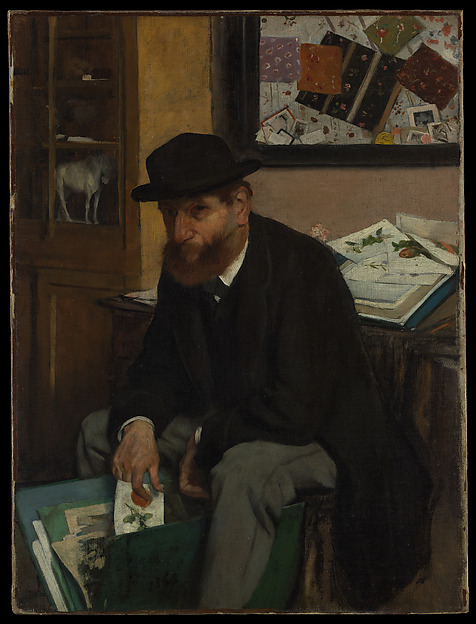
The Collector of Prints is an oil-on-canvas painting by the French Impressionist artist Edgar Degas. The painting, which was produced in 1866, depicts an unknown male subject sitting down, pausing while browsing through a portfolio of prints and meeting the viewer's gaze. This work, influenced by prominent artists and critics of the time such as Daumier, Manet, and Duranty, embodied Degas's interest in exploring complex backgrounds. As a result, the background behind the subject displays a varied compilation of photographs, cards, prints, fabrics, and other objects.
Particulars
- Accession number
- 29.100.44
What it shows
Sources
- The Metropolitan Museum of Art: the museum's own open data · fetched 4 days ago
- Image: The Metropolitan Museum of Art — Open Access (CC0)
Meanwhile, in the life of Edgar Degas
The whole life1862–1864
Meets Édouard Manet
Manet introduced Degas to the circle of future Impressionists. Degas shared their rejection of the academic Salon but would not work in the open air.
1865
Debut at the Salon of 1865
The jury accepted “Scene of War in the Middle Ages”, Degas's first picture in the Salon, which attracted little attention. For the next five years he exhibited annually but sent no more history paintings.
late 1860s
The turn to modern life: racecourses, milliners, laundresses
By the late 1860s Degas had moved from history painting to an original observation of contemporary life: racecourse scenes let him paint horses and riders in a modern setting, and then he turned to women at work — milliners and laundresses.
late 1860s
Begins modelling in wax
Degas modelled small wax figures of dancers, bathers and jockeys for himself, in place of studies. He never worked in bronze or stone; he valued wax for its changeability, and his sculptor friend Bartholomé encouraged him.