ART WIKI32,963 on view
MapCollectionArtistsMuseumsExhibitionsJournal
Sign in

ART WIKI

Where the masterpiece hangs, and when they let you in.

Collections: Art Institute of Chicago, Getty Villa, Harvard Art Museums, Hirshhorn Museum and Sculpture Garden, J. Paul Getty Museum, Minneapolis Institute of Art, Musée du Louvre, National Gallery of Art, National Museum of Asian Art, National Portrait Gallery (Smithsonian), Pushkin State Museum of Fine Arts, Rijksmuseum, Smithsonian American Art Museum, SMK — National Gallery of Denmark, State Hermitage Museum, State Russian Museum, The Cleveland Museum of Art, The Metropolitan Museum of Art, The Museum of Modern Art, Tretyakov Gallery, Victoria and Albert Museum, Whitney Museum of American Art, State Catalogue of the Museum Fund of Russia (274 museums), Europeana (19 museums), Wikidata (6 museums), Paris Musées (12 museums), and Joconde, the French Ministry of Culture's museum database (495 museums). Images belong to their rights holders.

Sections

  • Map
  • Search
  • Collection
  • Masterpieces
  • On view now
  • Artists

More

  • Museums & galleries
  • Exhibitions
  • Journal
  • Where the data comes from
  • Privacy & cookies
HomeMapBrowse
  1. Collection/
  2. The Cleveland Museum of Art/
  3. The Bohemians
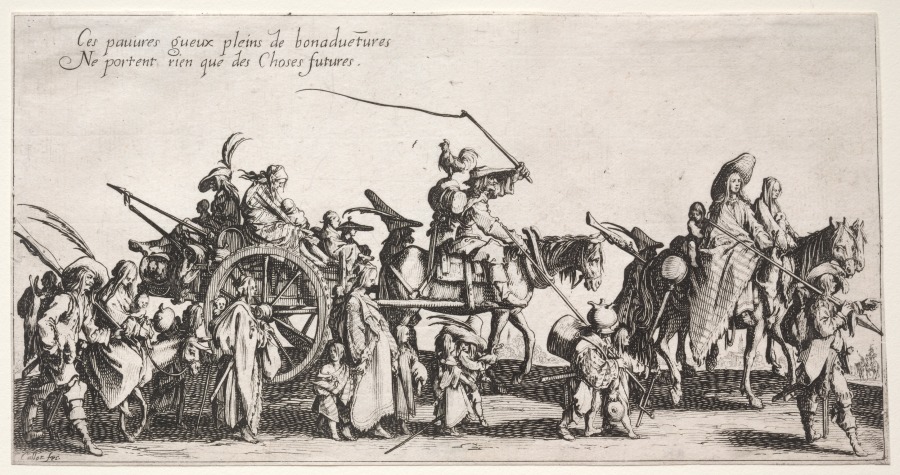
The Bohemians, Jacques Callot, c. 1621–25
Jacques Callot, portraitJacques CallotFrench, 1592–1635

The Bohemians

c. 1621–25 · Print

May one see it?

Not receiving at present

The Cleveland Museum of Art

Cleveland, United States

It belongs to the collection, but is not on display at present.

Checked
3 days ago
In this state since
Aug 19, 2026
Source
The museum
On the mapMuseum page

About the work

Jacques Callot, a masterful draftsman, spent the greater part of his life at the ducal courts of Tuscany and Lorraine, where he produced prints to record festivals and theatrical performances. He also executed religious subjects and scenes reflecting many aspects of daily life including war, pervasive in 17th-century Europe. When returning to France from Italy, Callot probably saw bands of rootless men, women, and children-a common sight-which became the subject of The Bohemians. He conceived of these four prints as a long frieze; the lines in each of the sheets extend into the sheet that follows. The first two scenes depict a procession of scrawny horses and disheveled families in tattered, exotic clothing. The last two show these vagrants pillaging a farm and then enjoying a feast.

Read on

The inscriptions, from left to right, comment on the action: The only things these poor fortune-telling beggars carry with them are things yet to come. Are these not fine messengers, straying through foreign lands? You who take pleasure in their words, watch out for your blancs, testons and pitolles (coins). When all is said and done, they find that their fate is to have come from Egypt to this feast.

The Cleveland Museum of Art

Particulars

c. 1621–25
15921635
Accession number
2004.42

In the catalog

PrintsEtchingBaroque17th centuryFrance

Sources

  • The Cleveland Museum of Art
  • Image: The Cleveland Museum of Art — Museum open access

Meanwhile, in the life of Jacques Callot

The whole life
  1. 1611–1621 · Workplace

    Florence

  2. 1614–1621

    At the court of Cosimo II de’ Medici

    Under Parigi’s direction Callot works at the court of the Grand Duke of Tuscany Cosimo II de’ Medici in the Uffizi, designing festivals and theatrical performances — later these give him themes for his series of grotesque prints; during his Florentine years he becomes an independent master and often works for the Medici.

  3. 1621

    Returns to Nancy after the death of Cosimo II

    After the death of Grand Duke Cosimo II de’ Medici, Callot responds to Duke Charles IV of Lorraine’s wish to see him at his court and returns to Lorraine, where he is received with flattering honours; staying in Nancy, he sends his prints all over Europe, and Rembrandt becomes a keen collector of them.

  4. 1621–1635 · Workplace

    Nancy

More by Jacques Callot

All works
Lust, Jacques Callot, 17th century

Lust

17th century · Harvard Art Museums

Temptation of Saint Anthony, Jacques Callot, 17th century

Temptation of Saint Anthony

17th century · Harvard Art Museums

Envy, Jacques Callot, 17th century

Envy

17th century · Harvard Art Museums

Pardon des Rochelois, Jacques Callot, 17th century

Pardon des Rochelois

17th century · Harvard Art Museums

Pride, Jacques Callot, 17th century

Pride

17th century · Harvard Art Museums

Anger, Jacques Callot, 17th century

Anger

17th century · Harvard Art Museums

Descente dans l'île de Ré, Jacques Callot, 17th century

Descente dans l'île de Ré

17th century · Harvard Art Museums

Gluttony, Jacques Callot, 17th century

Gluttony

17th century · Harvard Art Museums

Neighbors at The Cleveland Museum of Art

Museum page
The Red Kerchief, Claude Monet, c. 1868–73

Claude Monet

The Red Kerchief, c. 1868–73

Melencolia I, Albrecht Dürer, 1514

Albrecht Dürer

Melencolia I, 1514

The Virgin and Child with the Pear, Albrecht Dürer, 1511

Albrecht Dürer

The Virgin and Child with the Pear, 1511

The Nativity, Albrecht Dürer, probably c. 1509/1510

Albrecht Dürer

The Nativity, probably c. 1509/1510

The Virgin and Child on a Crescent with a Starry Crown, Albrecht Dürer, 1508

Albrecht Dürer

The Virgin and Child on a Crescent with a Starry Crown, 1508

The Lamentation, Albrecht Dürer, 1507

Albrecht Dürer

The Lamentation, 1507

Large Horse, Albrecht Dürer, 1505

Albrecht Dürer

Large Horse, 1505

Nemesis (The Great Fortune), Albrecht Dürer, c. 1501/1502

Albrecht Dürer

Nemesis (The Great Fortune), c. 1501/1502