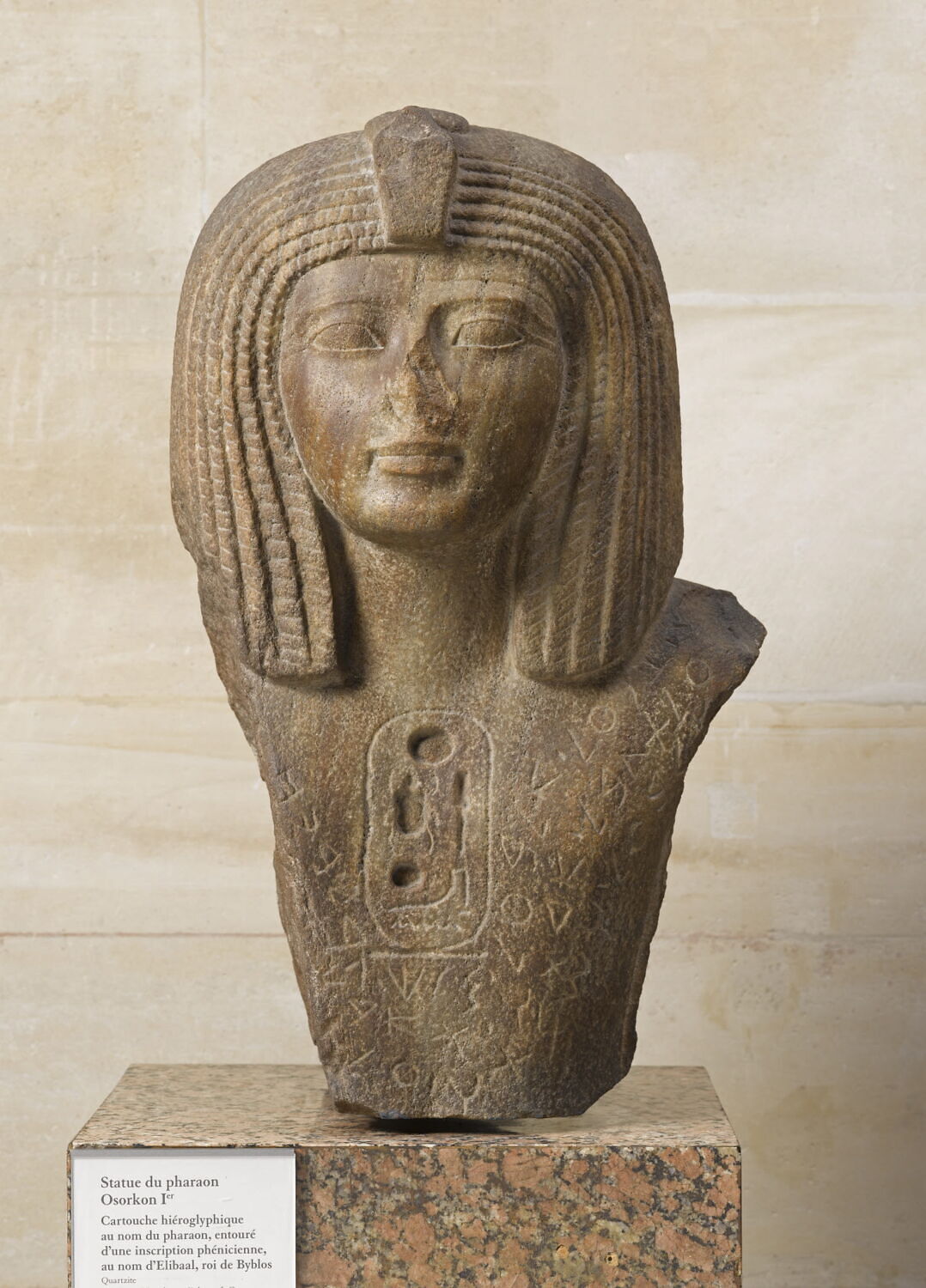
Statue d'Osorkon Ier
May one see it?
Unknown: the museum keeps its counsel

Musée du Louvre
Paris, France
The owner is known. Whether it is on view today, the museum does not say, and we were not trained to guess.
- In this state since
- Sep 26, 2026
- Source
- The museum's own collection data
About the sculpture
The Osorkon Bust, also known as the Eliba'l Inscription, is a bust of Egyptian pharaoh Osorkon I, discovered in Byblos (in today's Lebanon) in the 19th century. Like the Tabnit sarcophagus from Sidon, it is decorated with two separate and unrelated inscriptions – one in Egyptian hieroglyphics and one in Phoenician script. It was created in the early 10th century BC, and was unearthed c. 1881, very likely in the Temple of Baalat Gebal.
The Egyptian writing is the prenomen of Osorkon, and the Phoenician is a dedication to Elibaal, the king of Byblos.
The details of the find were published in by French archaeologist René Dussaud in 1925.
The bust is made of quartzite, and is 60 cm × 36 cm × 37.5 cm.
Particulars
- Accession number
- AO 9502
In the catalog
Sources
- Musée du Louvre: the museum's own open data · fetched 4 days ago
- Image: Musée du Louvre — © 2008 GrandPalaisRmn (musée du Louvre) / Franck Raux