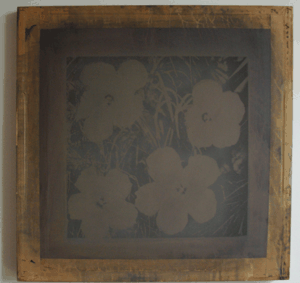
 Andy WarholAmerican, 1928–1987
Silkscreen for Flowers Print
May one see it?
No: it was stolen and is being sought
Listed in the FBI's National Stolen Art File under no. 00714.
- Checked
- · Reported
- In this state since
- Source
- A register of stolen art
About the work
Original silkscreen with photo of flowers screened on to it. Used by Warhol to produce the “Flowers” print.
Particulars
In the catalog
Sources
- The FBI's National Stolen Art File
- Image: FBI National Stolen Art File
Meanwhile, in the life of Andy Warhol
The whole lifeDecember 1961
The decision to paint money
After seeing Claes Oldenburg's installation The Store in December 1961, Warhol went home frustrated, feeling his comic-strip paintings were no longer original enough. He accepted Muriel Flatow's tongue-in-cheek advice, given for $50, to paint what he liked most — money — and began painting dollar bills.
1961–1962
Mastering silkscreen
Seeking technical advice, Warhol turned to Floriano Vecchi of Tiber Press, who showed him the basics of silkscreen printing: transferring designs to acetate, preparing screens and pulling ink with a squeegee. The experiments became a turning point and soon led to some of his earliest silkscreen works.
9 July 1962
Soup cans at the Ferus Gallery
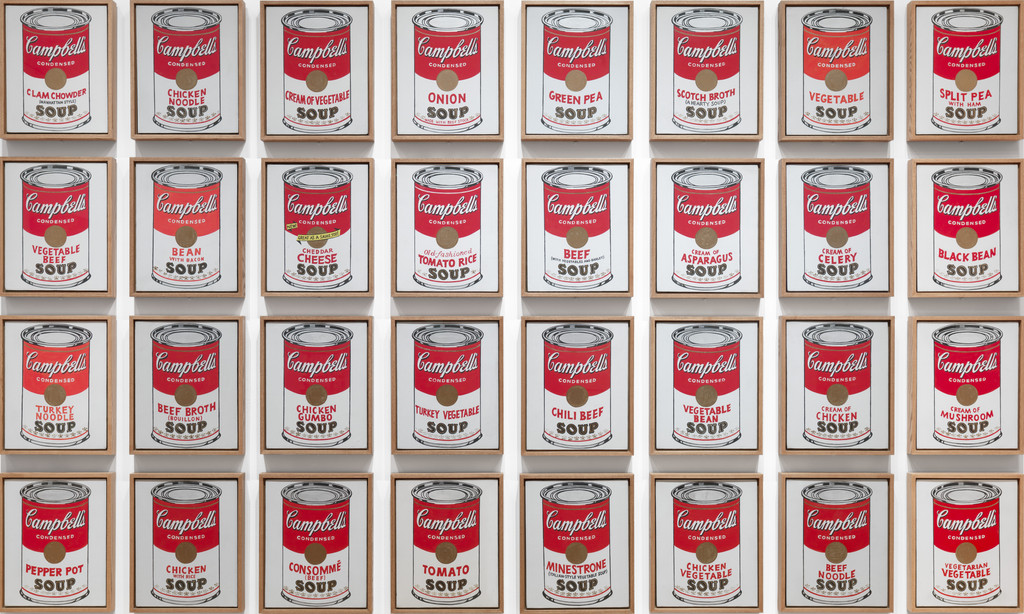
The Los Angeles dealer Irving Blum, surprised that Warhol had no gallery, offered him a solo show at the Ferus Gallery. Warhol sent 32 canvases, one for each variety of Campbell's soup; the exhibition opened on 9 July 1962 and marked his West Coast debut.
1964
The Factory on 47th Street
By 1964 Warhol had moved his studio to 231 East 47th Street, which became known as the Factory; Billy Name covered it in aluminium foil and silver paint. The poet Gerard Malanga helped him with silkscreens and films, and working with assistants became a lasting feature of his method.
May 1965
Paris: announcing his retirement from painting
The second Flowers series was shown at Galerie Ileana Sonnabend in Paris; during the trip Warhol announced that he was retiring from painting to focus on film, saying he no longer believed in painting.
3 June 1968
The shooting at the Factory
The writer Valerie Solanas, author of the SCUM Manifesto, who had appeared in his film I, a Man, shot Warhol and the art critic Mario Amaya; Amaya was lightly injured, while Warhol was seriously wounded and spent nearly two months in hospital. Solanas turned herself in to the police a few hours later, saying that Warhol had too much control over her life.

![Liz #3 [Early Colored Liz], Andy Warhol, 1963](/api/img?u=https%3A%2F%2Fwww.artic.edu%2Fiiif%2F2%2F362c0c2a-4576-2207-4ba9-2b87e6d0bad0%2Ffull%2F1686%2C%2F0%2Fdefault.jpg)