 Andy WarholAmerican, 1928–1987
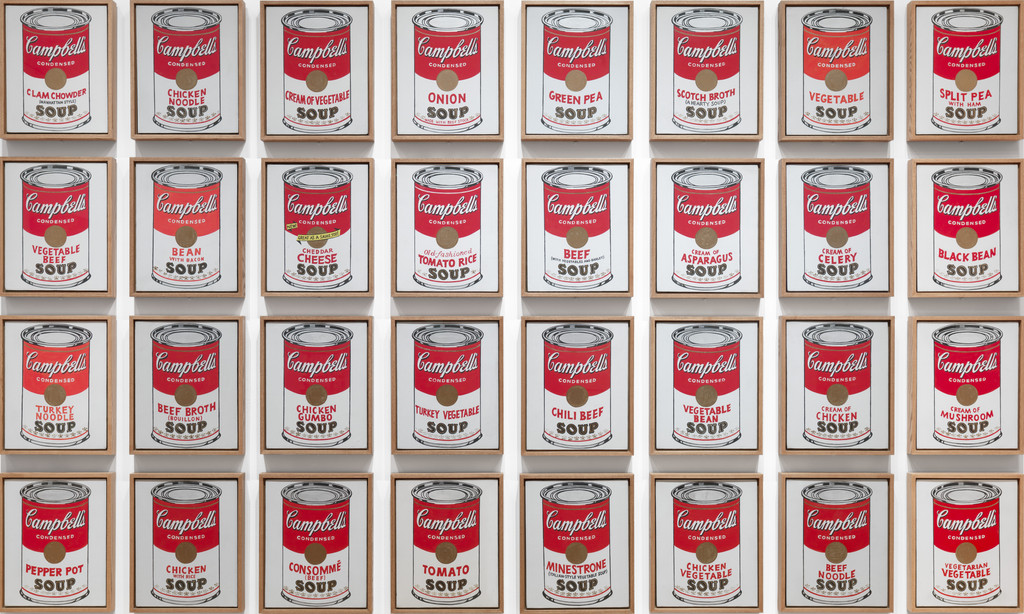
Campbell's Soup Cans
May one see it?
Yes, receiving visitors

The Museum of Modern Art
RoomMoMA, Floor 4, 412New York, United States
On public display.
- Checked
- 11 days ago
- Source
- The museum's own collection data
About the painting
Campbell's Soup Cans is a series of 32 paintings produced by American artist Andy Warhol between 1961 and 1962. Each painting depicts a different variety of Campbell's soup cans in a uniform 20-by-16-inch format. First exhibited in July 1962 at the Ferus Gallery in Los Angeles, the pop art works challenged traditional distinctions between fine art and commercial imagery. Warhol's association with the subject led to his name becoming synonymous with the Campbell's soup cans. The series catapulted Warhol to fame and contributed to critical discourse about originality, reproduction, and the meaning of art in a consumer society.
Read on
Drawing on his background as a commercial illustrator, Warhol focused on the packaging of everyday items, making high art of the artistic depiction of the commercial packaging rather than of the everyday items themselves, prompting initial controversy but eventual acclaim. The Campbell's Soup Cans series generally refers to the original 32 canvases, but it also encompasses Warhol's many subsequent variations: approximately 20 similar paintings produced in the early 1960s; a 1965 set of 20 larger multi-colored canvases; numerous related drawings, sketches, and stencils created over the years; and two separate editions of 250 ten-print screen print portfolios issued in 1968 and 1969. The original 32 canvases were preserved by art dealer Irving Blum and later acquired by the Museum of Modern Art in 1996.
Warhol's Campbell's Soup Cans are widely regarded as a canonical symbol of Pop art and one of the most influential bodies of art of the 20th century. The later sets of screen prints are sometimes confused with the original 1962 series, and unauthorized prints have also circulated. Despite this, the series has maintained a lasting presence in popular culture, inspiring derivative works by other artists and achieving multimillion-dollar results in the art market.
Particulars
- Accession number
- 476.1996.1-32
Sources
- The Museum of Modern Art: the museum's own open data · fetched 11 days ago
- Image: The Museum of Modern Art — © the artist or rights holder
Meanwhile, in the life of Andy Warhol
The whole lifeDecember 1961
The decision to paint money
After seeing Claes Oldenburg's installation The Store in December 1961, Warhol went home frustrated, feeling his comic-strip paintings were no longer original enough. He accepted Muriel Flatow's tongue-in-cheek advice, given for $50, to paint what he liked most — money — and began painting dollar bills.
1961–1962
Mastering silkscreen
Seeking technical advice, Warhol turned to Floriano Vecchi of Tiber Press, who showed him the basics of silkscreen printing: transferring designs to acetate, preparing screens and pulling ink with a squeegee. The experiments became a turning point and soon led to some of his earliest silkscreen works.
9 July 1962
Soup cans at the Ferus Gallery
The Los Angeles dealer Irving Blum, surprised that Warhol had no gallery, offered him a solo show at the Ferus Gallery. Warhol sent 32 canvases, one for each variety of Campbell's soup; the exhibition opened on 9 July 1962 and marked his West Coast debut.
October 1962
“The New Realists” at the Sidney Janis Gallery
Invited by the dealer Sidney Janis, Warhol took part in the exhibition The New Realists, showing 200 Soup Cans, Big Campbell's Soup Can 19c (Beef Noodle) and Do It Yourself (Flowers). The show was widely seen as a turning point for the acceptance of Pop art: The New Yorker likened its effect on the New York art world to an “earthquake”.
6 November 1962
First solo Pop show in New York
The filmmaker Emile de Antonio introduced Warhol to Eleanor Ward of the Stable Gallery, who agreed to a show in exchange for a painting of a two-dollar bill; the eighteen new works included Marilyn Monroe Twenty Times and Red Elvis. Michael Fried wrote in Art International that of all the painters working in the service of a popular iconography, Warhol was probably the most single-minded and the most spectacular.
1964
The Factory on 47th Street
By 1964 Warhol had moved his studio to 231 East 47th Street, which became known as the Factory; Billy Name covered it in aluminium foil and silver paint. The poet Gerard Malanga helped him with silkscreens and films, and working with assistants became a lasting feature of his method.

![Liz #3 [Early Colored Liz], Andy Warhol, 1963](/api/img?u=https%3A%2F%2Fwww.artic.edu%2Fiiif%2F2%2F362c0c2a-4576-2207-4ba9-2b87e6d0bad0%2Ffull%2F1200%2C%2F0%2Fdefault.jpg)