 Vernet, HoraceFrench, 1789–1863
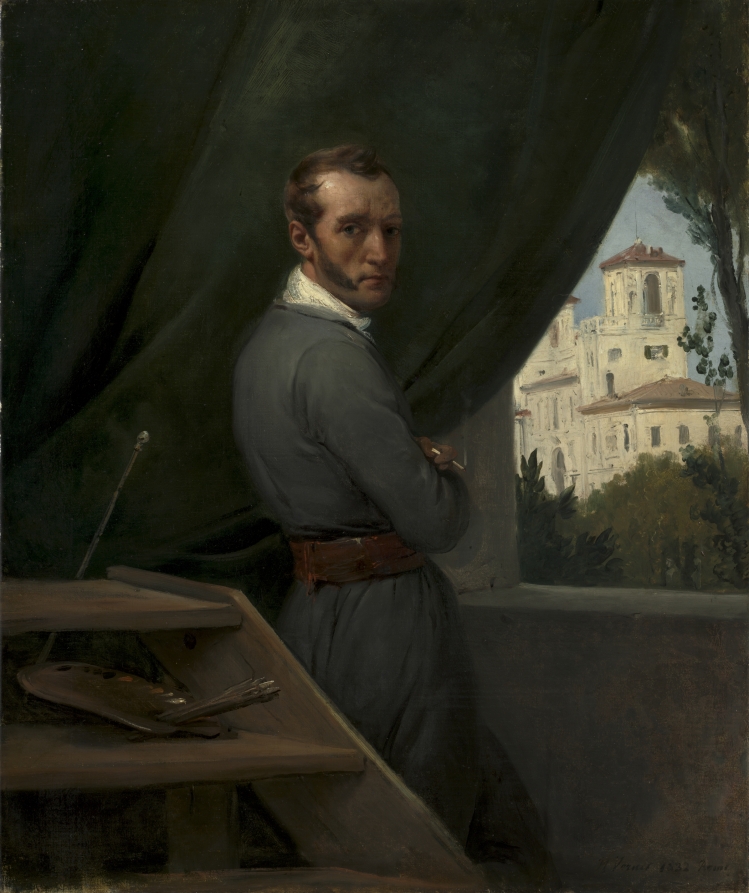
Self-Portrait in Rome
Can I see it?
Not on view at present
Where is “Self-Portrait in Rome” now? Collection: The Cleveland Museum of Art, Cleveland. Not on view at present. Checked October 12, 2026.

Cleveland, United States
It belongs to the collection, but is not on display at present.
- Checked
- In this state since
- Source
- The museum
About the painting
Vernet stands before the Villa Medici, seat of the French Academy in Rome, where he was director from 1829 to 1835. The palette, brushes, and maulstick on the stepladder hint at his talent for painting large canvases. The artist's sideward glance, disheveled hair, and burning cigarette lend him a romantic aura. The recipient of numerous commissions for military paintings, Vernet was patronized by Jérôme Bonaparte (the youngest brother of Napoleon) and later taught at the École des Beaux-Arts.
The Cleveland Museum of Art
Details
- Accession number
- 1977.171
In the catalog
Sources
- The Cleveland Museum of Art
- Image: The Cleveland Museum of Art — Museum open access
In the life of Vernet, Horace
The whole life1829–1834
Post: director of the French Academy in Rome
1829–1835
Friendship with Bertel Thorvaldsen
In Rome he befriends the world-famous Danish sculptor Bertel Thorvaldsen, who spent most of his professional life in Italy.
1830
The July Revolution opens new commissions
The Revolution of 1830 puts Louis-Philippe, who had backed Vernet under the Restoration, on the throne and opens new opportunities: the artist receives numerous state commissions for battle paintings.
1833
Travels to Algeria as official artist
At Louis-Philippe's request he goes to Algeria as an official artist, with two battalions assigned to guard his journeys; yet he is struck less by the feats of the French soldiers than by their brave opponents in picturesque costumes. It is the first of five long visits to North Africa (1833, 1837, 1839–1840, 1845, 1853), during which he eagerly draws and gathers documents on the French conquests in Algeria and Morocco, material later turned into large canvases for the military gallery at Versailles.