
 Edgar DegasFrench, 1834–1917
Scene from the Steeplechase: The Fallen Jockey
May one see it?
Yes, receiving visitors

National Gallery of Art
Room83 · West Building, Main FloorWashington, D.C., United States
On public display.
- Checked
- 4 hours ago
- In this state since
- Aug 19, 2026
- Source
- The museum's own collection data
About the painting
Scene from the Steeplechase: The Fallen Jockey is an 1866 oil-on-canvas painting by Edgar Degas. Degas reworked the painting on multiple occasions, once in 1880–81, and again in 1897. The painting, now on display in the National Gallery of Art in Washington, D.C., was exhibited at the 1866 Salon in Paris.
Degas painted the work on a large canvas. Horses race from the right to left side. In total, there are four horses, with three jockeys. One of the jockeys has fallen off his horse and lies motionless in the foreground. Degas's interest in the subject and his motivation to paint the scene have been subject of art historical debate.
According to Mary Cassatt's mother, Katherine Cassatt, Degas said of the painting: "It is one of those works which are sold after a man's death and artists buy them not caring whether they are finished or not."
Particulars
- Accession number
- 1999.79.10
What it shows
In the catalog
Sources
- National Gallery of Art: the museum's own open data · fetched 4 days ago
- Image: National Gallery of Art — Museum open access
Meanwhile, in the life of Edgar Degas
The whole life1862–1864
Meets Édouard Manet
Manet introduced Degas to the circle of future Impressionists. Degas shared their rejection of the academic Salon but would not work in the open air.
1870
A volunteer in the war; a flaw in his eyesight
When the Franco-Prussian War broke out Degas volunteered; at the first shooting practice it turned out that he saw poorly with his right eye. It was the first sign of the macular degeneration that left him almost blind at the end of his life; he was transferred to the artillery and served there to the end of the war.
October 1872 – March 1873 · Residence
New Orleans
1873–1874
His brother's debts: he sells his house and collection
After his father's death Degas learned that his brother René had run up enormous business debts. To save the family's reputation he sold his house and an inherited art collection and for the first time in his life depended on sales of his own work.
1874
The first Impressionist exhibition
Disenchanted with the Salon, Degas joined a group of young artists organizing an independent exhibiting society. He took a leading role in organizing the eight shows of 1874–1886 and exhibited in all but one, despite constant conflicts with the group.
1881
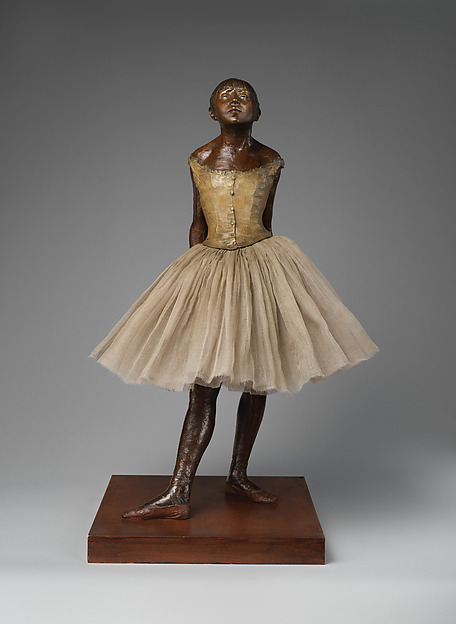
“The Little Dancer of Fourteen Years” on show
The nearly life-size wax figure with real hair and a cloth tutu, modelled on Marie van Goethem, provoked a strong reaction: critics found its realism extraordinary, but many denounced the dancer as ugly. It was the only sculpture Degas showed in his lifetime.


![Scenes from the Passion of Christ: The Descent into Limbo [right panel], Andrea Vanni, 1380s](https://api.nga.gov/iiif/4205a539-eadd-4486-89a7-3cff9c1ba428/full/!2400,2400/0/default.jpg)


