 Lucas CranachGerman, 1472–1553
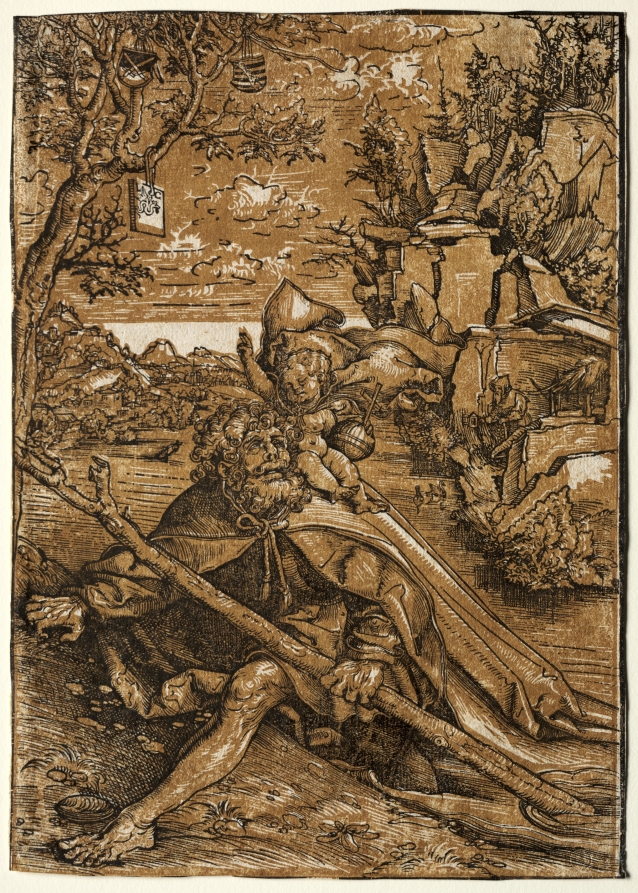
Saint Christopher
May one see it?
Not receiving at present

The Cleveland Museum of Art
Cleveland, United States
It belongs to the collection, but is not on display at present.
- Checked
- 2 days ago
- In this state since
- Aug 19, 2026
- Source
- The museum's own collection data
About the work
In Hans Burgkmair's Emperor Maximilian on Horseback, the black outline and white highlights are printed and the paper is washed blue. In Saint Christopher, however, while the black line block is still printed, color is now printed with a tone block and unprinted areas of the white paper act as highlights. Although Saint Christopher is dated 1506, it was probably made after 1508 when Cranach was granted permission by Duke Friedrich to use the coat of arms with a winged serpent seen hanging from the tree. Further, it was only after the artist returned from a trip to the Netherlands in 1508 that he probably would have learned about the use of a tone block by his rival Burgkmair. He then produced two woodcuts using tone blocks—Saint Christopher and Venus and Cupid—predating them to 1506 to claim the invention of chiaroscuro woodcuts for himself.
The Cleveland Museum of Art
Particulars
- Accession number
- 1941.40
In the catalog
Sources
- The Cleveland Museum of Art: the museum's own open data · fetched 6 days ago
- Image: The Cleveland Museum of Art — Museum open access
Meanwhile, in the life of Lucas Cranach
The whole life1505–1547
Post: court painter
1508
Diplomatic Mission to Mechelen
He was sent on a diplomatic mission to Mechelen (Netherlands), where he painted portraits of Emperor Maximilian I and the future Emperor Charles V.
6 January 1508
Granted Nobility and a Coat of Arms
Cranach was granted nobility and a personal coat of arms — a winged serpent with a ruby ring in its mouth, which became the signature of his works and workshop.