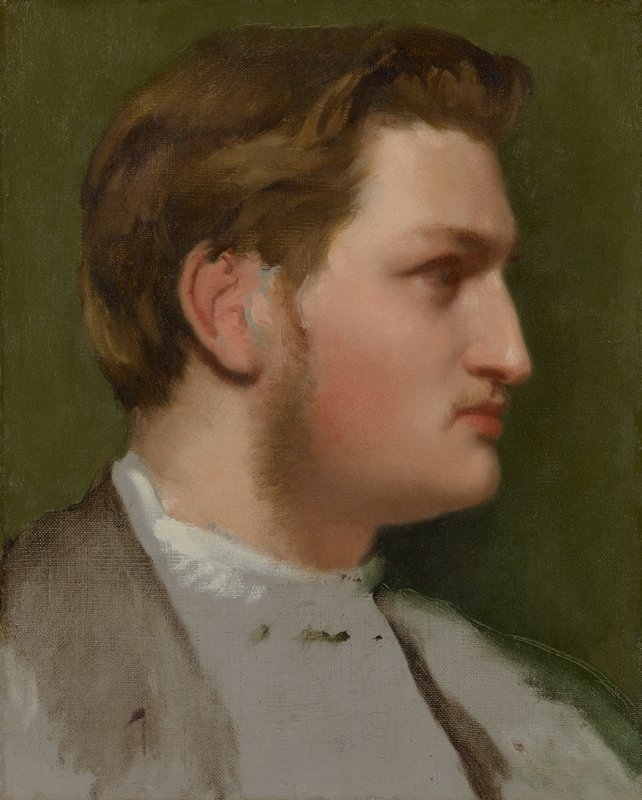
 Edgar DegasFrench, 1834–1917
Portrait of Paul Valpinçon
May one see it?
Yes, receiving visitors

Minneapolis Institute of Art
RoomG352Minneapolis, United States
On public display.
- Checked
- 4 hours ago
- In this state since
- Sep 25, 2026
- Source
- The museum's own collection data
About the painting
Edgar Degas and Paul Valpinçon had a lifelong friendship that began even before the two became classmates in 1846. In fact, their fathers were friends. Paul’s father, Edouard Valpinçon, played a role in Degas’s artistic development by encouraging the young artist’s interest in the French neoclassical painter Jean-Auguste-Dominique Ingres. Degas’s admiration of Ingres is apparent in the crisp, classicizing manner with which he captured his friend’s likeness in this portrait.
Many years later, Paul’s daughter, Hortense, recounted the family history of the portrait’s creation. She said it was painted in the courtyard of her grandfather’s Paris home when her father was only twenty-one years old—an age that corresponds with the date of 1855 inscribed, in an unknown hand, on the painting’s reverse.
Read on
The portrait remained with Hortense until the 1930s. Eventually it came into the collection of David M. Daniels, a native of St. Paul, who donated it to The Minneapolis Institute of Arts in 1974.
Minneapolis Institute of Art
Particulars
- Accession number
- 74.28
In the catalog
Sources
- Minneapolis Institute of Art: the museum's own open data · fetched 4 days ago
- Image: Minneapolis Institute of Art — public domain
Meanwhile, in the life of Edgar Degas
The whole life1853
The Louvre instead of the law
After graduating from the lycée in 1853 Degas registered as a copyist in the Louvre, although his father expected him to become a lawyer; in November he duly enrolled in the Faculty of Law but applied little effort to his studies.
1854
The studio of Louis Lamothe, a pupil of Ingres
At twenty Degas entered the studio of Louis Lamothe, a pupil and follower of Ingres. In the Louvre he copied Poussin and Holbein the Younger, and Courbet and Delacroix influenced him.
1855
Meets Ingres; the École des Beaux-Arts
In 1855 Degas met Ingres, whom he revered, and was advised to draw lines and still more lines, from life and from memory. In April of that year he was admitted to the École des Beaux-Arts, where he studied drawing with Lamothe.
July 1856 – 1859
Three years in Italy
In July 1856 Degas left for Italy, where he stayed for three years. He copied Michelangelo, Raphael and Titian but, contrary to convention, usually picked out of an altarpiece a detail that caught his eye — a secondary figure or a head that he treated as a portrait.