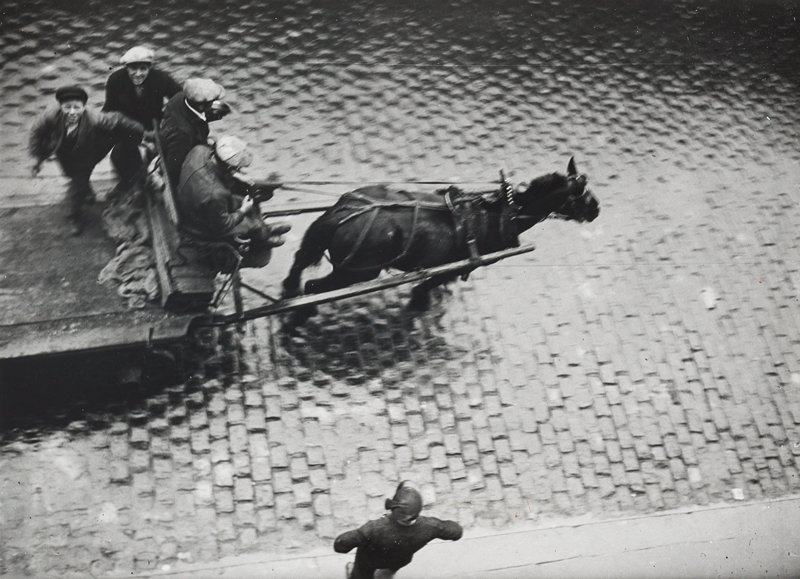
 André KertészAmerican, 1894–1985
Paris (Fallen Horse)
May one see it?
Not receiving at present

Minneapolis, United States
It belongs to the collection, but is not on display at present.
- Checked
- In this state since
- Source
- The museum
Particulars
- Accession number
- 2013.35.19.4
In the catalog
Sources
- Minneapolis Institute of Art
- Image: Minneapolis Institute of Art — © Estate of André Kertész
Meanwhile, in the life of André Kertész
The whole lifeSeptember 1925
Moves to Paris against his family’s wishes
He leaves for Paris, then the artistic capital of the world, against his family’s wishes, leaving behind his mother, his unofficial fiancée Elizabeth, both brothers and his uncle Hoffmann, who dies shortly afterward; Jenő later emigrates to Argentina. Soon after arriving he changes his first name from Andor to André, which he keeps for the rest of his life; at first he takes commissions from several European magazines, in Germany, France, Italy and Great Britain, and then works for VU, France’s first illustrated magazine.
1927
His first solo exhibition at the Au Sacre du Printemps gallery
Jan Slivinsky presents 30 of his photographs at the “Sacre du Printemps Gallery”, and Kertész becomes the first photographer to have a one-man exhibition. At the show Paul Dermée dubs him “Brother Seer” and “Brother Seeing Eye”, alluding to a medieval monastery where all the monks were blind but one; Kertész has become connected with members of the growing Dada movement.
1928
Switches to a Leica
He switches from plate-glass cameras to a Leica; this period is one of his most productive, with daily photographing divided between magazine commissions through the late 1920s and his personal pieces.
17 June 1933
Marries Elizabeth
Despite his mother’s death earlier that year, Kertész marries Elizabeth; he is said to have spent less time with his artist friends in favour of his new wife.
15 October 1936
Emigrates to New York
Magazines emphasise political stories and stop publishing Kertész for his apolitical subjects; with commissions dropping and persecution of Jews increasing, he and Elizabeth decide to move, which may have saved his life, as four years later France would fall under Nazi occupation. They board the SS Washington and arrive in New York on 15 October 1936, living at the Beaux Arts Hotel in Greenwich Village; deprived of his artist friends, struggling with English and among Americans who reject having their photos taken on the street, he goes through a period he later calls the “absolute tragedy”.
1964
A solo show at MoMA under John Szarkowski
Soon after John Szarkowski becomes photography director at the Museum of Modern Art he features Kertész in a solo show; with his work critically acclaimed, Kertész gains recognition in the photographic world as an important artist, and his photographs go on to be shown in exhibitions throughout the world, even into his early nineties.