ART WIKI32,963 on view
MapCollectionArtistsMuseumsExhibitionsJournal
Sign in

ART WIKI

Where the masterpiece hangs, and when they let you in.

Collections: Art Institute of Chicago, Getty Villa, Harvard Art Museums, Hirshhorn Museum and Sculpture Garden, J. Paul Getty Museum, Minneapolis Institute of Art, Musée du Louvre, National Gallery of Art, National Museum of Asian Art, National Portrait Gallery (Smithsonian), Pushkin State Museum of Fine Arts, Rijksmuseum, Smithsonian American Art Museum, SMK — National Gallery of Denmark, State Hermitage Museum, State Russian Museum, The Cleveland Museum of Art, The Metropolitan Museum of Art, The Museum of Modern Art, Tretyakov Gallery, Victoria and Albert Museum, Whitney Museum of American Art, State Catalogue of the Museum Fund of Russia (274 museums), Europeana (19 museums), Wikidata (6 museums), Paris Musées (12 museums), and Joconde, the French Ministry of Culture's museum database (495 museums). Images belong to their rights holders.

Sections

  • Map
  • Search
  • Collection
  • Masterpieces
  • On view now
  • Artists

More

  • Museums & galleries
  • Exhibitions
  • Journal
  • Where the data comes from
  • Privacy & cookies
HomeMapBrowse
  1. Collection/
  2. The Cleveland Museum of Art/
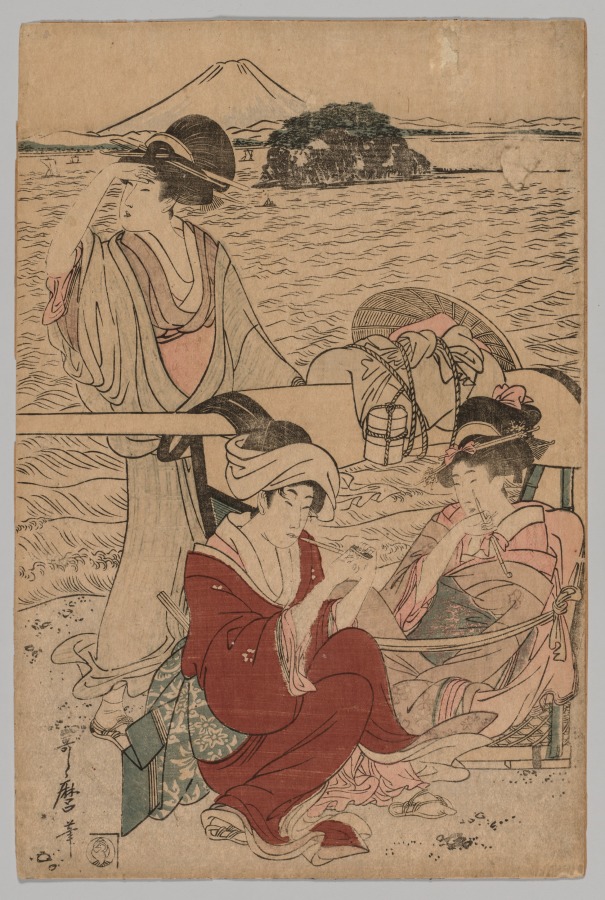
  3. No Title
No Title, Kitagawa Utamaro, 1753–1806
Kitagawa Utamaro, portraitKitagawa UtamaroJapanese, 1754–1806

No Title

1753–1806 · Print

May one see it?

Not receiving at present

The Cleveland Museum of Art

Cleveland, United States

It belongs to the collection, but is not on display at present.

Checked
2 days ago
In this state since
Aug 19, 2026
Source
The museum
On the mapMuseum page

Particulars

Accession number
1949.129

In the catalog

PrintsWoodcutJapanese printsRococo18th centuryJapan, Edo period (1615–1868)

Sources

  • The Cleveland Museum of Art
  • Image: The Cleveland Museum of Art — Museum open access

Meanwhile, in the life of Kitagawa Utamaro

The whole life
  1. 1753/1754

    Born

  2. 1775

    Meeting the publisher Tsutaya Jūzaburō

    By some accounts, in 1775 Utamaro meets the publisher Tsutaya Jūzaburō, who had an enormous influence on his work: many of his finest albums, illustrated books and series of single-sheet prints came out of their long collaboration. His first known work for Tsutaya, however, dates only from 1783.

  3. c. 1791

    Giving up book prints for half-length portraits of beauties

    Around 1791 Utamaro gives up designing prints for books and concentrates on single portraits of women shown half-length, rather than the group scenes favoured by other ukiyo-e artists. He was the first in Japanese woodblock printing to use half-length compositions for women's portraits; none of his work from 1790–1792 has survived.

  4. 1797

    The death of his friend and patron Tsutaya Jūzaburō

    In 1797 Utamaro's long-time friend and supporter, the publisher Tsutaya Jūzaburō, dies; the artist is apparently very upset by the loss, and some commentators feel that his work never reached its former heights afterwards. He later lives in Kyūemon-chō, then Bakuro-chō, and finally near the Benkei Bridge.

  5. 1804

    Arrest and fifty days in manacles

    In 1804 Utamaro is imprisoned over prints of the sixteenth-century ruler Toyotomi Hideyoshi, depicted, in the authorities' view, “in an improper form”, and then manacled for fifty days, together with Tsukimaro, Toyokuni, Shuntei, Shun'ei and Jippensha Ikku; their publishers are heavily fined. It is probably the most famous case of censorship of the Edo period, and Utamaro appears to have been the most prominent of those punished.

  6. 31 October 1806

    Died

More by Kitagawa Utamaro

All works
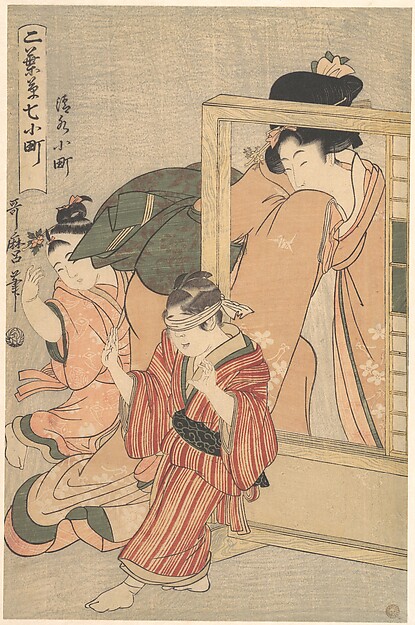
Kiyomizu Komachi, from the series Futabagusa nana Komachi, Kitagawa Utamaro, 1790s

Kiyomizu Komachi, from the series Futabagusa nana Komachi

1790s · The Metropolitan Museum of Art

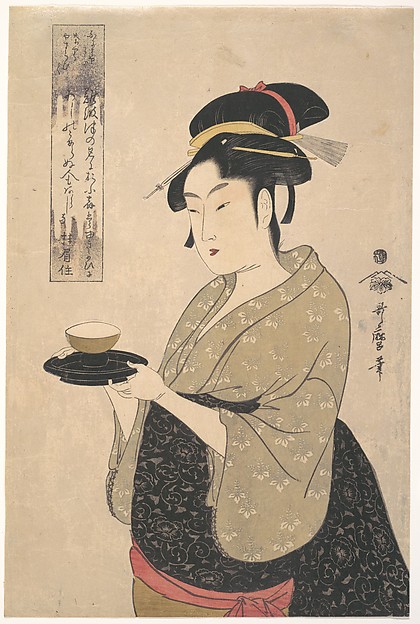
Okita of the Naniwa-ya Teahouse, Kitagawa Utamaro, ca. 1793

Okita of the Naniwa-ya Teahouse

ca. 1793 · The Metropolitan Museum of Art

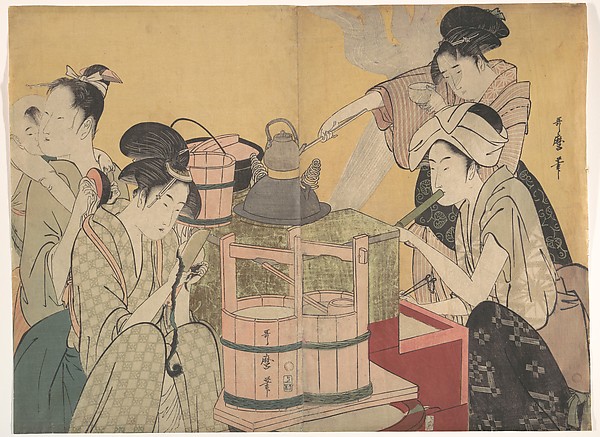
Kitchen Scene, Kitagawa Utamaro, ca. 1794–95

Kitchen Scene

ca. 1794–95 · The Metropolitan Museum of Art

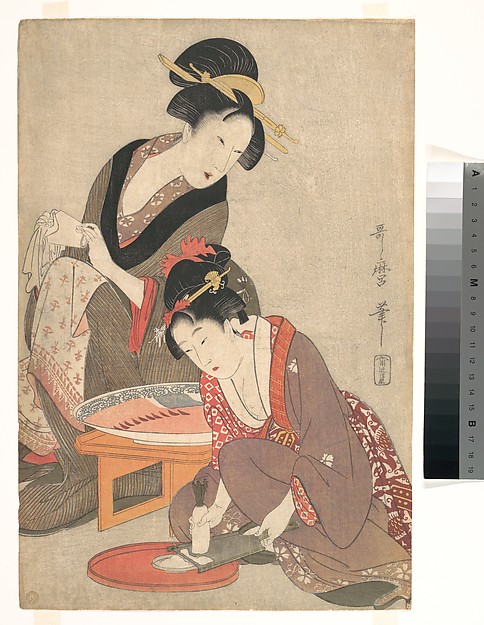
Women Grating Radish for Sashimi, Kitagawa Utamaro, ca. 1798–99

Women Grating Radish for Sashimi

ca. 1798–99 · The Metropolitan Museum of Art

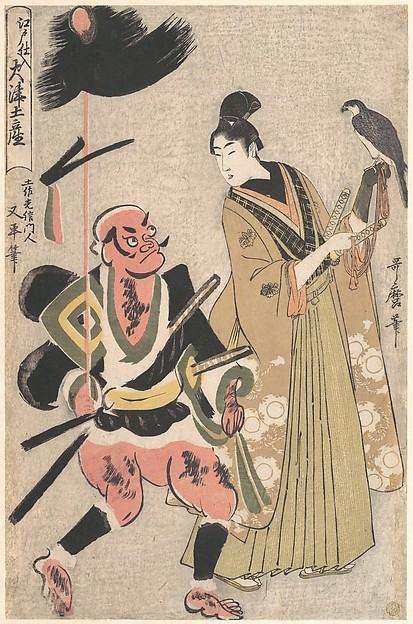
Foot-Soldier with a Spear and Hawk-Handler (Yari-mochi yakko to taka shō), from the series Souvenir Paintings from Ōtsu, Stocked in Edo (Edo Shi-ire Ōtsu Miyage), Kitagawa Utamaro, ca. 1802–3

Foot-Soldier with a Spear and Hawk-Handler (Yari-mochi yakko to taka shō), from the series Souvenir Paintings from Ōtsu, Stocked in Edo (Edo Shi-ire Ōtsu Miyage)

ca. 1802–3 · The Metropolitan Museum of Art

House cleaning in preparation for the New Year, Kitagawa Utamaro, late 1790s

House cleaning in preparation for the New Year

late 1790s · Art Institute of Chicago

Enjoying the Cool in a Garden, Kitagawa Utamaro, c. 1788/90

Enjoying the Cool in a Garden

c. 1788/90 · Art Institute of Chicago

Seiro niwaka onna geisha no bu : Asazumabune Ogiuri Uta....., Kitagawa Utamaro, 1793

Seiro niwaka onna geisha no bu : Asazumabune Ogiuri Uta.....

1793 · Art Institute of Chicago

Neighbors at The Cleveland Museum of Art

Museum page
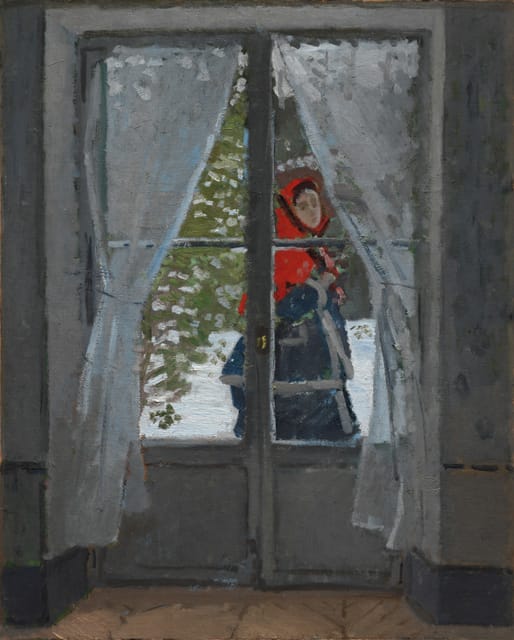
The Red Kerchief, Claude Monet, c. 1868–73

Claude Monet

The Red Kerchief, c. 1868–73

Melencolia I, Albrecht Dürer, 1514

Albrecht Dürer

Melencolia I, 1514

The Virgin and Child with the Pear, Albrecht Dürer, 1511

Albrecht Dürer

The Virgin and Child with the Pear, 1511

The Nativity, Albrecht Dürer, probably c. 1509/1510

Albrecht Dürer

The Nativity, probably c. 1509/1510

The Virgin and Child on a Crescent with a Starry Crown, Albrecht Dürer, 1508

Albrecht Dürer

The Virgin and Child on a Crescent with a Starry Crown, 1508

The Lamentation, Albrecht Dürer, 1507

Albrecht Dürer

The Lamentation, 1507

Large Horse, Albrecht Dürer, 1505

Albrecht Dürer

Large Horse, 1505

Nemesis (The Great Fortune), Albrecht Dürer, c. 1501/1502

Albrecht Dürer

Nemesis (The Great Fortune), c. 1501/1502