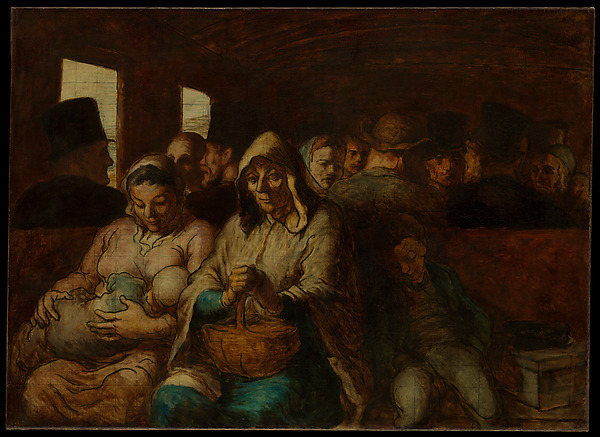
Honoré DaumierFrench, 1808–1879
Na konci
May one see it?
Unknown

Bratislava, Slovakia
The owner is known; whether it is on view today is not.
- In this state since
- Source
- The museum
Particulars
In the catalog
Sources
- Slovak National Gallery
- Image: Slovak National Gallery — Public Domain Mark 1.0
Meanwhile, in the life of Honoré Daumier
The whole life1848
Sketch "The Republic" Among Competition Finalists
On Courbet's advice, Daumier submitted an oil sketch, "The Republic" (now in the Musée d'Orsay), to the competition for an allegory of the new Republic; it was very well received and was among the twenty finalists, but Daumier never executed the finished painting.
1848
Albums on the Revolution of 1848
The Revolution of 1848 provided the material for two of Daumier's albums, "Parliamentary Idylls" and "The Representatives Represented"; he once again launched a political campaign in the pages of Le Charivari.
1849
First Participation in the Salon
In 1849 Daumier exhibited at the Salon for the first time, showing the painting "The Miller, His Son, and the Donkey"; from the late 1840s he devoted himself increasingly to painting.
1849
State Commission for a Painting
Through the Academy of Fine Arts, Daumier received a commission from the Ministry of the Interior for a painting worth 1,000 francs (later increased to 1,500). He never painted the picture, though he drew advances, and only in 1863 did he deliver to the state the gouache "The Drunkenness of Silenus" (1849).
1852
Baudelaire on Daumier in a Collection of Essays
Baudelaire contributed to a collection of essays published in 1852 celebrating Daumier's lithographs and prints, calling him "one of our leading men not only in caricature but in modern art."
from 1853
Summer Trips to Valmondois and Barbizon
From about 1853 Daumier spent the summer months in Valmondois and Barbizon, where Corot, Daubigny, Millet, and Rousseau were working, deepening his friendships with the artists of the Barbizon school.