 Honoré DaumierFrench, 1808–1879
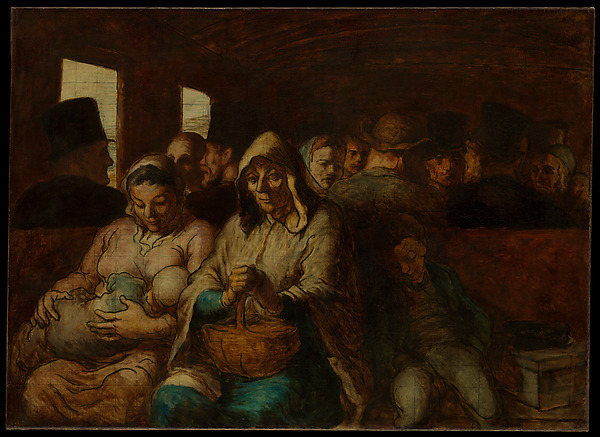
The Third-Class Carriage
May one see it?
Yes, receiving visitors

The Metropolitan Museum of Art
Room812New York, United States
On public display.
- Checked
- 5 hours ago
- In this state since
- Sep 26, 2026
- Source
- The museum's own collection data
About the painting
The Third-Class Carriage (French: "Le Wagon de troisième classe") is the name of at least three oil paintings entitled made by the French painter Honoré Daumier. In a realistic manner, Daumier depicts the poverty and fortitude of working class travellers in a third class railway carriage. One oil-on canvas version, dated to c. 1862–1864 but left unfinished, is in the collection of the Metropolitan Museum of Art in New York, and a similar but completed painting dated to c. 1863–1865 is in the National Gallery of Canada in Ottawa. A third oil-on-panel version, dated to c. 1856–1858, with a different arrangement of the main three figures, is held by the Fine Arts Museums of San Francisco.
Particulars
- Accession number
- 29.100.129
What it shows
Sources
- The Metropolitan Museum of Art: the museum's own open data · fetched 4 days ago
- Image: The Metropolitan Museum of Art — Open Access (CC0)
Meanwhile, in the life of Honoré Daumier
The whole life1863
Departure from the Île Saint-Louis to Montmartre
By 1863 Daumier was selling off his furniture to raise funds; he left the Île Saint-Louis and in 1863–1865 moved through a succession of lodgings in Montmartre, losing touch with many of his friends.
1864
New Contract with Le Charivari
In 1864 Le Charivari offered Daumier a new contract; he returned to caricature to earn a living and found an appreciative public, producing 100 lithographs in a year for an income of 400 francs a month.
1865
Settling in Valmondois
After spending the summer of 1865 in Valmondois with Théodore Rousseau, whose health was failing, Daumier soon left Montmartre for good and rented a small cottage in Valmondois, where he lived for the rest of his life.
c. 1865 – 1866
Onset of Failing Eyesight
Around 1865–1866 Daumier's eyesight began to fail; the condition progressed, though he continued to make drawings and poster sketches as late as 1872 and painted almost until his death.