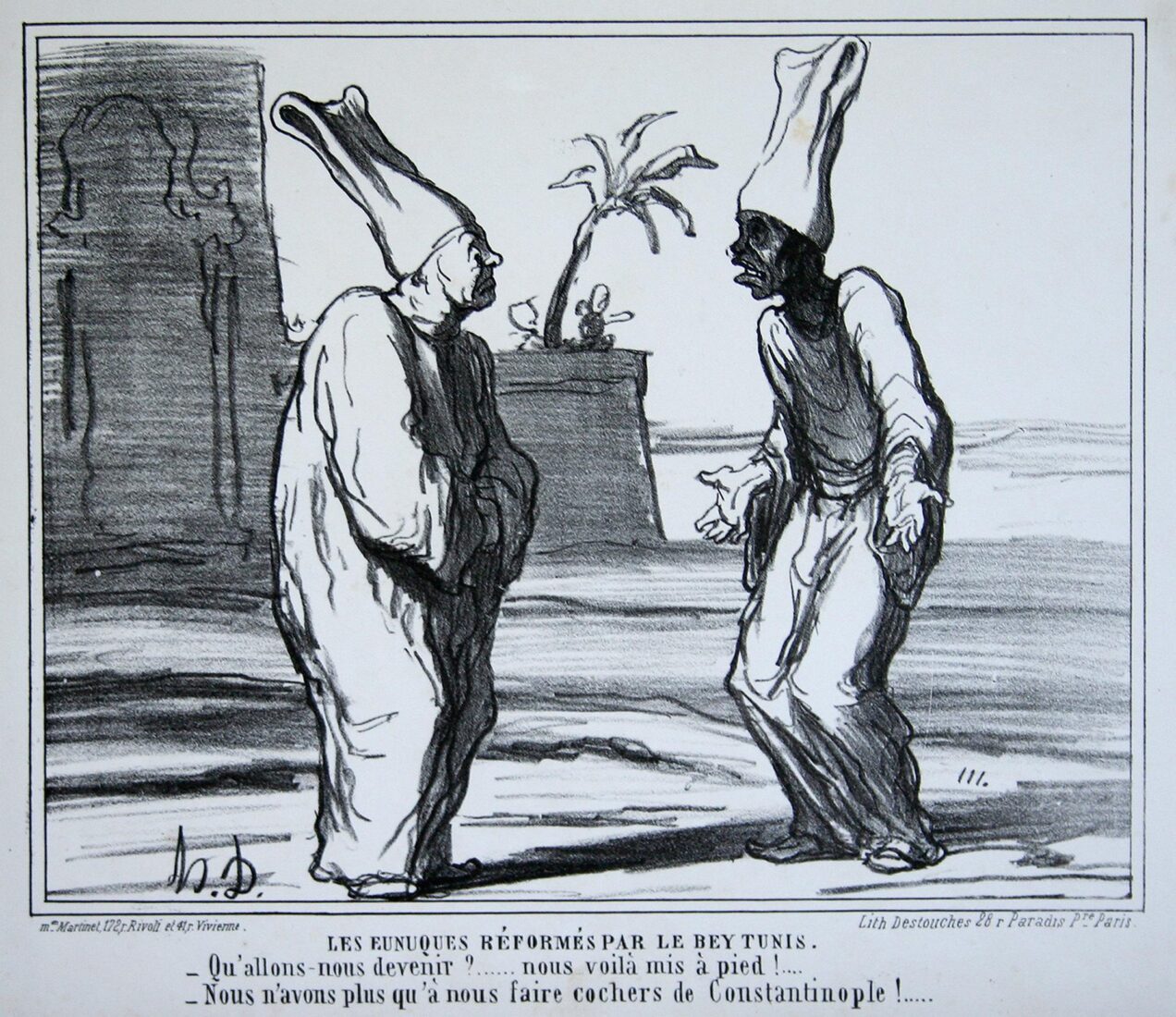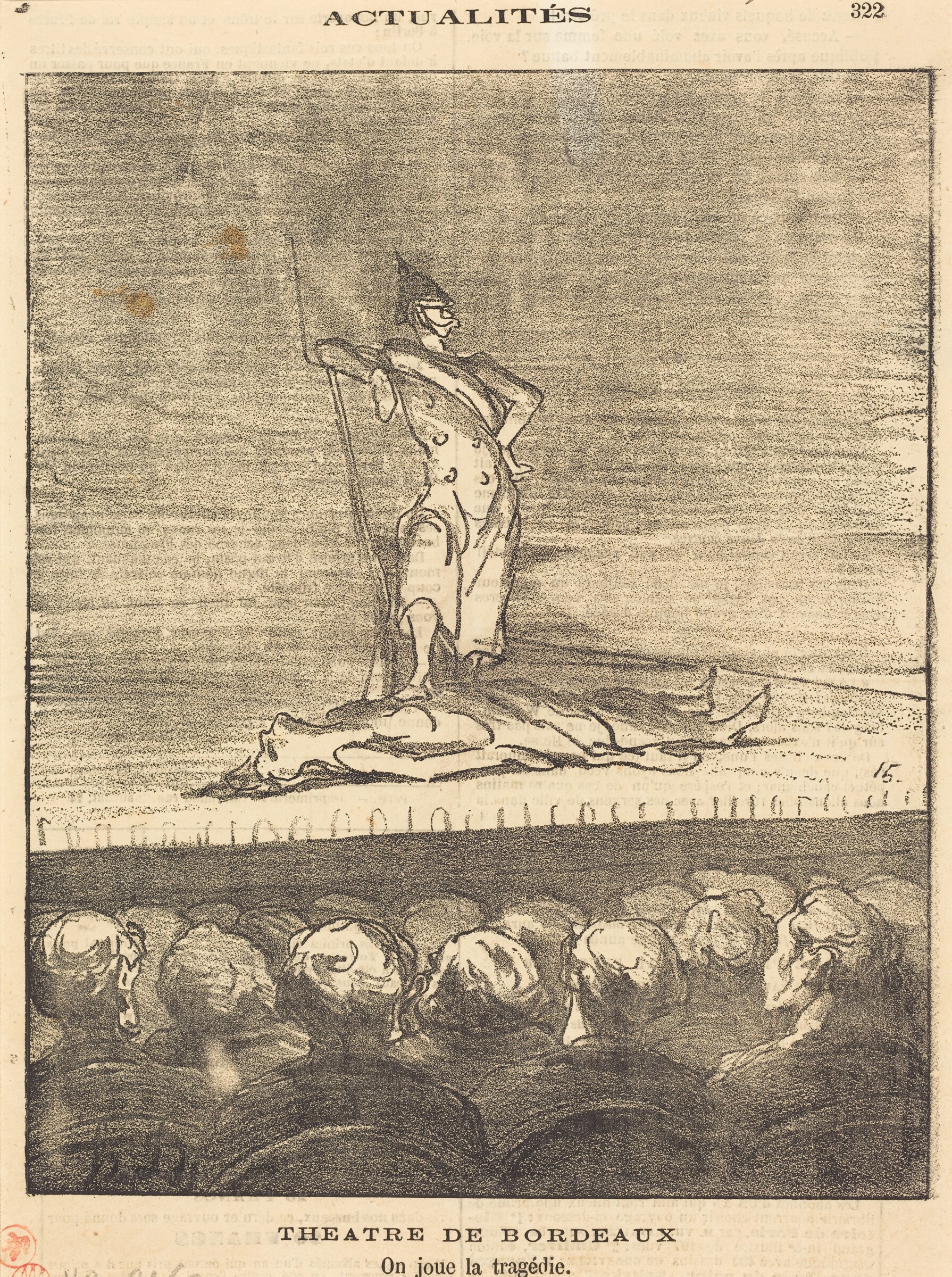

Honoré-Victorin Daumier (26 February 1808 – 10 or 11 February 1879) was a French painter, sculptor, and printmaker, whose many works offer commentary on the social and political life in France, from the Revolution of 1830 to the fall of the Second French Empire in 1870. He earned a living producing caricatures and cartoons in newspapers and periodicals such as La Caricature and Le Charivari, for which he became well known in his lifetime and is still remembered today. He was a republican democrat (working class liberal), who satirized and lampooned the monarchy, aristocracy, clergy, politicians, the judiciary, lawyers, police, detectives, the wealthy, the military, the bourgeoisie, as well as his countrymen and human nature in general.
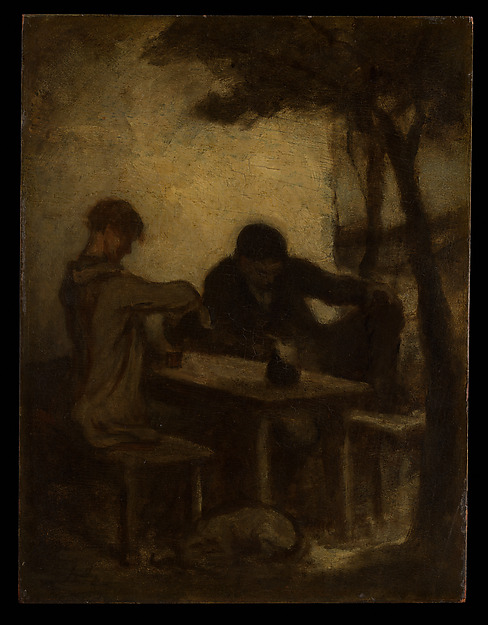
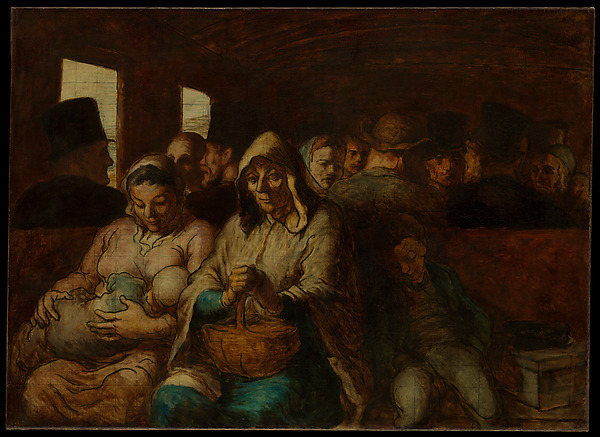
Daumier was a serious painter, loosely associated with realism, sometimes blurring the boundaries between caricature and fine art. Although he occasionally exhibited at the Parisian Salon, his paintings were largely overlooked and ignored by the French public and critics of the day. Yet Daumier's fellow painters, as well as the poet and art critic Charles Baudelaire, noticed and greatly admired his work. Later generations would recognize Daumier as one of the great French artists of the 19th century, profoundly influencing a younger generation of impressionist and postimpressionist painters. Daumier was a tireless and prolific artist and produced more than 100 sculptures, 500 paintings, 1,000 drawings, 1,000 wood engravings, and 4,000 lithographs.
Daumier came from a poor family and was working by the age of 12, first at a huissier de justice, then at a bookstore frequented by artists where he began to draw. He received some mentorship from Alexandre Lenoir, attended the Académie Suisse, learned lithography, and was producing advertisements, illustrations, and caricatures by the time he was twenty. After the July Revolution of 1830 he began working for satirical political papers that were highly critical of the new monarch Louis Philippe I and his court. He was jailed for several months in 1832 after the publication of Gargantua, a particularly offensive depiction of the King, Louis Philippe. After his release Daumier resumed publishing political lithographs until the September Laws were passed in 1835, limiting the freedom of the press. Afterwards, his cartoons softened, the bourgeoisie and daily Parisian life were more frequent subjects, and when political subjects did appear they were oblique and veiled. Daumier experienced financial hardships and debt throughout much of his life.